When it comes to choosing gold, you're essentially balancing purity against practicality. The whole 14k vs 18k gold conversation boils down to one key difference: 18k gold is 75% pure gold, which gives it that deep, rich colour we all love. On the other hand, 14k gold is 58.5% pure gold, and those extra alloys make it a tougher, more durable option for daily life.
So, which one is right for you? It really comes down to your lifestyle, what you're willing to spend, and whether you value that intense colour over rugged resilience.
Your Guide to Choosing Between 14k and 18k Gold
Picking out a piece of fine jewellery is a big deal, and getting your head around the difference between 14k and 18k gold is the perfect place to start. It’s what empowers you to make a choice you’ll be happy with for years.
These numbers simply refer to the karat, which is a measure of gold purity. Pure, 24k gold is stunning but far too soft for jewellery that needs to withstand daily life. To give it strength, we mix it with other metals, known as alloys.
This choice between 14k and 18k gold really shapes the final piece:
- Purity and Colour: With more pure gold in the mix, 18k has a noticeably richer, more vibrant yellow hue. In contrast, 14k gold’s higher alloy content gives it a slightly lighter, softer yellow tone.
- Durability: Those extra alloys in 14k gold make it significantly harder and more resistant to the scuffs and scratches that come with everyday wear. This is a huge plus for pieces you never take off, like an engagement ring.
- Price: It’s simple maths, really. Because 18k gold contains a higher percentage of pure gold, it naturally comes with a higher price tag than its 14k equivalent.

This gives you a solid foundation for making a decision. For a quick overview, the table below breaks down the key differences, helping you see at a glance which attributes line up with your priorities.
Quick Comparison 14k vs 18k Gold
This table summarises the essential differences between 14k and 18k gold to help guide your initial decision.
| Attribute | 14k Gold (585) | 18k Gold (750) |
|---|---|---|
| Pure Gold Content | 58.5% (14 parts gold) | 75% (18 parts gold) |
| Colour | Lighter, subtle yellow | Rich, saturated yellow |
| Durability | Higher scratch resistance | Softer, more prone to wear |
| Best For | Everyday wear, active lifestyles | Special occasions, luxury pieces |
| Price Point | More affordable | More expensive |
While this table gives you the technical breakdown, it's also worth looking at what's happening in the market.
Here in Australia, 18k gold has long been the go-to for its luxurious feel and prestige. But we're seeing a fascinating shift. Import data from late 2024 showed that 18k gold imports into Australia had dropped by a staggering 34% year-on-year. This likely points to rising gold prices and cost-of-living pressures influencing what people are buying.
If you're interested in market dynamics, you can see the latest gold import data to explore these trends further. It’s a clear reminder that both personal taste and economic reality play a big part in the 14k vs 18k gold debate.
Understanding Gold Purity and Alloy Metals
To really get to the heart of the 14k vs 18k gold debate, you need to look past the shine and understand what’s actually in the metal. The term ‘karat’ (k) is just a way of measuring gold purity, broken down into 24 parts. Pure gold is 24k, but on its own, it’s far too soft for jewellery that you plan to wear every day.
That’s where alloys come in. To give it strength and durability, pure gold is mixed with other metals. An 18k gold piece is made of 18 parts pure gold and 6 parts other metals, which means it’s 75% pure gold. A 14k gold piece, on the other hand, contains 14 parts pure gold and 10 parts other metals, making it 58.5% pure gold.
These percentages are often stamped on jewellery as ‘fineness’ marks. You’ll see a ‘750’ stamp for 18k gold and a ‘585’ stamp for 14k gold, indicating the parts per thousand of pure gold. This simple ratio is the key to everything that sets them apart, from their colour to their resilience.
The Science Behind Gold Alloys
Those other metals in the alloy aren't just filler; they’re carefully chosen ingredients that define the final character of the gold. The specific mix and proportion of metals—usually copper, silver, zinc, and palladium—dictate the jewellery’s final colour and hardness.
With a higher concentration of alloy metals (41.5%), 14k gold is noticeably tougher and more resistant to scratching. It’s like adding rebar to concrete—the other metals create a stronger internal structure. This makes 14k gold a fantastic workhorse, perfect for pieces that have to stand up to the knocks of daily life.
Meanwhile, 18k gold, with only 25% alloy metals, keeps more of the inherent qualities of pure gold. This gives it that signature rich, luxurious colour and a heavier, more substantial feel in your hand. The trade-off is that it’s softer and more prone to getting dented or scratched.
Key Takeaway: The percentage of alloy metals is the most critical factor in the 14k vs 18k gold decision. It creates the fundamental choice you have to make: the deep, rich colour of higher purity versus the superior durability of a stronger alloy.
How Alloys Create Different Gold Colours
The specific metals blended into the alloy are what give us the beautiful range of gold colours we see today. It’s a craft that balances metallurgy with artistry.
- Yellow Gold: To get that classic sunny look, gold is alloyed with a mix of silver and copper. 18k yellow gold has a much richer, more saturated glow because of its higher gold content, while 14k yellow gold is a bit lighter and more subtle.
- White Gold: For a cool, silvery-white finish, pure gold is mixed with white metals like palladium, silver, or nickel. These pieces are almost always plated with rhodium for a brilliant, protective coating. This rhodium plating often makes it nearly impossible to tell 14k and 18k white gold apart just by looking.
- Rose Gold: The warm, romantic blush of rose gold comes from increasing the amount of copper in the alloy. A 14k rose gold piece will have a more intense pink hue due to its higher copper ratio, while 18k rose gold offers a softer, peachy tone.
This interplay between purity and alloys also has a real impact on market trends. In Australia, jewellery standards define 14k gold as 585 fineness and 18k as 750. While 18k has long been the standard for luxury, recent data reveals a noticeable drop in 18k gold imports, hinting that consumers are shifting towards more accessible options as precious metal prices climb. You can dive deeper by exploring Australian gold market trends and industrial shifts. Understanding the material science behind your piece helps you appreciate why one karat might be a better fit for a specific design or your lifestyle.
Comparing Colour Saturation and Real-World Durability
When you’re weighing up 14k vs 18k gold, the conversation nearly always comes down to two things: how it looks and how it lasts. The numbers on paper are simple enough, but what those differences in gold content actually mean for colour and day-to-day durability is where the real decision lies. Getting this right is about matching the metal to your personal style and your lifestyle.
The most obvious difference is the colour, especially in yellow gold. With its 75% pure gold content, 18k gold has a deep, rich, and unmistakably vibrant yellow lustre. It’s that classic, luxurious warmth you associate with fine jewellery. In contrast, 14k gold, at 58.5% pure, offers a lighter, more subtle hue. This isn't a lesser option at all; many people actually prefer its softer glow, finding it a bit more understated for everyday wear.
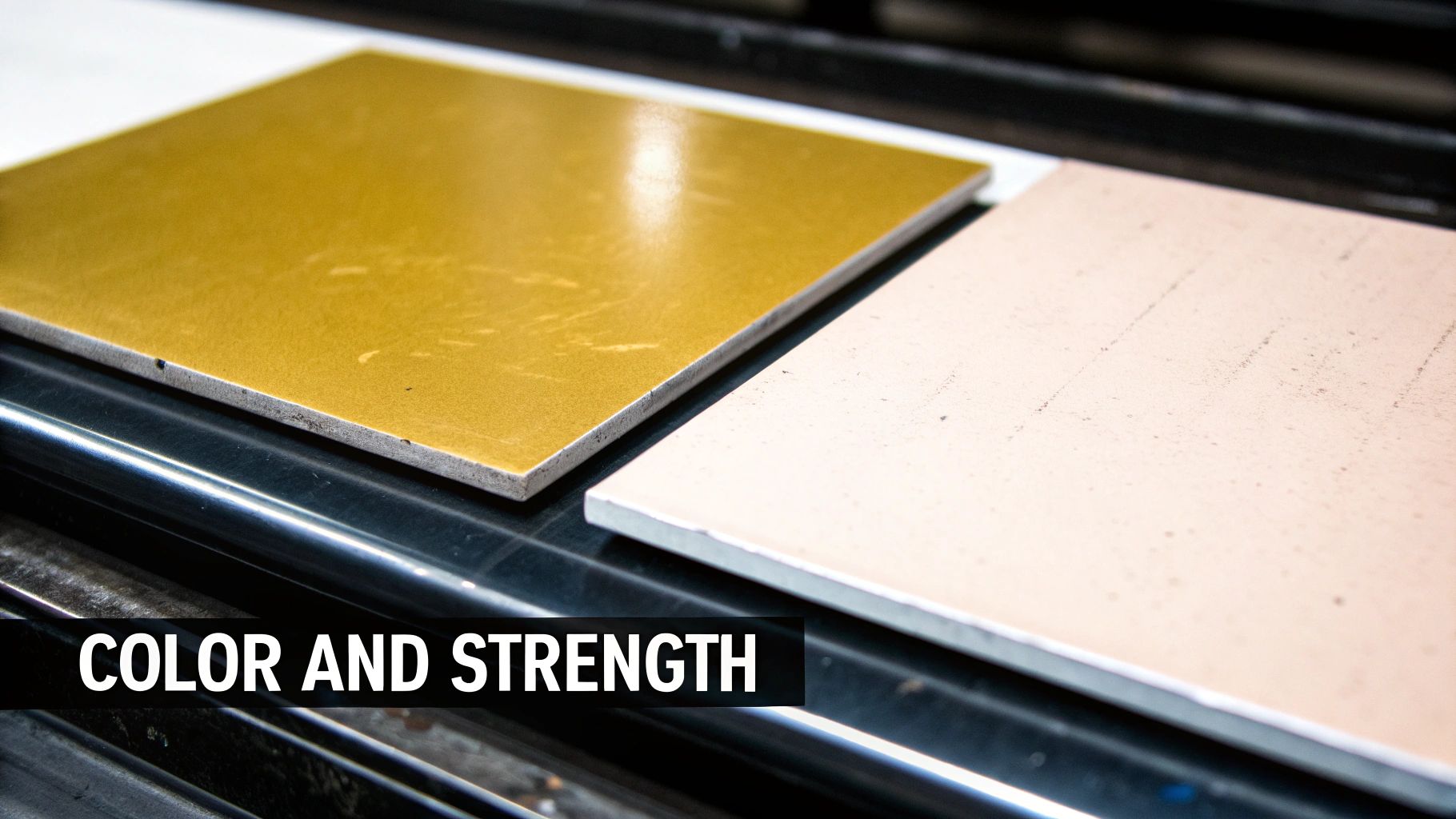
This colour play becomes even more interesting with rose gold, where the alloy mix completely defines the final look. The higher proportion of copper in 14k rose gold gives it a bold, distinctly pinkish tone. If you're after that strong, rosy blush, 14k is definitely the way to go. 18k rose gold, on the other hand, leans into a more delicate, peachy-gold shade because the higher gold content tempers the copper's red influence.
A Deeper Look at Gold Colour Nuances
Ultimately, the right colour often comes down to what you love and what works with your skin tone. The intense, buttery yellow of 18k gold is stunning against olive or darker complexions, while the softer warmth of 14k can be incredibly flattering on fairer skin.
Here’s a quick guide to what you’ll see:
- 18k Yellow Gold: Deep, rich, and highly saturated. Think classic, high-carat gold.
- 14k Yellow Gold: A lighter, softer yellow. More contemporary and subtle.
- 18k Rose Gold: A sophisticated, warm blend of peachy-pink and gold. Often described as a champagne-rose.
- 14k Rose Gold: A much stronger, more vivid pink thanks to its higher copper content.
It’s worth noting that when it comes to white gold, the visual difference between 14k and 18k is almost non-existent. Both are almost always plated with rhodium—a bright white metal from the platinum family—which gives them their brilliant, reflective finish. This rhodium coating completely hides the slight yellowish tint of the underlying gold alloy.
Practical Durability for Everyday Life
Looks aside, the biggest practical differentiator in the 14k vs 18k gold debate is durability. This isn't just a technical spec; it's about how your ring or bracelet will handle the reality of daily life, from tapping on a laptop to a bump against a doorframe.
Because 14k gold contains more strengthening alloys (41.7%), it’s tougher and far more resistant to scratching, bending, and denting. This makes it the clear winner for anyone with an active lifestyle or who works with their hands. For pieces you’ll wear constantly—like an engagement ring or a wedding band—14k offers genuine peace of mind.
Being 75% pure gold, 18k is naturally a softer, more malleable metal. While this softness gives it a wonderfully luxurious feel, it also means it’s more prone to showing wear and tear. An 18k gold ring will inevitably pick up more fine scratches and is more likely to dent from an accidental knock.
Expert Insight for Daniel Fine Clients: For a bespoke engagement ring, especially a design with fine details like a pavé setting, we often recommend 14k gold. Its superior hardness means the tiny prongs securing the diamonds are stronger and less likely to bend out of shape over time, keeping your gemstones safe.
This isn’t to say 18k gold is a bad choice—not at all. That same softness makes it a dream for jewellers to work with when creating intricate, highly detailed pieces. For jewellery worn on special occasions, or simply for those who are naturally very careful, 18k offers a level of luxury and colour that is second to none.
Comparing Durability in Real-World Scenarios
To really see the difference, let’s imagine how each metal holds up in a few common situations.
| Scenario | 14k Gold Performance | 18k Gold Performance |
|---|---|---|
| Daily Office Wear | Excellent. Easily resists scratches from desks, keyboards, and general movement. | Good. Will likely show fine surface scratches over time and need more frequent polishing. |
| Working Out at the Gym | Recommended. Strong enough to handle an accidental knock against equipment. | Not recommended. The risk of denting, scratching, or even bending the piece is high. |
| Household Chores | Good resistance to minor bumps, but avoid harsh chemicals with any gold. | Prone to damage. The softer metal can easily scratch or bend on hard surfaces like countertops. |
| Special Occasion Wear | Perfect. Looks beautiful while providing great protection against any mishaps. | Ideal. This is where 18k shines—its rich colour stands out in settings where wear is minimal. |
At the end of the day, it's a trade-off you make consciously. With 14k gold, you’re choosing long-term durability and a more worry-free experience. With 18k gold, you’re opting for that unmatched colour and the prestigious feel of higher-purity gold, knowing it asks for a little more mindfulness in return.
Weighing Up the Price and Long-Term Value
When you're looking at 14k vs 18k gold, the most immediate difference you'll see is on the price tag. It's simple, really: 18k gold has more pure gold in it—75% to be exact, compared to 58.5% in 14k—so it naturally costs more upfront. That higher price directly reflects the larger amount of precious metal you're getting.
But the story of value doesn't stop at the initial cost. The final price of a beautiful piece of jewellery is a blend of its raw metal value and the artistry poured into it. Things like the complexity of the design, the skill of the jeweller, and even the reputation of the house all add significant value.
Think about it this way: a simple, mass-produced 18k gold wedding band could easily cost less than a stunning, handcrafted 14k engagement ring from a celebrated designer. The hours of labour, the unique design, and the exclusivity play a massive role in the final price—sometimes even more than the gold content itself. This is especially true when you're commissioning a bespoke piece, where craftsmanship is everything.
Intrinsic Value vs. Retail Price: What Are You Paying For?
It's important to get your head around the difference between the raw value of the gold and what you actually pay for the finished piece. The intrinsic value is just the market price of the pure gold in your item, which changes daily. The retail price, on the other hand, wraps up that intrinsic value with costs for labour, design, branding, and the jeweller's own margin.
When you choose a piece from a house like Daniel Fine, you're investing in more than just a certain weight of gold; you're investing in decades of expertise and a design process that’s all about you.
- The Case for 14k Gold: Its more accessible price point is a huge plus. It can free up more of your budget for what might matter most to you—a larger diamond, a better quality gemstone, or a more intricate and personal design. It hits that sweet spot between beauty and smart spending.
- The Allure of 18k Gold: This option carries a higher intrinsic value from the get-go and is widely seen as the more luxurious choice. Its price reflects its purity, making it the go-to for anyone who puts a premium on the rich colour and prestige that only high-karat gold can offer.
This is why figuring out your own priorities is key. Are you dreaming of a show-stopping gemstone set in a complex design, or is the inherent purity of the gold the most important part of the story for you?
A Quick Word on Resale: While 18k gold technically has a higher 'scrap' value because of its gold content, fine jewellery is rarely sold for scrap. When it's resold, it's as a complete piece. In that world, things like the brand, the design's timelessness, and its condition often have a much bigger impact on the resale price than the karat alone.
Thinking Long-Term: Investment and Upkeep
Beyond the day you buy it, the real value of your jewellery is also tied to how it wears and what it takes to look after it. Both 14k and 18k gold are built to last for generations, but their different makeups mean they'll age a little differently.
Because it's softer, 18k gold is more prone to showing the knocks and scratches of daily life. This isn't a flaw, just its nature. It might mean you'll want to get it professionally polished more often to keep it looking brand new, which is a small but real ongoing cost. An 18k ring worn every day will tell the story of its life on its surface a bit more readily than a 14k one.
On the flip side, the extra hardness of 14k gold makes it a bit of a workhorse. It stands up to the rigours of an active life, holds its shape exceptionally well, and resists those minor surface scuffs. For someone who's always on the go, the sheer resilience of 14k gold adds a practical long-term value and a certain peace of mind.
Ultimately, choosing between 14k and 18k gold on a financial basis is a personal call. If you want to put more of your budget towards the design and gemstones while getting a piece that can handle daily wear, 14k gold is an incredibly smart, practical investment. But if you're after that unmatched golden glow and the prestige of a purer metal, and you're happy to be a bit more mindful with it, then the premium for 18k gold is an investment in pure luxury.
Matching the Right Gold to Your Lifestyle
Choosing between 14k and 18k gold isn’t about which one is inherently "better," but which is better for you. It really comes down to how a piece of jewellery fits into your daily life. Think of it as a practical choice, one that balances the deep, luxurious colour you want with the real-world resilience you need.
The trade-off is pretty straightforward. With an 18k gold piece, you get that incredible depth of colour and the prestige of purer gold, but it's a softer metal that asks for more mindful wear. On the other hand, 14k gold is a robust, worry-free workhorse, perfect for pieces that will see a lot of action.
This is where context is king. The best gold for a wedding band you’ll wear for the next fifty years is probably different from the ideal choice for a statement cocktail ring you only bring out on special occasions. By walking through a few real-world scenarios, you can land on the metal that perfectly aligns with your habits and what you expect from your jewellery.
For Engagement Rings and Wedding Bands
These are, without a doubt, the most significant pieces of jewellery most of us will ever wear. They're meant to be a constant companion, so the debate between 14k and 18k gold here is a classic tug-of-war between the heart and the head.
For most people, 14k gold is the clear winner for an engagement or wedding ring. Its harder alloy composition gives it the durability it needs to stand up to the inevitable bumps and scrapes of daily life. This is particularly important for more intricate designs, like those with pavé or micropavé settings, where the strength of the tiny prongs holding the stones is absolutely critical. A 14k setting simply offers more security for your precious diamonds.
That said, 18k gold will always be the ultimate luxury option. If you work in a less hands-on profession, are diligent about taking your rings off during chores or exercise, and you truly prioritise that deep, saturated golden hue above all else, then 18k is a stunning choice. It just has a tangible sense of prestige and a richer look that many find impossible to resist.
Everyday Jewellery: Necklaces, Bracelets, and Earrings
When it comes to the pieces that form your daily uniform—that favourite chain, a simple go-to bracelet, or your everyday studs—durability often takes the front seat. These items are in constant contact with your skin, your clothes, and everything in between.
Bracelets, especially, take a lot of abuse, making them prime candidates for 14k gold. Its natural resistance to scratching and bending helps the piece keep its shape and finish for much longer. For necklaces, the choice is a bit more flexible, but the strength of 14k is still a huge plus, particularly for finer chains that might otherwise be at risk of snapping.
Daniel Fine's Perspective: When we're commissioning everyday pieces, we always guide clients to think about their personal habits. For a delicate tennis bracelet that's going to be worn 24/7, 14k offers genuine peace of mind. But for a special pendant you’ll wear to nice dinners, the luxurious glow of 18k makes a much more powerful statement.
Special Occasion and Statement Pieces
This is where 18k gold truly gets to shine. For jewellery that’s reserved for special events, anniversaries, or formal nights out, the main goal is maximum visual impact. The wear-and-tear factor drops significantly, allowing the rich, vibrant colour of 18k gold to be the star of the show.
Statement earrings, bold cocktail rings, or a heavy gold chain worn infrequently just don't face the same daily hazards. In these cases, the luxurious feel and deeper hue of 18k gold elevate the piece, making it feel truly special. Its inherent softness also allows jewellers to create more intricate and artistic designs that can be more challenging to execute in a harder alloy.
This infographic simplifies the value proposition, showing how 14k gold offers better upfront pricing while 18k gold holds a higher intrinsic value for potential resale.
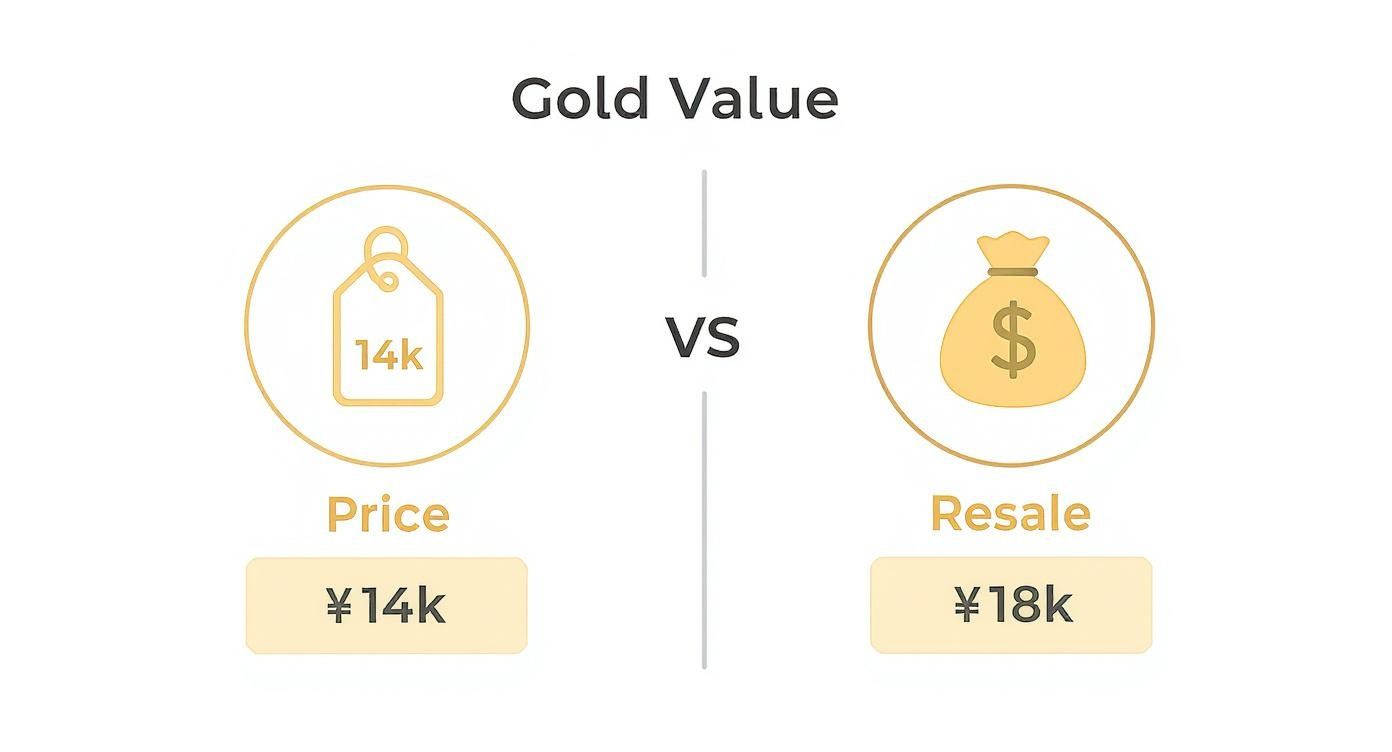
It really just illustrates the core financial trade-off: 14k is the more budget-conscious choice for the initial purchase, while the higher gold content in 18k gives it greater long-term material worth.
Which Gold Karat Suits Your Jewelry Needs
To make the choice even clearer, let’s quickly break it down by lifestyle and jewellery type. Use this table to find your perfect match in the 14k vs 18k gold discussion and pinpoint the best option based on your daily activities.
| Jewelry Type and Wearer Lifestyle | Recommended Karat | Primary Justification |
|---|---|---|
| Engagement Ring for an Active Person | 14k Gold | Offers superior durability and scratch resistance for constant, worry-free wear. |
| Wedding Band for Sensitive Skin | 18k Gold | Contains fewer alloy metals, making it more hypoallergenic and reducing the risk of irritation. |
| Daily-Wear Gold Chain or Bracelet | 14k Gold | Its hardness resists stretching, bending, and the fine scratches that come with everyday use. |
| Luxury Statement Ring for Events | 18k Gold | The richer colour and premium feel are prioritised over durability for pieces worn occasionally. |
| Intricate Design with Many Small Stones | 14k Gold | Provides stronger, more secure prongs to hold gemstones safely in place over time. |
Ultimately, there is no wrong answer here. The best choice is simply the one that fits seamlessly into your world, reflecting both your personal style and your daily realities. Whether you land on the resilient charm of 14k or the opulent glow of 18k, you're investing in a beautiful piece designed to last a lifetime.
Common Questions About 14k and 18k Gold
Even after breaking down the details, a few questions always pop up when it's time to make that final call between 14k and 18k gold. Let's tackle the most common ones we hear in the studio. Getting these right is the key to making sure the piece you choose is one you'll love for a lifetime.
Ultimately, the whole 14k vs 18k gold conversation comes down to what matters most to you in a piece of fine jewellery. Once you know your priorities, the choice becomes much clearer.
Is 18k Gold Really Better Than 14k Gold?
This is probably the number one question we get, and the honest answer is: no, one isn't flat-out "better" than the other. It all boils down to what you're looking for.
When it comes to pure gold content and colour, 18k gold has the edge. With 75% pure gold, it has that deep, rich, saturated yellow that just screams luxury. You can feel the difference, too—it has a certain heft and prestige to it.
But when you shift the focus to practicality, 14k gold comes out on top. Its higher alloy content (41.5%) makes it significantly tougher. It stands up much better to the inevitable bumps, scratches, and knocks of daily life, making it a more pragmatic choice for something you’ll wear constantly, like an engagement ring.
The Verdict: If you're all about that rich, buttery colour and a luxurious feel for a special occasion piece, 18k is your winner. But if you need something beautiful that can also handle an active lifestyle, 14k gold is the smarter, more resilient choice.
Will 14k or 18k Gold Cause a Skin Allergy?
Pure gold itself is hypoallergenic, so it’s almost never the cause of a skin reaction. The issue usually comes from the alloy metals mixed in with the gold, and the main offender is typically nickel.
Because 14k gold contains a higher percentage of these other metals, the risk of a reaction is slightly higher if you know you have sensitive skin. With only 25% alloy content, 18k gold is generally considered the more hypoallergenic option. It's what we often suggest for clients with known metal sensitivities.
If you have a serious nickel allergy, it’s always a good idea to ask about the specific alloys used in the mix. Or, you might want to consider platinum, which is a different precious metal altogether and naturally hypoallergenic.
How Different Is the Colour of 14k and 18k Rose Gold?
In rose gold, the colour difference is actually quite distinct, and it all comes down to the amount of copper in the recipe.
- 14k Rose Gold: This blend has a higher ratio of copper, which gives it a very noticeable, vibrant pink or even reddish-pink hue. It’s a bold, modern look that really makes a statement.
- 18k Rose Gold: With more pure yellow gold in the alloy, the red from the copper is softened. The result is a more delicate, peachy-gold or champagne-rose colour. It’s a much warmer and subtler take on rose gold.
This choice is purely about aesthetics. If you’re after that warm, golden-blush tone, go for 18k. If you want a punchier, true pink, you’ll get exactly that with 14k.
Which Gold Is Better for an Engagement Ring?
An engagement ring is probably the hardest-working piece of jewellery you'll ever own, so this decision really needs to factor in the wearer's daily life.
For most people, 14k gold is the go-to recommendation for an engagement ring, and for good reason. Its extra hardness offers better protection against the wear and tear of everyday life. More importantly, it means the tiny prongs holding your diamond or gemstone are stronger and less likely to bend over time, keeping that precious stone safe and secure.
That said, 18k gold is still a stunning and luxurious choice. It’s a fantastic option for someone who works a desk job or is just naturally very careful with their jewellery. If the wearer has sensitive skin or simply loves the idea of a purer, richer gold, an 18k ring is beautiful—it just needs a little extra mindfulness and care.
Here at Daniel Fine, we believe your jewellery should be a perfect reflection of your story and lifestyle. Whether you lean towards the resilient beauty of 14k gold or the opulent glow of 18k, our team is here to guide you through every detail. Explore our collection or book a consultation to begin crafting your bespoke piece today at https://danielfine.com.au.