Right, let's get straight to the biggest question on everyone's mind: are lab-grown diamonds real diamonds?
The short answer is a resounding yes.
Think of it this way: ice from your freezer is just as much real ice as a chunk taken from a glacier. Both are frozen H₂O. They just have very different origin stories. The same principle applies here.
What Makes a Diamond a Diamond?
To really grasp this, we need to forget about where a diamond comes from for a moment and focus on what it is. At its very core, a diamond is pure carbon, with its atoms locked into a specific crystal structure. It’s this unique atomic arrangement that gives a diamond its legendary hardness and that fiery sparkle we all know and love.
The magic of lab-grown diamonds is that they are chemically, physically, and optically identical to those pulled from the earth. Sophisticated processes like High Pressure High Temperature (HPHT) and Chemical Vapour Deposition (CVD) are just scientific ways of recreating the intense conditions found deep within the Earth's mantle. The result is a stone that is, for all intents and purposes, the same. This scientific breakthrough is a key reason behind their surging popularity in the Australian diamond market and beyond.
To put it in perspective, let's do a quick side-by-side.
Lab-Grown vs. Mined Diamonds At a Glance
| Attribute | Lab-Grown Diamond | Mined Diamond |
|---|---|---|
| Chemical Makeup | Pure crystallised carbon (C) | Pure crystallised carbon (C) |
| Physical Hardness | 10 on the Mohs scale | 10 on the Mohs scale |
| Optical Brilliance | Identical refractive index | Identical refractive index |
| Origin | Created in a controlled lab | Formed deep in the Earth |
As you can see, when it comes to the stuff that actually matters—what the diamond is made of and how it performs—they are one and the same.
Identical on a Molecular Level
When a gemologist puts a diamond under their loupe, they're looking for the fundamental properties that define it as a diamond. Lab-grown stones tick every single box.
- Chemical Composition: They are pure, crystallised carbon, through and through.
- Physical Hardness: Both hit a perfect 10 on the Mohs scale of hardness, the highest score possible. Nothing is harder.
- Optical Properties: They bend and reflect light in exactly the same way, creating that unmistakable, brilliant sparkle.
The only true difference between a lab-grown diamond and a mined diamond is its point of origin. One is formed over billions of years deep within the Earth's crust, while the other is created over several weeks in a highly controlled, scientific setting.
This scientific parity is why the world's leading gemological institutes, like the Gemological Institute of America (GIA), grade them using the exact same rigorous standards—the famous 4 Cs of Cut, Colour, Clarity, and Carat. For you, the buyer, this means you're getting a stone with the exact same beauty and quality as a mined one, just with a different, and much shorter, backstory.
How Science Recreates a Diamond in the Lab
Making a diamond in a laboratory isn't about creating something artificial. It’s about recreating the exact, intense conditions found deep inside the Earth’s mantle, but on a much faster timeline. Think of it as accelerating a geological process that takes billions of years and compressing it into a matter of weeks.
The result isn't a "fake" diamond—it's a stone that is physically, chemically, and visually identical to one pulled from the ground.
There are two main recipes that scientists use to achieve this: High Pressure/High Temperature (HPHT) and Chemical Vapour Deposition (CVD). While the equipment and techniques are different, they both share the same fundamental goal: coaxing carbon atoms to arrange themselves into that perfect, incredibly strong crystal structure that makes a diamond a diamond.
This infographic breaks down the journey of a diamond, showing how both nature’s path and the lab’s path lead to the same beautiful result.
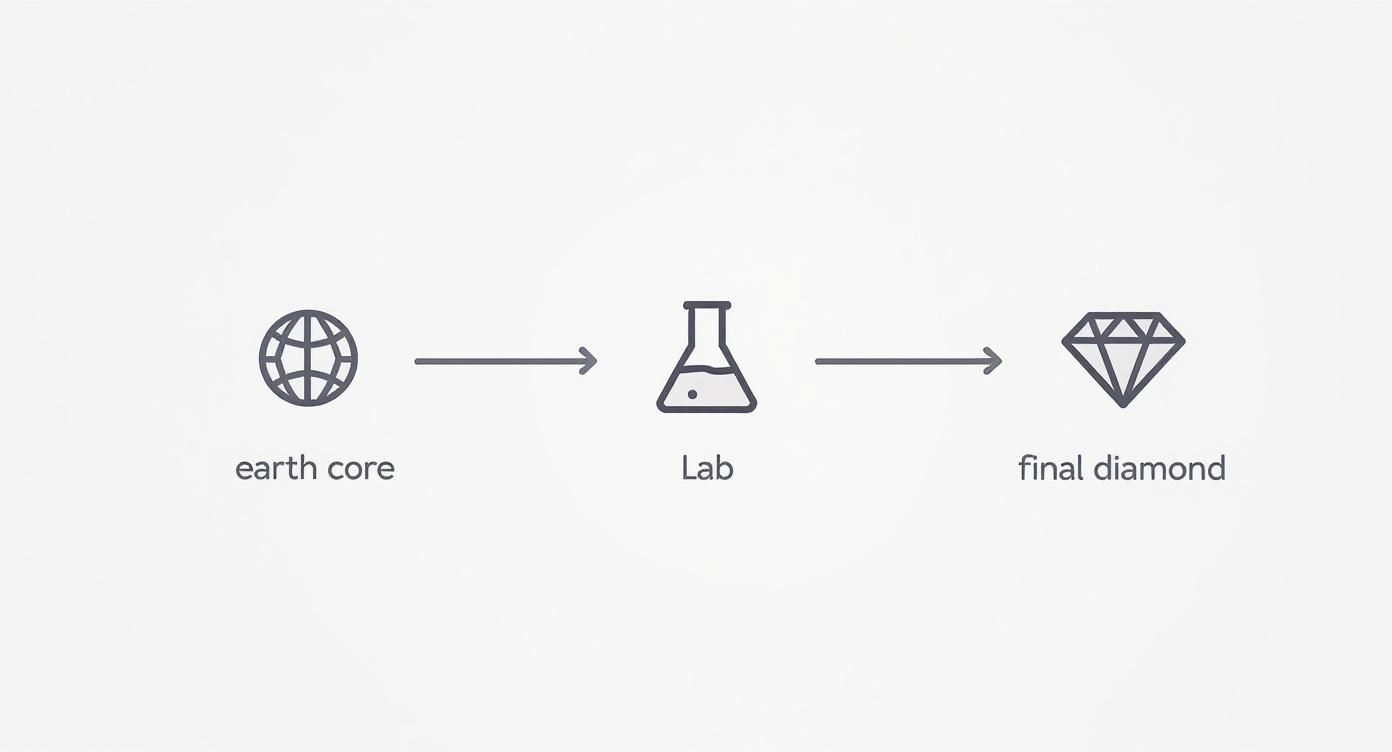
As you can see, the final product is identical in substance. The only real difference is where it came from.
High Pressure High Temperature (HPHT)
The HPHT method is the original technique, and it’s a brilliant brute-force approach. At its core, it’s about simulating the crushing force and blistering heat of the Earth’s mantle.
It all starts with a tiny, genuine diamond fragment called a diamond seed. This seed is placed inside a specialised press with a source of pure carbon. Then, the machine applies an incredible amount of pressure—around 1.5 million pounds per square inch—while heating everything to over 1,500°C.
Under these extreme conditions, the carbon source melts and deposits itself onto the diamond seed, atom by atom. Over several weeks, it grows into a sizeable rough diamond, ready to be cut and polished.
Chemical Vapour Deposition (CVD)
CVD is a more modern, nuanced approach. Instead of pressure-cooking a diamond, you can think of it as building one up, layer by microscopic layer.
This method also starts with a thin slice of a diamond seed. The seed is placed inside a vacuum chamber, which is then filled with a carbon-rich gas, like methane. The gas is heated until the carbon atoms break away from their molecules.
These free-floating carbon atoms then 'rain' down onto the cooler diamond seed, bonding to it and slowly building up the diamond’s crystal structure. It’s a meticulous, controlled process that takes weeks to form a high-quality gem.
Whichever method is used, the final product is a stone that is unequivocally a real diamond. Both HPHT and CVD successfully assemble carbon atoms into the same crystal structure found in nature. That’s why the question "are lab grown diamonds real" has a definitive, scientific "yes"—and why even a seasoned gemmologist needs sophisticated equipment to tell their origins apart.
What Gemologists Say About Diamond Authenticity
When you really want to know if something is the genuine article, you go to the experts. In the world of fine gems, that means turning to a gemologist. Their verdict on lab-grown diamonds? They are absolutely, unequivocally, real diamonds. This isn't just an opinion—it's a scientific fact backed by the most respected gemological institutions on the planet.
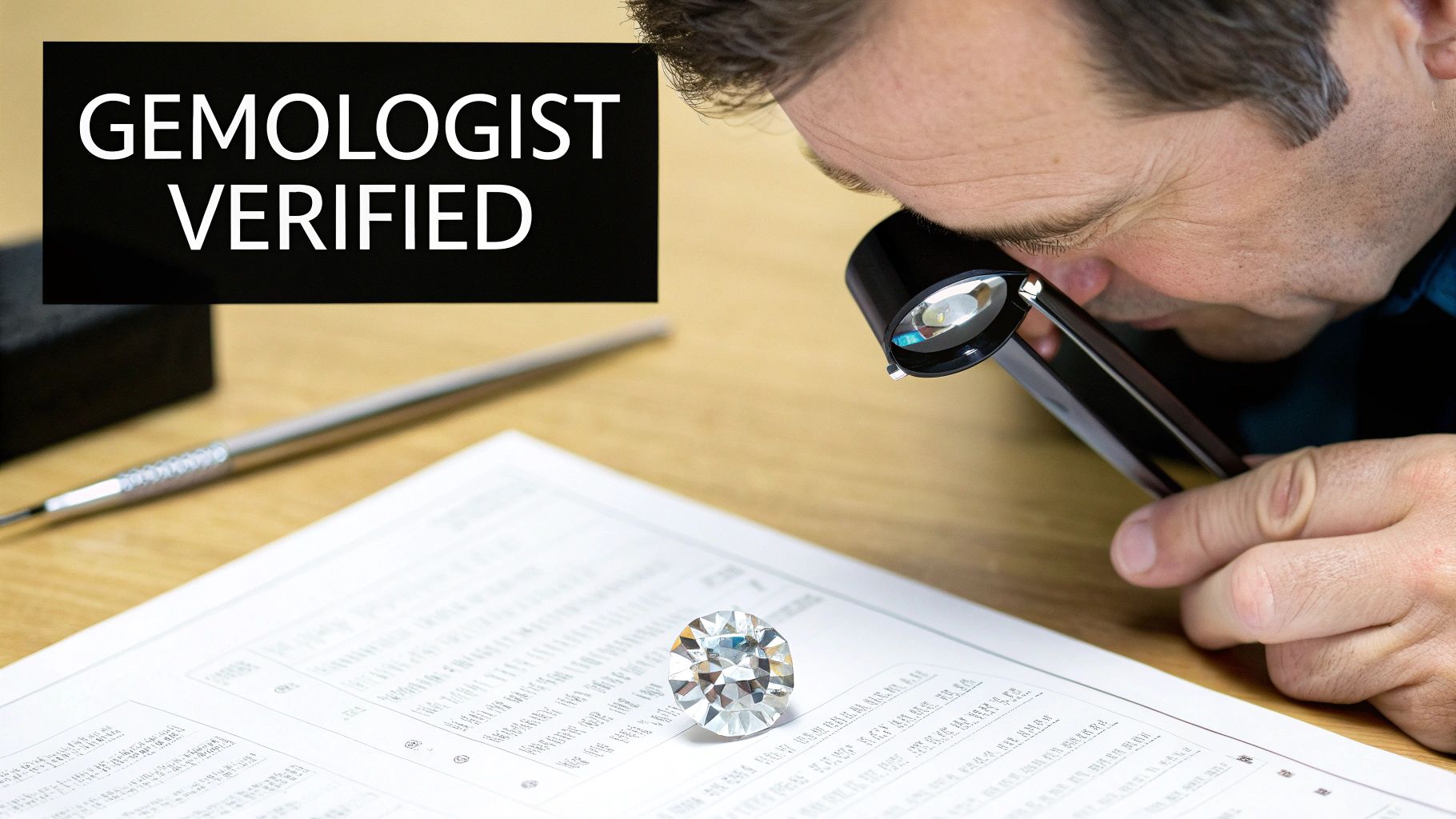
Experts from leading organisations like the Gemological Institute of America (GIA) aren't just making an educated guess. They use highly sophisticated equipment to analyse the very essence of a stone. A lab-grown diamond goes through the exact same battery of rigorous tests as a mined diamond, and it passes with flying colours because, on a molecular level, they are one and the same.
Think of it this way: a lab-grown diamond is made of the same pure carbon, arranged in the same crystal structure, that bends and reflects light in the exact same dazzling way. Without advanced machinery, even a seasoned gemologist can't distinguish one from the other just by looking.
Identical Hardness and Brilliance
A diamond’s legendary status comes from its exceptional hardness. It scores a perfect 10 on the Mohs hardness scale, the definitive measure of scratch resistance. Gemological testing confirms that lab-grown diamonds also hit that perfect 10, meaning they are every bit as durable and perfectly suited for a lifetime of daily wear as their mined counterparts.
It’s the same story with their optical properties—the magic that makes a diamond come alive. The brilliance (that bright white light), the fire (those stunning rainbow flashes), and the scintillation (the overall sparkle) are all identical. These visual fireworks are a direct result of the diamond's carbon crystal structure, which science has now perfectly replicated.
"A diamond is a diamond, no matter whether it is grown in a lab or comes out of the ground." – Matthew Hall, GIA's vice president and chief operating officer.
This quote from a top authority really gets to the heart of it. The origin story is different, but the stone itself is the same.
The Role of Certification and Transparency
While gemologists confirm their authenticity, they are also huge advocates for transparency. Reputable labs like the GIA and the International Gemological Institute (IGI) issue grading reports for lab-grown diamonds that are just as comprehensive as those for mined stones. They meticulously assess the 4 Cs: Cut, Colour, Clarity, and Carat.
These reports, however, do two very important things:
- Certification: They provide an official, independent verification of the diamond’s quality and confirm its specific characteristics.
- Disclosure: They clearly state the diamond’s origin as "laboratory-grown" to ensure you, the buyer, have all the facts.
On top of this, many certified lab-grown diamonds have a tiny, microscopic laser inscription on their girdle (the thin edge of the stone) that identifies their origin. This isn't about marking them as 'lesser than'; it’s about providing an honest, transparent, and permanent record of where the diamond came from. For buyers here in Australia, this combination of certification and clear disclosure gives you complete confidence that you're getting a genuine diamond with a fully known history.
A Practical Comparison for Australian Buyers
Choosing the right diamond really comes down to what you value most. For many of us here in Australia, picking between a lab-grown and a mined diamond is about more than just sparkle—it's a careful balance of budget, personal ethics, and what you expect from the stone in the long run. Let's walk through the key things you'll want to think about.
Price and Value: Getting More for Your Money
Let's be upfront: one of the biggest draws for lab-grown diamonds is the incredible value they offer. You can expect a lab-created diamond to cost anywhere from 20% to 40% less than a mined diamond of the exact same size and quality, and sometimes the savings are even greater.
This price gap isn't because one is 'better' or 'worse'. It's purely down to the economics of how they get to the jeweller. Mining is a massive, expensive, and often unpredictable undertaking. Creating a diamond in a lab, on the other hand, is a much more streamlined and controlled process.
What This Means for Your Budget
This difference in cost can completely change what's possible for your ring. It means you could:
- Go Bigger: Get a much larger, more impressive diamond than you ever thought your budget would allow.
- Aim for Perfection: Choose a stone with a higher colour and clarity grade, giving you that breathtaking, flawless brilliance.
- Focus on the Design: Free up more of your budget to invest in a truly special, intricate setting or upgrade to a premium metal like platinum.
This financial freedom is a huge deal. We’ve seen the Australian diamond market shift dramatically, with lab-grown prices dropping by more than 70% since 2020. This trend has made them a brilliant option for anyone wanting the real deal without the eye-watering price tag. If you're interested in the numbers, you can dive deeper into the Australian diamond market research.
Ethical and Environmental Considerations
Money aside, a growing number of Australians want to know their purchase aligns with their values. This is where lab-grown diamonds really shine.
Because they’re made in a secure, controlled setting, they are guaranteed to be 100% conflict-free. It's that simple. You get total peace of mind, completely avoiding the complicated and sometimes ethically murky supply chains that can be associated with mined diamonds.
From an environmental perspective, the contrast is just as stark. The lab process uses far less water and causes significantly less land disruption than traditional large-scale mining. For anyone prioritising sustainability, this smaller environmental footprint is a massive plus.
When you choose a lab-grown diamond, you're not just buying a stone; you're making a statement about your values. It represents a modern approach to luxury—one that is conscious, transparent, and aligned with a more sustainable future.
The Honest Truth About Resale Value
It’s crucial to have a straight-up conversation about resale value. Mined diamonds have a very established history and a secondary market, so they tend to hold onto a portion of their value over time—though it’s important to remember they aren't a financial investment in the traditional sense.
Lab-grown diamonds are the newer kid on the block. As the technology to create them gets better and more efficient, their production cost continues to fall. This means they generally have a lower resale value compared to their mined counterparts.
However, for most people, an engagement ring is a deeply sentimental piece meant to be worn and cherished for a lifetime, not an asset to be flipped for a profit. If your main goal is getting the most beautiful, impressive diamond you can for your money today, then the lower resale value probably won't be a major factor in your decision.
Decision Matrix for Lab-Grown vs Mined Diamonds
To help you weigh everything up, we've put together a simple table that compares the two side-by-side. Think of it as a cheat sheet for your decision-making process.
| Factor | Lab-Grown Diamonds | Mined Diamonds |
|---|---|---|
| Price & Value | Significantly lower cost (20-40% less). Offers more size and quality for the same budget. | Higher price point due to complex and costly mining and supply chain logistics. |
| Ethical Sourcing | 100% conflict-free guaranteed. Origin is fully traceable to a specific laboratory. | Can be conflict-free with certifications like the Kimberley Process, but traceability can be complex. |
| Environmental Impact | Minimal land disruption and lower carbon footprint. A more sustainable choice. | Involves significant land excavation, high water usage, and energy consumption. |
| Authenticity | A real diamond—chemically, physically, and optically identical to a mined diamond. | The traditional, natural standard for a diamond, formed over billions of years. |
| Resale Value | Currently has limited resale value as production technology evolves and costs decrease. | Retains a portion of its original value in a long-established secondary market. |
| Aesthetic & Durability | Identical. Both are a 10 on the Mohs scale and offer the same brilliance, fire, and sparkle. | Identical. The hardest known natural substance, offering timeless beauty and durability. |
| Perception | A modern, conscious choice representing innovation. Some value the technological aspect. | A classic, romantic choice representing rarity and natural history. Some value the "treasure" aspect. |
Ultimately, there's no right or wrong answer—only what's right for you. Both options result in a beautiful, real diamond. This table is here to help you feel confident in your choice by clarifying which factors matter most to you and your partner.
How to Shop for a Lab Grown Diamond with Confidence
Diving into the world of diamonds can feel a little overwhelming, but the good news is that buying a lab-grown diamond is refreshingly straightforward. Why? Because the very same quality standards that have guided buyers of mined diamonds for generations apply here too. Since they are real diamonds in every sense, your focus stays squarely on the classic ‘4 Cs’.
This timeless grading system—Cut, Colour, Clarity, and Carat—is the universal language of diamond quality. A diamond's Cut is what gives it that mesmerising sparkle. Colour refers to its transparency, or lack of any yellow tint. Clarity measures how free it is from tiny internal marks, and Carat is simply its weight. Getting a feel for how these four elements play off each other is your first step to finding a stone you’ll absolutely love.

Always Insist on Certification
Let's get straight to the point: the single most important tool you have is the official grading report. You should never purchase a significant lab-grown diamond without a certificate from a reputable, independent gemological lab like the International Gemological Institute (IGI) or the Gemological Institute of America (GIA).
Think of this document as your diamond's birth certificate and quality guarantee all in one. It gives you an unbiased, expert assessment of the 4 Cs and, critically, will clearly state the diamond’s origin as "laboratory-grown." This disclosure provides total transparency, so you know exactly what you are buying.
A diamond certificate isn't just a piece of paper; it's your guarantee of quality and a detailed map of your stone's unique characteristics. It empowers you to compare options fairly and confirms you are getting the value you paid for.
Key Questions to Ask Your Jeweller
Walking into a jewellery store armed with the right questions changes the entire experience. It shows you've done your homework and helps you get the clear, direct answers needed to choose with confidence.
Here are a few essential questions to have ready:
- Can you show me the laser inscription on the diamond's girdle? Most certified lab-grown diamonds have a microscopic inscription of the report number etched onto their edge, proving the stone matches the certificate in your hand.
- What is your policy on returns or upgrades for lab-grown diamonds? It’s always smart to understand a jeweller's long-term policies before you make a final decision.
- Can I see this diamond alongside another of a different quality grade? Comparing stones side-by-side is the absolute best way to see for yourself how a slight difference in colour or clarity actually looks in person, rather than just on paper.
The Future of Real Diamonds in Australia
Lab-grown diamonds aren't just a fleeting trend—they represent a permanent, fundamental shift in the world of fine jewellery. Here in Australia, they’re completely changing the conversation around luxury, choice, and what we value in a gemstone. What was once a niche alternative has quickly become a mainstream staple. And let's be clear: they are, in every meaningful way, real diamonds.
Their growing acceptance is cementing their place as a modern, intelligent choice for anyone buying jewellery. It’s not hard to see why. Lab-grown diamonds offer a powerful mix of affordability, ethical peace of mind, and sustainability that just clicks with today's values. As the technology behind them gets better and better, we can only expect their quality and availability to improve, making them an even more compelling option in the years ahead.
A Permanent Place in the Australian Market
Within the Australian jewellery industry, the debate over "are lab-grown diamonds real?" is essentially over. Both jewellers and their clients have moved past the question, treating them as a permanent fixture, not some passing fad. This comes down to a simple, undeniable fact: they have the exact same physical and chemical properties as mined diamonds.
Innovations like blockchain traceability are also giving buyers incredible confidence, offering crystal-clear origin verification for all types of diamonds. If you’re interested in the data behind this shift, the 2025 diamond market forecast offers a great look at how technology is cementing their place in the market.
Ultimately, the future of diamonds in Australia is all about choice. It's about giving you the freedom to choose a stone that perfectly aligns with your story, your budget, and your personal values—without ever having to compromise on beauty or quality.
Whether you're captivated by the ancient, earthy story of a mined diamond or the clean, modern ingenuity of a lab-grown one, you're choosing a real diamond. Hopefully, this guide has left you feeling confident and well-informed, ready to find the stone that’s absolutely perfect for you.
Answering Your Questions About Lab Grown Diamonds
Even after getting to know the science, it's natural to have a few more questions rattling around. Let's clear up some of the most common ones so you can feel completely confident about what a lab-grown diamond really is.
Will Lab Grown Diamonds Last Forever?
Absolutely. This is probably the most important thing to know: because lab-grown diamonds are real diamonds, they share the exact same incredible durability.
They clock in at a perfect 10 on the Mohs scale of hardness, the highest score possible. This means they're just as tough and scratch-resistant as any diamond pulled from the earth, making them perfect for a lifetime of daily wear. They simply will not cloud, fade, or change their appearance over time.
Can a Jeweller Tell the Difference Just by Looking?
Nope. Not even a highly trained gemologist can tell a lab-grown and a mined diamond apart with the naked eye or a standard jeweller's loupe. They are optically and physically identical.
It takes highly specialised equipment, the kind you’d only find in a major gemological lab, to spot the microscopic markers left behind by the crystal's growth process. These subtle clues are the only thing that reveals its origin, which is why official certification is so crucial for both types of stones.
The bottom line is this: a lab-grown diamond’s beauty and resilience are identical to a mined diamond's. They are built to be cherished for generations, holding their sparkle and structural integrity just as a stone from the earth would.
Are They the Same as Moissanite or Cubic Zirconia?
This is a big one, and the answer is a firm no. It’s a crucial distinction to make. Lab-grown diamonds are made of pure, crystallised carbon—the exact same stuff as mined diamonds.
Moissanite and Cubic Zirconia (CZ), on the other hand, are diamond simulants. This means they're completely different materials engineered to look like diamonds, but they aren't the real deal.
- Moissanite is a gemstone made of silicon carbide.
- Cubic Zirconia is a synthesised material called zirconium dioxide.
While they might look convincing at a glance, they don't have the same hardness, the same kind of brilliance, or the same chemical soul as a diamond. Lab-grown diamonds aren't fakes or look-alikes; they are genuinely diamonds, just with a modern origin story.
At Daniel Fine, we believe luxury should be personal and accessible. Whether you are drawn to the modern story of a lab-grown diamond or the timeless tale of a mined one, our focus is on creating a bespoke piece that perfectly reflects you. Explore our collection or begin your custom jewellery journey at https://danielfine.com.au.