Designing your own engagement ring is an incredible journey. It's a creative process that unfolds across four main stages: gathering inspiration, choosing your perfect stone and setting, selecting the right metal, and finally, working hand-in-hand with a jeweller to bring it all to life. Following this path ensures the ring isn't just a piece of jewellery, but a true reflection of your love story.
Your Journey to a Bespoke Engagement Ring
Creating a custom engagement ring is so much more than a simple purchase. It’s a deeply personal experience, a chance to craft a symbol that is uniquely yours. Think of this guide as your complete roadmap, designed to walk you through the entire journey, from that first flicker of an idea to the stunning reality you’ll hold in your hands. My goal is to give you the confidence to make every decision, ensuring the final piece becomes a future heirloom you'll both treasure forever.
Understanding the Process
We'll break down all the big decisions together. We'll look at how to choose the perfect gemstone, understand the nuances of different settings, and select a metal that perfectly suits your partner’s style. We’ll also cover the practical side of things, like setting a realistic budget and what it’s really like to collaborate with a skilled jeweller.
This visual gives you a great overview of the journey when you decide to design your own engagement ring.
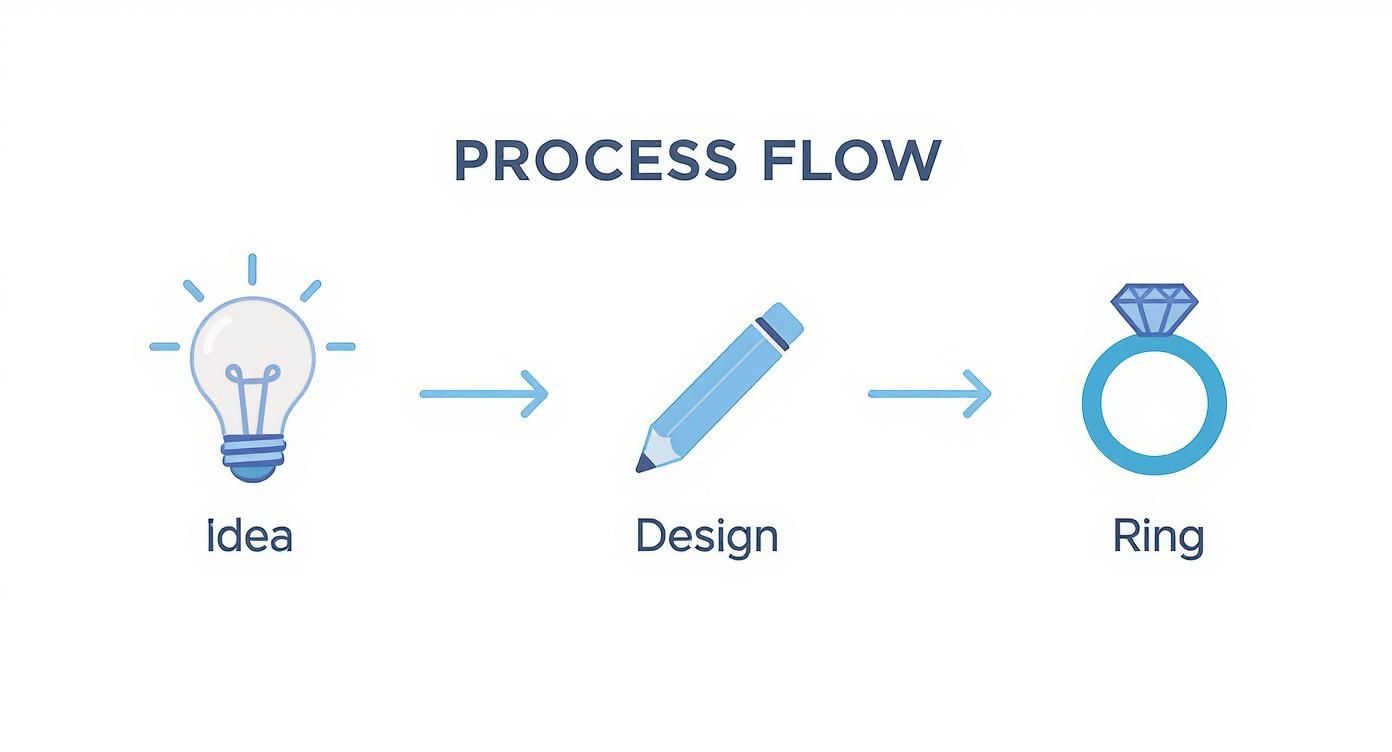
As you can see, the path from a dream in your mind to a physical ring on your finger is a structured, collaborative effort. It’s a genuinely rewarding experience that turns feelings and ideas into a tangible piece of art.
The Growing Desire for Personalisation
If you're leaning towards a custom ring, you're in good company. The shift towards bespoke jewellery is a major trend in Australia’s luxury market. In fact, the wedding ring market in Australia is a significant segment, estimated to be worth around AUD 1.5 billion as of 2025.
This market is set to grow even more, driven by couples wanting personalised and modern designs that truly express their individual tastes and values. You can get a better sense of this by looking into the Australian wedding ring market trends and seeing how customisation is shaping the industry.
A custom engagement ring is an instant attention grabber and conversation starter. When people ask about your ring, you’ll have a unique story to tell—one that goes far beyond just picking a piece from a display case.
Ultimately, choosing to design your own engagement ring is about creating something with deep, lasting meaning. It’s an investment not just in a beautiful object, but in a symbol that will tell your unique story for generations to come.
Kickstarting the Journey: Inspiration & Your Budget
Every truly special engagement ring starts with an idea, a feeling, a spark of inspiration. Before you even think about carats or cuts, this is where the magic begins. It’s the process of taking your partner’s unique personality, your shared memories, and their individual style, and weaving it all into a concept for their ring.
Think about the things that make them light up. Are they captivated by the bold, clean lines of Art Deco design? Or do they find beauty in the soft, flowing forms of nature, like a twisting vine or a delicate flower? Inspiration is everywhere—it could be a piece of art you both love, a detail from a vintage heirloom, or even the memory of a special place. The goal isn't just to find pretty pictures; it's to gather ideas that tell your story.
Turning a Vibe into a Vision
Once you've got a collection of ideas swirling around, it's time to start refining them into a clearer design direction. This is a huge help when you're ready to sit down with a jeweller. Try to pin down the overall aesthetic. Is your partner's style more…
- Modern and Minimalist? Picture clean lines, sleek forms, and uncluttered designs. Think of a simple, elegant solitaire or a modern bezel setting that feels effortlessly chic.
- Vintage and Romantic? This style is all about the details. We're talking delicate milgrain edging, intricate filigree metalwork, and halo settings that feel like they've been plucked from another era.
- Bold and Unconventional? Maybe a traditional diamond isn't their thing. You could explore a unique coloured gemstone, an asymmetrical design, or a distinctive band that truly stands apart from the crowd.
Don't worry about having a perfect sketch. Honestly, just gathering images and making a few notes about what you love—the curve of a particular band, the style of the prongs, a certain metal texture—is one of the most powerful things you can do at this stage.
Your inspiration doesn't have to be another ring. It can be a feeling, a place, or a pattern. The real artistry is in translating that abstract idea into the concrete details of a ring design.
Let's Talk Money: Setting a Realistic Budget
With the creative juices flowing, it's time to ground the project with a practical budget. And let's be clear: that old "three months' salary" rule is completely outdated. The right budget is one that you feel genuinely comfortable with, one that allows you to create something beautiful without causing financial stress. It’s all about investing smartly to prioritise the elements that matter most to you and your partner.
To give you a bit of context, in 2025, the average spend on an engagement ring in Australia is around AUD 5,854. But that's just an average. Most couples we see invest somewhere between AUD 5,000 and AUD 15,000. Of course, the spectrum is huge—we've crafted stunning solitaires for under AUD 2,000 and breathtaking bespoke pieces that exceed AUD 100,000. These figures, which you can read more about in these insights on Australian engagement ring spending, show that it's all about personal choice.
The best part about going custom? You are in the driver's seat. Every single decision you make from here on out will shape the final cost.
How Your Design Choices Steer the Final Cost
When you design your own engagement ring, you get to play with the different variables to hit that sweet spot between your vision and your budget. It really boils down to three key areas:
- The Centre Stone: This is almost always the biggest chunk of the budget. A diamond's price is a dance between its carat weight, cut, colour, and clarity. Sometimes, a slightly smaller diamond with a superb cut will outshine a larger stone with noticeable flaws. It's all about finding that perfect balance.
- The Metal: Your choice of metal impacts both the ring's look and its price tag. Platinum is a premium, incredibly durable choice, and it typically costs more than gold. With gold, 18k has a higher gold content and price compared to 14k.
- The Complexity: The more intricate the design, the more time and craftsmanship are involved. A classic solitaire is far simpler to create than a detailed halo setting with a pavé band (a band covered in tiny diamonds). Custom features like hand-engraving or delicate filigree work also add to the labour cost.
Understanding these trade-offs is your superpower. For instance, you could choose a dazzling moissanite for your centre stone, which frees up more of your budget for an elaborate, handcrafted platinum setting. Or, you might decide a classic 14k gold solitaire is the perfect way to pour as much of your budget as possible into the biggest, most beautiful diamond you can find. It’s all about making informed choices to create a ring that’s perfect for you, both aesthetically and financially.
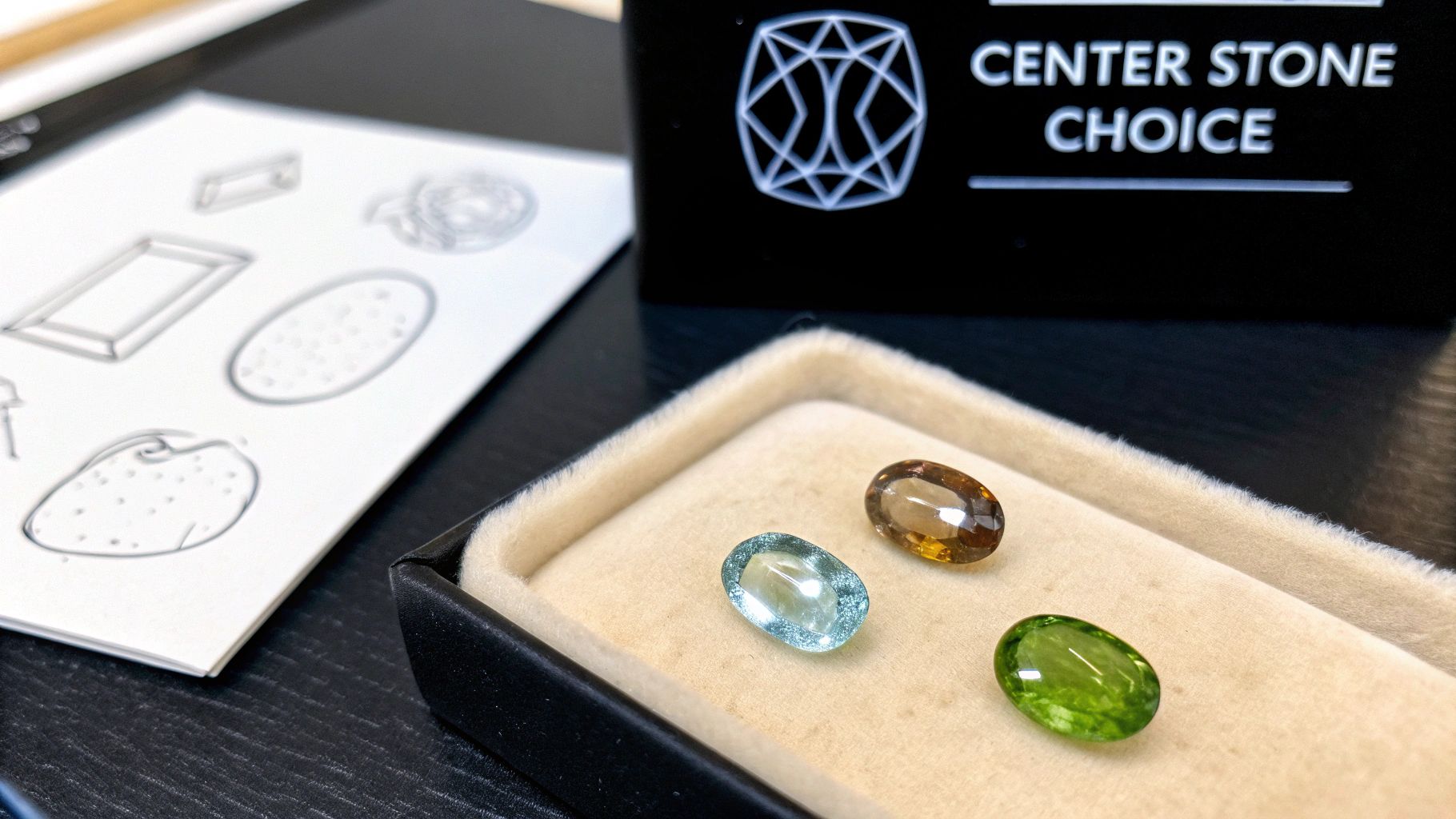
Choosing Your Centre Stone and Setting Style
This is where the real magic happens. The centre stone is the star of the show, and the setting is the stage that lets it shine. When you design your own engagement ring, these two decisions go hand-in-hand, influencing each other far more than you might expect.
Diamonds and Moissanite Unpacked
The first big decision you'll make is the gemstone itself. For years, natural diamonds were the only classic choice, but today’s market gives you incredible options that tick different boxes for beauty, value, and origin.
A natural diamond, formed over billions of years deep within the earth, has a romance and rarity that’s hard to beat. On the other hand, a lab-grown diamond is physically and visually identical to its natural twin but created in a controlled environment. The upshot? You can often get a much larger or higher-quality stone for the same budget.
Then you have moissanite, a stunning and incredibly durable gemstone first discovered in a meteorite crater. It's famous for its fiery brilliance, often throwing more rainbow-like flashes than a diamond. Moissanite offers amazing value, making it a go-to for anyone wanting a big, eye-catching stone without the diamond price tag.
Making an Informed Choice
There’s no right or wrong answer here; it’s all about what you value most. Thinking through these options is a deeply personal step.
To help you get your head around it, here's a quick comparison of the three most popular choices for a custom engagement ring.
Stone Comparison Diamond vs Lab Diamond vs Moissanite
| Characteristic | Natural Diamond | Lab-Grown Diamond | Moissanite |
|---|---|---|---|
| Origin | Mined from the Earth | Created in a laboratory | Lab-created (natural is rare) |
| Hardness | 10/10 on the Mohs scale | 10/10 on the Mohs scale | 9.25/10 on the Mohs scale |
| Brilliance | Intense white light sparkle | Identical to natural diamonds | Exceptional fire and rainbow flashes |
| Price | Highest price point | More affordable than natural | Most affordable option |
| Value | Holds long-term resale value | More accessible luxury | Excellent value for size/quality |
Ultimately, choosing a lab-grown stone or moissanite can free up a significant part of your budget. That extra room could go towards a more intricate setting, a higher-quality metal, or simply a bigger stone. It’s a strategic trade-off that puts you firmly in control.
Demystifying the Four Cs
No matter which stone you lean towards, getting familiar with the "Four Cs" will help you get the most beautiful result. This isn't about becoming a gemologist overnight—it's about knowing where your money makes the biggest visual impact.
- Cut: This is, without a doubt, the most important 'C'. It’s not about the shape (like round or oval), but the stone's proportions and facets. This is what dictates how well it plays with light. A well-cut stone will be brilliant and fiery; a poorly cut one will look dull, no matter its colour or clarity.
- Colour: For diamonds, this is a grade for the absence of colour, running from D (colourless) to Z (light yellow). Honestly, most people can't see the tiny differences in the near-colourless range (G-J), which can offer fantastic value.
- Clarity: This grades the tiny natural imperfections, or inclusions, within the stone. Many of these are microscopic and totally invisible to the naked eye. A smart way to manage your budget is to prioritise an "eye-clean" stone over a technically flawless one.
- Carat: This is simply the weight of the stone, which corresponds to its size. Just remember that a bigger carat weight doesn't automatically mean a more beautiful stone. It's the cut quality that truly brings it to life.
Prioritise an excellent cut above all else. A beautifully cut stone can mask minor imperfections in colour and clarity, giving you a dazzling ring that looks far more expensive than it is. This is the secret to getting the most sparkle for your spend.
Finding the Perfect Setting
The setting does so much more than just hold the stone; it’s what gives the ring its entire personality. Your choice here can make the ring feel classic and timeless, sleek and modern, or wonderfully romantic.
A solitaire setting is the ultimate classic, with a simple band and prongs that put all the focus on the centre stone. A halo setting, which encircles the main stone with smaller diamonds, creates a seriously dazzling, larger-than-life look. For something clean and modern, a bezel setting wraps the stone in metal, giving it maximum protection and a unique profile.
We're also seeing a huge return to vintage and antique-inspired designs. Here in Australia, 2025 trends are leaning heavily towards Art Deco and Victorian styles, with couples looking for intricate milgrain details and delicate filigree. Rings with unique cuts like emerald or Asscher are also soaring in popularity for their elegant, historic charm. You can dive deeper into these Australian engagement ring trends to see how old-world craftsmanship is making a big comeback.
Your setting is the final piece of the puzzle, framing your stone and completing the story you started with your inspiration.
Choosing the Right Metal and Adding the Final Details
You’ve landed on the perfect centre stone and setting, which is a huge step! Now it’s time to choose the metal that will hold it all together. This decision goes far beyond just picking a colour; it shapes the ring's personality, durability, and how it feels on the finger day in and day out.
Think of the metal as the frame for your artwork. It’s what completes the picture you’ve been so carefully putting together.
Exploring Your Precious Metal Options
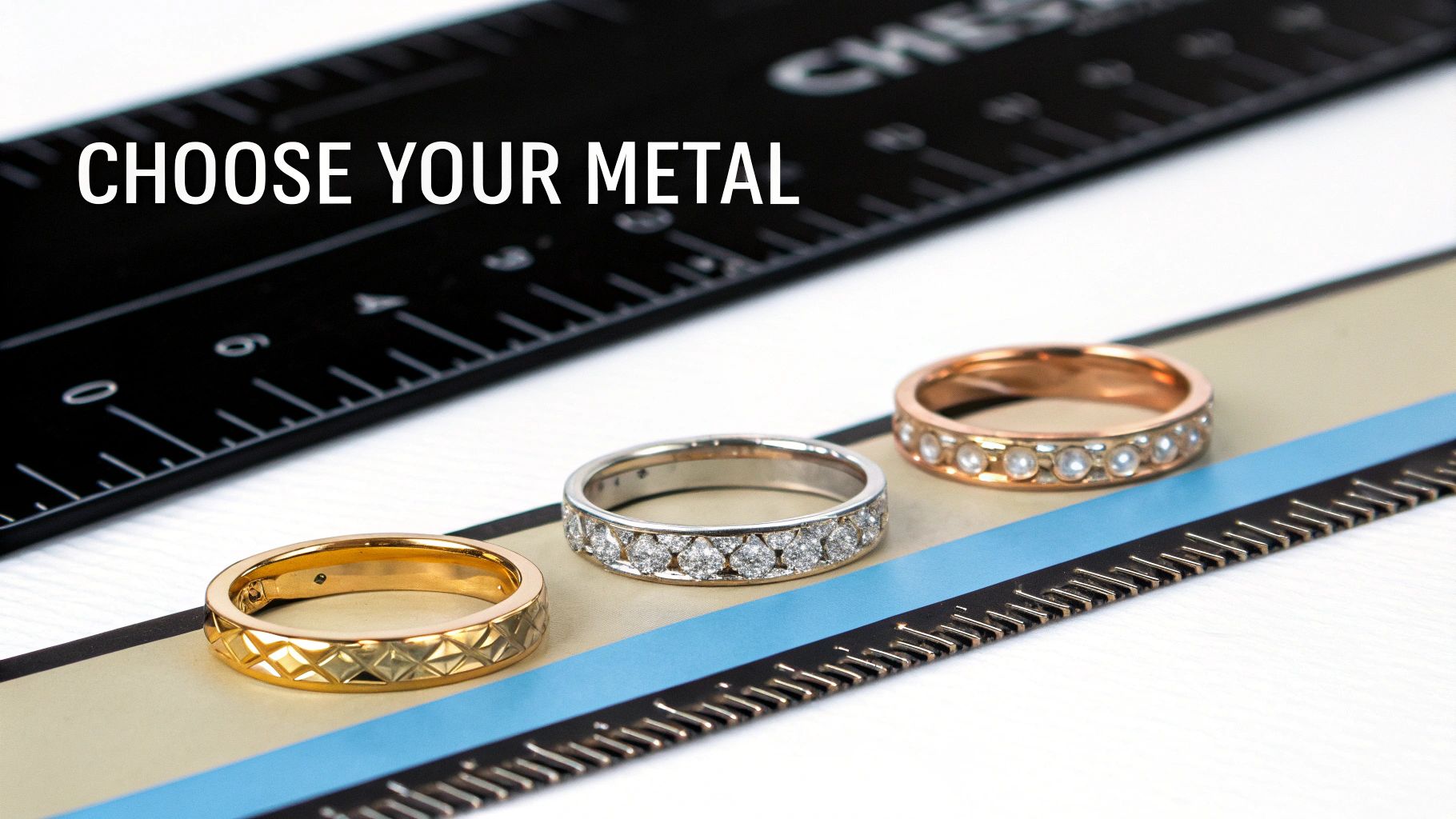
The metal you choose has a massive influence on the final look. The four most popular choices each have their own vibe, making them a great fit for different styles and lifestyles.
- Yellow Gold: You can’t go wrong with this classic. Its warm glow is a beautiful complement to warmer skin tones and creates a stunning contrast against a brilliant white diamond. It also makes coloured gemstones really pop.
- White Gold: This is your go-to for a modern, sophisticated look. It’s actually yellow gold mixed with white alloys and then plated with rhodium to give it that bright, silvery-white finish that really amplifies a diamond's sparkle.
- Rose Gold: Known for its romantic, pinkish hue, rose gold gets its gorgeous colour from a copper alloy. It's a stylish, warm choice that genuinely looks incredible on just about every skin tone.
- Platinum: The premium choice, and for good reason. Platinum is naturally white, incredibly dense, and hypoallergenic, making it the perfect option for sensitive skin. It’s also the most durable of the bunch, so it will hold your precious stones securely for a lifetime.
When you design your own engagement ring, you have the freedom to pick the metal that not only looks right but also makes sense for the person wearing it. If they have an active lifestyle or a hands-on job, the sheer strength of platinum might be the most practical choice.
Durability and Lifestyle Considerations
Let’s talk about hardness, because it's a crucial factor. Gold’s purity is measured in karats. 18k gold is 75% pure gold, while 14k is 58.3% pure. While 18k gold has a richer, more vibrant colour, the higher alloy content in 14k gold makes it a bit more resistant to the little bumps and scratches of daily life.
Platinum is in a league of its own when it comes to strength. When it gets scratched, the metal is simply moved around rather than lost, developing a beautiful, unique patina over time without losing any volume. On the other hand, white gold will need to be re-plated with rhodium every few years to keep its bright white shine, which is an important bit of long-term maintenance to keep in mind.
The perfect ring is a blend of beauty and practicality. Think about your partner's daily routine—do they work with their hands, spend a lot of time outdoors, or have a more gentle lifestyle? The answer will point you toward a metal that can truly go the distance.
The Finishing Touches That Tell a Story
Now for the really fun part—the subtle details that take a ring from beautiful to uniquely yours. These finishing touches are where you can weave in personal meaning and character. It’s easy to overlook these small elements, but they make a huge difference.
First, think about the band's profile and width. A slender, delicate band can create the illusion of a larger centre stone, while a wider band gives off a bolder, more substantial feel. The finish of the metal itself can also completely change the ring's personality.
- Polished Finish: The classic, mirror-like shine everyone pictures when they think of fine jewellery.
- Matte Finish: A soft, non-reflective surface that feels modern and elegantly understated.
- Hammered Finish: A textured, artisanal look that catches the light in interesting ways, perfect for a rustic or unconventional style.
- Brushed Finish: A subtle texture, almost like it’s been brushed with a fine wire, that does a fantastic job of hiding minor scratches.
Finally, consider adding a personal engraving inside the band. It could be a meaningful date, a short private joke, or a set of initials. This hidden message is a secret just for the two of you, turning the ring into a true one-of-a-kind symbol of your story. It’s these final details that make the journey to design your own engagement ring so incredibly rewarding.
Working With a Jeweller on Your Custom Design
This is where all your research, dreaming, and Pinterest-boarding starts to become real. Working with a jeweller isn’t just a transaction; it’s a creative partnership. Think of it as a collaborative dance that turns abstract ideas into a tangible, sparkling symbol of your love.
The right artisan won't just build your ring. They’ll be your guide, offering their expertise to make sure the final piece is not only stunning but also engineered to last a lifetime. When you choose to design your own engagement ring, you step into the role of co-creator. It all hinges on clear communication and trust. A great jeweller listens—really listens—to your story, gets a feel for your style, and respects your budget, making these final steps feel exciting, not overwhelming.
The Initial Design Consultation
Your first chat with us is all about sharing your vision. Bring everything you've gathered—your Pinterest board, a few scribbled notes, or even just a feeling you want the ring to capture. Don't stress about knowing all the technical lingo. A good designer is an expert at translating your "I'm not sure how to describe it, but…" into a concrete design plan.
During this conversation, we'll dive into a few key things:
- Your Inspiration: We'll look at the images you’ve saved and pinpoint exactly what you love about them. Is it the delicate milgrain on a vintage piece, or the bold, clean lines of a modern setting?
- Lifestyle Considerations: We'll talk about your partner's day-to-day life. A high-profile, six-prong setting might be breathtaking, but it might not be the most practical choice for a doctor who's always pulling on gloves.
- Material Preferences: We can review your ideas on gemstones and metals, offering advice on which combinations will give you the look you want while working within your budget.
This is a two-way street. It's your chance to see if our style feels right for you, and it's our chance to make sure we can bring your vision to life perfectly.
The goal of the first consultation is simple: to make sure you leave feeling heard, understood, and more excited than ever. It's about establishing a shared vision and a clear path forward.
Bringing Your Vision to Life with CAD Renders
Once we have a solid direction, the real magic begins behind the scenes. Using sophisticated Computer-Aided Design (CAD) software, we’ll create a detailed, three-dimensional digital model of your ring. This is one of the biggest game-changers in modern jewellery making because it completely removes the guesswork.
The CAD render is your digital blueprint. You get to see the ring from every possible angle, with every proportion and detail laid out precisely. You’ll know exactly how high the stone will sit, how thick the band will feel, and how the prongs will cradle the gemstone. It’s the moment your ideas stop being ideas and become something you can actually see.
The Power of Revisions and Feedback
The CAD stage is your most important moment to give feedback. Trust me, it’s far easier (and cheaper) to adjust a digital model than it is to alter a finished piece of platinum or gold. Never, ever hesitate to speak up if something isn’t exactly what you pictured.
Maybe you’d like the band to be a fraction of a millimetre thinner, or you're curious to see how a different style of prong would look. A good jeweller not only welcomes this feedback but expects it. We’ll usually go through a round or two of tweaks to get every detail just right before the ring heads into production. This is what makes it your ring.
Once you give the final thumbs-up on the design, your jeweller will use the CAD file to 3D-print a wax replica. This model is then used to cast the ring in your chosen metal, after which the stones are meticulously set and the entire piece is polished to perfection by hand.
Understanding the Custom Timeline
Creating a bespoke piece of jewellery is an art, and it’s a process that shouldn't be rushed. For a custom design, a realistic timeframe is anywhere from six to twelve weeks from your initial consultation to holding the finished ring in your hands.
Here’s a rough breakdown of how that timeline usually plays out:
- Design & CAD (1-3 weeks): This covers our first chat, creating the initial CAD renders, and making any revisions you've requested.
- Casting & Crafting (3-6 weeks): After you approve the design, the ring is cast, the stones are sourced and perfectly set, and all the detailed finishing work is done.
- Final Checks & Hallmarking (1-2 weeks): Before it gets to you, the ring goes through a final, rigorous quality control inspection and receives its hallmarks.
Keep in mind that very intricate designs, especially those with lots of pavé stones or hand-engraving, can sometimes extend this timeline. It’s always a good idea to start the process well ahead of when you plan to propose. That way, the experience is enjoyable and completely stress-free, and we have the time to ensure every single detail is perfect.
Common Questions About Designing a Ring
https://www.youtube.com/embed/dyxsd5zFrFs
Taking the leap to design your own engagement ring is a genuinely exciting process, but it’s completely normal to have a few questions pop up. Think of this as your final checklist, where we tackle the practical queries that we hear all the time. Getting these details sorted will help you move forward with total confidence.
Navigating these last few points ensures the whole experience stays smooth and enjoyable, without any last-minute surprises. We've gathered the most common questions from our clients to help demystify the journey of creating a custom ring.
How Long Does a Custom Ring Take to Make?
This is probably one of the first and most practical questions we get, and for good reason—you’ve got a proposal to plan! Generally, you can expect the timeline for a custom engagement ring to be anywhere from four to twelve weeks, from our first chat to the finished piece.
That timeframe covers every single step. It includes our initial design conversations, sourcing the perfect stone that ticks all your boxes, and creating the detailed CAD models. The digital design part alone can take between one and three weeks, as it nearly always involves a round or two of tweaks to get every detail just right.
Once you’ve given the final nod to the digital design, the real hands-on magic begins. This is where we cast the ring, set the gemstones, and do the final polishing. It's worth remembering that more complex designs, like a ring with intricate hand-engraving or a pavé band with dozens of tiny stones, will naturally sit at the longer end of that timeline. My best advice? Always start the process well ahead of when you hope to propose.
Is Designing Your Own Ring More Expensive?
It’s a common myth that the word "custom" is just another way of saying "more expensive." The truth is, when you design your own engagement ring, you get full control over every single element that contributes to the final cost. And that control is your biggest asset.
Instead of being presented with a fixed price tag, you're in the driver's seat. You get to decide where you want to allocate your budget. You can prioritise what really matters to you both, whether that's a larger centre stone, a premium metal like platinum, or beautiful hand-finished details.
In many cases, working directly with a jeweller to create something bespoke actually offers better value than buying a pre-set designer ring off the shelf. You're putting your money directly into quality materials and expert craftsmanship, not paying for a brand name markup. It allows you to create something truly meaningful that also sits comfortably within your budget.
A custom engagement ring gives you unparalleled control. You can choose to invest in a higher-quality diamond by opting for a simpler setting, or you can select a stunning moissanite to free up your budget for an elaborate, handcrafted design. It’s all about making smart, personal choices.
What if I Dislike the CAD Render?
The CAD render is your creative safety net—it’s one of the most important steps in the whole process. We build this stage into our workflow for one specific reason: so you can see, refine, and perfect the design before we even think about touching precious metals. A great jeweller doesn't just expect your feedback at this stage; they welcome it.
This is your moment to be picky. Please, don't hesitate to ask for changes. Whether you want to see a different style of prongs, make the band a fraction of a millimetre thinner, or adjust the height of the stone, now is the time. Seeing the design in 3D is often the moment when it all clicks into place.
Most designers, ourselves included, factor a couple of rounds of revisions into the process as standard. Getting every detail finalised at this digital stage is absolutely key. Trying to make changes once the ring has been cast in metal is a far more complicated and costly affair, so speaking up during the CAD review is the best way to ensure the final piece is the one you’ve been dreaming of.
How Can I Secretly Find My Partner's Ring Size?
Ah, the classic proposal dilemma! Getting the ring size right while keeping the whole thing a surprise takes a bit of clever detective work. Here are a few tried-and-true methods we always recommend.
- Borrow a Ring: This is easily the most accurate method. If your partner has a ring they wear often on their ring finger (the one on the right hand is a good substitute), you can discreetly borrow it for a day. Just bring it to a jeweller to have it professionally sized.
- Enlist an Ally: A trusted friend or family member can be your secret weapon. They could suggest a "just for fun" jewellery shopping trip or casually bring up ring sizes under the guise of buying a gift for someone else.
- Trace the Inside: If you can only get your hands on a ring for a moment, place it on a piece of paper and carefully trace the inside circle with a very sharp pencil. A jeweller can usually get a very close estimate from a precise tracing.
If all else fails, please don’t stress. You can always propose with a standard-sized ring. Most jewellers, including us, offer a complimentary resizing after the big moment to guarantee it fits perfectly for a lifetime.
At Daniel Fine, our bespoke process is designed to be a seamless and personal journey. We guide you through every choice, ensuring your final piece is a perfect reflection of your story and style. Explore our bespoke engagement ring services to start creating your one-of-a-kind symbol of love.