Alright, let's cut to the chase. The "right" amount to spend on an engagement ring is whatever you and your partner are comfortable with. Seriously. Forget those old, dusty rules. Modern couples are all about starting their future together on solid financial ground.
To give you a bit of a benchmark, the average spend in Australia hovers around $5,854. Most people find their sweet spot somewhere in the $5,000 to $15,000 range.
Setting Your Engagement Ring Budget
Figuring out the budget for an engagement ring is often one of the first big financial conversations a couple has. It should be exciting, not a source of stress. And that old "three months' salary" rule? That was just a clever marketing ploy from decades ago, not actual financial advice. Today, it’s all about what feels right for you and aligns with your shared goals.
The whole point of this guide is to help you land on a realistic number that fits your life. A beautiful ring should symbolise your commitment, not derail your financial future. Whether you're saving for a house deposit, planning the wedding, or dreaming of other big adventures, the ring budget needs to fit neatly into the bigger picture.
Understanding the Numbers
It can be helpful to get a sense of what other Aussies are spending, just to ground your expectations. Recent figures show the national average spend on an engagement ring is $5,854. Dig a little deeper, and you'll find most couples land somewhere in the $5,000 to $15,000 bracket. This is a pretty broad range that covers everything from timeless solitaires to more intricate, personalised designs. If you're curious, you can learn more about Australian engagement ring spending habits.
This diagram breaks down the key figures at a glance—the average spend, the most popular price range, and a typical starting point for a quality ring.
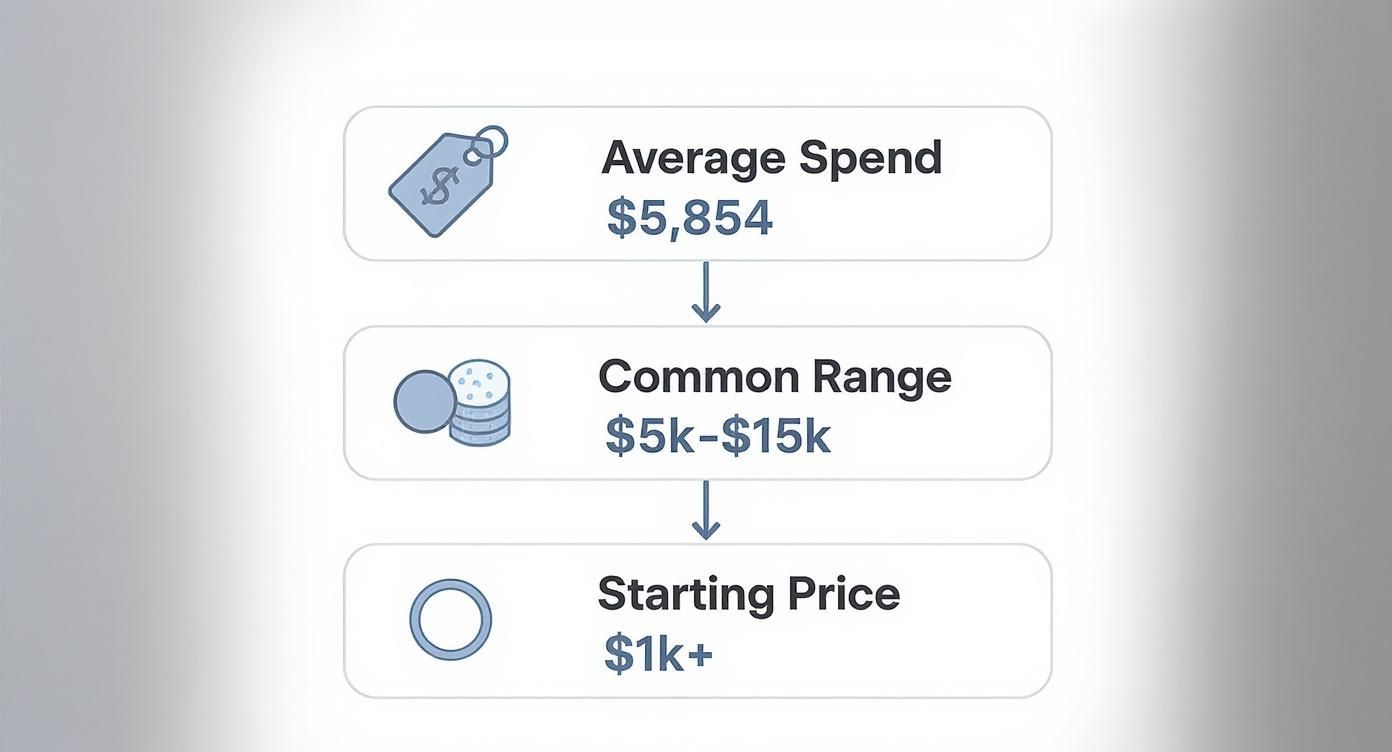
What this tells us is that while there are definitely luxury options out there, most couples make a smart, balanced decision, finding that perfect intersection of quality and affordability.
What Different Budgets Can Get You
So, what do those dollar figures actually translate to? Your budget is the main driver behind every detail of the ring, from the size and sparkle of the centre stone to the complexity of the band. It's not about spending more for the sake of it; it's about strategically putting your money toward the features you both value most.
To give you a clearer picture, I've broken down what you can realistically expect at different price points in the Australian market.
Australian Engagement Ring Budget Tiers at a Glance
This table shows what you can typically expect to find at different engagement ring price points in Australia, from entry-level options to premium bespoke designs.
| Budget Tier | Price Range (AUD) | What to Expect (Typical Features) |
|---|---|---|
| Entry-Level | $2,500 – $5,000 | Beautiful, understated rings. Often features a high-quality diamond under 0.75 carats, a larger moissanite, or other gemstones in a simple 14k gold solitaire setting. |
| Mid-Range | $5,000 – $15,000 | The most common tier. Opens up options for larger diamonds (around 1 carat), more intricate settings like halos or pavé bands, and premium metals like platinum. |
| Premium | $15,000 – $30,000 | Exceptional diamonds (1.5 carats+) with high grades in cut, colour, and clarity. Access to more elaborate custom designs and unique side stones. |
| High-End/Luxe | $30,000+ | The realm of truly bespoke, one-of-a-kind designs. Features large, rare, and exceptionally high-quality diamonds or gemstones from artisan jewellers. |
Ultimately, the best budget is one that lets you buy a ring you're both absolutely in love with, without causing any financial headaches down the road. Honest conversations and shared priorities are your best tools for getting this right.
So, you’ve probably heard the old rule of thumb: you should spend three months’ salary on an engagement ring. It’s one of those bits of "advice" that’s been floating around for ages, causing a whole lot of unnecessary stress for couples.
But have you ever wondered where that "rule" actually came from? The origin story isn't some nugget of ancient financial wisdom. It was actually cooked up by one of the most successful marketing campaigns in history.
This whole idea was the brainchild of De Beers, the company that for a long time had a near-monopoly on the world's diamond supply. Back in the 1930s, they launched a massive, decades-long campaign to convince everyone that a diamond ring was an essential part of getting engaged. As time went on, they got more specific, first suggesting one month's salary, then two, and finally landing on the now-infamous three-month figure.
A Sales Pitch, Not a Financial Plan
Let's be clear: this was never about what was best for a couple starting their life together. It was a clever sales tactic designed to do one thing—sell more, and more expensive, diamonds. It was high-pressure marketing dressed up as tradition.
The truth is, how much you spend on an engagement ring is an incredibly personal decision. It should be guided by your own financial reality, your shared goals, and what you both value—not a marketing slogan from the last century.
Following this outdated rule today can be more than just unnecessary; it can be downright irresponsible. For most modern couples in Australia, three months' salary is a huge chunk of cash. That’s money that could go towards a house deposit, the wedding itself, or simply building a secure future together. Kicking off a marriage with a significant debt just to live up to an old ad campaign is not what you’d call a solid foundation.
A Smarter Way to Think About Your Budget
Thankfully, couples today are ditching the myth. The conversation has shifted from "how much should I spend?" to "what makes sense for us?". The real goal is to find a ring that’s a beautiful symbol of your commitment, without derailing your financial health.
It’s about starting an open and honest conversation together. Ask questions like:
- What can we genuinely afford without getting into debt?
- What are our other major financial goals right now?
- What kind of ring actually means something to us, regardless of the price tag?
When you answer these questions as a team, you’re making a decision based on your unique story and shared future—not on a company's bottom line.
What Actually Determines an Engagement Ring's Price?
So, you've got a budget in mind. Now for the fun part: figuring out where that money actually goes. An engagement ring's final price tag isn't about one single thing; it’s a delicate balance of several key factors. Understanding them gives you the power to decide what truly matters to you.
Think of it like being the head chef for a signature dish. You choose the star ingredient—the steak, for instance—but the final flavour also depends on the quality of the supporting elements, like the sauce, the sides, and the seasoning. Each component influences the end result.
Getting a handle on these elements means you're in the driver's seat. You can choose to splurge on what you love and save on the things that are less important, ensuring you create the most beautiful ring possible within your budget.
The Famous 4Cs of a Diamond
For most rings, the centre stone is the main event. If it's a diamond, its value comes down to the legendary 4Cs: Cut, Colour, Clarity, and Carat weight. Getting to know these is your secret weapon for navigating the buying process.
-
Cut: This has nothing to do with the diamond's shape (like round or oval). Cut is all about how well the diamond’s facets have been angled to catch and reflect light. An expertly cut diamond explodes with sparkle, while a poorly cut one can look flat and lifeless, no matter how good its other stats are. Honestly, this is the most important 'C' because it's what makes a diamond truly brilliant.
-
Colour: For a white diamond, this grade actually measures the absence of colour. The scale runs from D (completely colourless) down to Z (light yellow). The trick here is that a diamond in the G-J range often looks perfectly white to the naked eye but comes with a much friendlier price tag than a top-tier D-F grade.
-
Clarity: This is all about purity. Clarity grades the tiny, natural imperfections found in a diamond, known as inclusions (inside the stone) or blemishes (on the surface). A "flawless" diamond is incredibly rare and expensive, but the good news is that many stones have inclusions you’d need a jeweller's loupe to see, offering phenomenal value.
-
Carat: This is simply the metric used to weigh the diamond. While a higher carat weight means a higher price, don't get too fixated on it. A well-cut diamond can look bigger and more impressive than a heavier diamond with a mediocre cut. It's a classic case of quality over quantity.
Beyond the Diamond: Natural vs Lab-Grown
These days, you're not just limited to diamonds pulled from the earth. The rise of lab-grown diamonds has opened up a whole new world of choice, with some serious benefits for your budget.
A natural diamond is a piece of ancient history, formed billions of years ago deep inside the Earth. A lab-grown diamond, however, is its identical twin, born in a high-tech facility. It has the exact same chemical, physical, and optical properties, but because its supply isn't finite, it can cost 20-40% less than a natural diamond of the same quality.
This choice is deeply personal. Some are drawn to the romance and rarity of a natural diamond. Others love the incredible value and modern innovation of a lab-grown stone. There's no right or wrong answer—just what feels right for you and your partner.
The Setting and Metal: The Supporting Cast
The centre stone may get the spotlight, but the setting and band play a huge part in the ring's overall look, feel, and final cost.
A classic, elegant solitaire setting is generally the most wallet-friendly choice, as its beauty lies in its simplicity. On the other hand, more elaborate designs like a halo setting (which frames the main stone with a circle of smaller diamonds) or a pavé band (where the band is literally "paved" with tiny diamonds) will add to the cost because of the extra gems and the intricate labour involved.
The precious metal you choose is also a key player:
- Platinum: The top-of-the-line option. It's naturally white, incredibly durable, and hypoallergenic, but it's also the most expensive.
- 18k Gold: A beautiful, popular choice with a high gold content that gives it a rich, warm lustre in yellow, white, or rose.
- 14k Gold: A fantastic all-rounder. It's slightly more durable than 18k gold due to its alloy mix and is also more affordable.
Here in Australia, all these variables mean that ring prices can vary wildly. The average spend often falls between $6,000 and $10,000. A 1-carat diamond ring, for example, could be anywhere from $6,000 to over $40,000, depending on how all these factors line up. Custom, hand-crafted rings reflecting an artisan's unique skill usually start from around $7,500. You can discover more insights about engagement ring costs in Australia to get a better sense of the local market.
How Australians Are Redefining Ring Value
There’s a quiet but powerful shift happening in how Aussies think about engagement rings. For generations, the conversation was all about size and status. Now, couples are asking different questions. It's less about "How big is the diamond?" and more about "What does this ring say about us?"
This change is incredibly freeing. It means couples are ditching outdated expectations and instead pouring their energy into things that actually matter to them, like craftsmanship, ethical sourcing, and genuine personal meaning. The value of a ring is now being measured by the story it tells, not just the numbers on its certificate.
Personalisation Over Price Tags
One of the clearest signs of this new mindset is the boom in bespoke and custom-designed rings. Couples are no longer passive buyers; they're becoming co-creators, deeply involved in designing a piece that reflects their unique journey. This might involve sourcing a rare gemstone, engraving a private joke, or sketching a setting from the ground up.
This isn’t just about getting something different. It’s about creating a true one-of-a-kind heirloom instead of buying something off the shelf. The ring transforms from a product into a tangible piece of a couple's history—a real celebration of their individuality.
What Aussies Are Actually Spending
Of course, even with all this focus on personal value, the numbers still matter. So, what’s the reality? Recent data shows the average spend on an engagement ring in Australia has climbed to around $7,000, up from just over $5,000 back in 2018.
The most common price bracket falls somewhere between $5,000 and $10,000. Delving a bit deeper, about a third of all buyers land in that $5,000–$7,500 sweet spot. If you want to get into the nitty-gritty, you can read more about current Australian spending trends.
What this really tells us is that there’s a massive comfort zone. There’s no single "right" amount to spend anymore. Australian couples are confidently choosing rings that fit their own financial situations and priorities, whether that’s $4,000 or $14,000.
This trend normalises making a smart, personal decision. It’s your reassurance that whatever path feels right for you is the right one.
The Rise of Conscious Choices
Another huge factor driving this change is a growing sense of responsibility. More and more, couples are asking the tough but important questions: Where did this diamond come from? What was the environmental cost?
This has led to a surge in popularity for more conscious options, including:
- Ethically Sourced Gemstones: Making sure that the stones are mined and cut under fair labour conditions and with respect for the environment.
- Lab-Grown Diamonds and Moissanite: These alternatives are not only beautiful and conflict-free but also have a much smaller environmental footprint.
- Vintage or Heirloom Rings: What could be more sustainable than giving a treasured family piece a new life? A ring with a history already built-in.
At the end of the day, modern couples are writing their own rules. The perfect ring has nothing to do with hitting a national average or following some dusty old marketing slogan. It's about finding a piece that genuinely and beautifully symbolises the beginning of your future together.
Smart Strategies to Get More Ring for Your Money
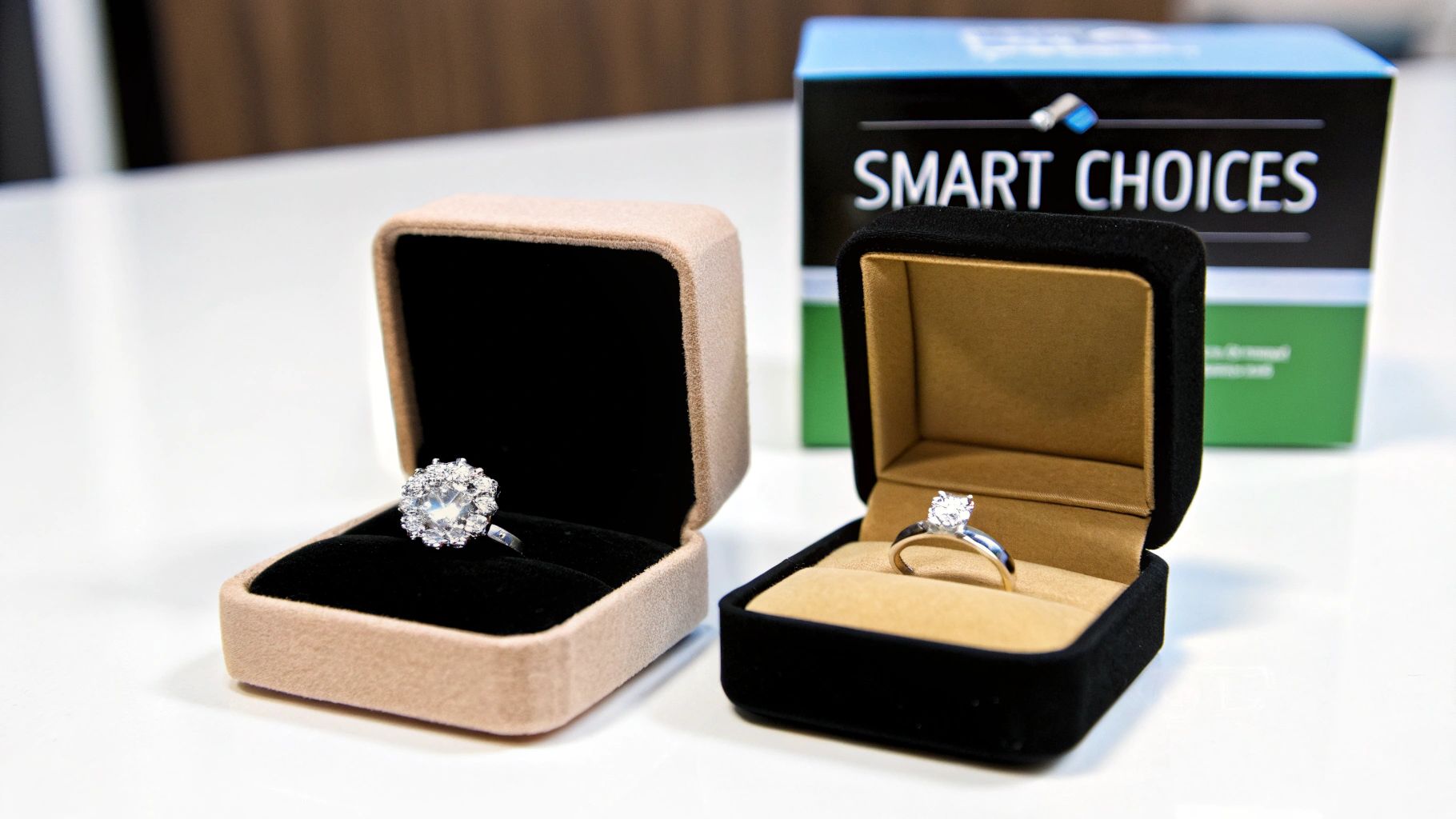
Knowing your budget is one thing, but making it work harder for you is where the real magic happens. Becoming a savvy ring shopper isn’t about having endless funds; it’s about understanding where the true value lies and putting your money into the details that make the biggest visual impact. You can absolutely get a breathtaking ring without the breathtaking price tag—it just takes a smarter approach.
These practical strategies will help you stretch every dollar, so you can walk away with a stunning piece that looks far more expensive than it was, all without adding any financial stress to this exciting time.
Embrace the Brilliance of Lab-Grown Diamonds
Without a doubt, one of the best ways to get more for your money is to choose a lab-grown diamond. Let's be clear: these are not "fakes." Lab-grown diamonds are physically, chemically, and optically identical to those pulled from the earth. The only thing that separates them is their origin story.
Because they are created in highly controlled environments, their supply isn’t at the mercy of geology, making them much more affordable. What does this mean for you? You could get a lab-grown diamond that is 20-40% larger or has noticeably better colour and clarity than a natural diamond for the very same price. It’s a fantastic way to prioritise that incredible size and sparkle without blowing your budget.
Play with Carat Weight to Your Advantage
Diamond prices don’t climb steadily. They jump, often dramatically, at certain "magic" carat weights—especially the full 1.0-carat mark. This pricing quirk creates a brilliant opportunity for savvy buyers.
Consider a diamond that's just shy of these popular sizes. For example, choosing a 0.90-carat stone instead of a 1.0-carat one can save you a significant amount of money, sometimes thousands of dollars. To the naked eye, the difference in size is completely unnoticeable, making this one of the smartest trade-offs you can possibly make.
Use Your Setting to Enhance the Centre Stone
The ring's setting is so much more than just a metal band. It’s your secret weapon for amplifying the beauty and perceived size of your centre stone. Some designs are absolute masters of illusion.
-
A Halo Setting: This popular style frames your main diamond with a circle of smaller ones. It does more than just add extra sparkle; it creates a much larger surface area of brilliance, making the centre stone look substantially bigger than it actually is.
-
A Slim Band: A delicate, slender band creates a beautiful contrast, making the centre stone pop and appear more prominent. The eye is naturally drawn to the diamond, making it the undeniable hero of the piece.
Think of the setting as the frame for a beautiful painting. The right frame doesn't just hold the art; it enhances its presence and directs your gaze, making the masterpiece feel even more impressive.
Protect Your Investment and Plan Ahead
Once you've found the one—the ring, that is!—there are two final steps that are absolutely crucial for your peace of mind: insurance and financing.
-
Get It Insured: An engagement ring is a huge investment, both financially and emotionally. Don't skip this step. Specialised jewellery insurance protects you from loss, theft, or damage, ensuring your symbol of love is secure.
-
Explore Financing Options: Many jewellers, including us here at Daniel Fine, offer financing plans that let you spread the cost out over time. This can make your dream ring much more attainable without needing all the cash upfront. Just be sure to find a plan with clear, favourable terms that fits comfortably into your monthly budget.
Your Budget, Your Story, Your Choice
So, let's bring this all back to what really matters. Figuring out how much to spend on an engagement ring isn't about chasing some magic number or meeting an arbitrary quota. It’s about finding a beautiful symbol that genuinely reflects your love story and fits comfortably within your financial reality.
Throughout this guide, we've dismantled the old, rigid 'rules' because, frankly, they deserve to be broken. They were dreamed up in a different era and simply don't make sense for modern couples who are partners in building a future together.
The most important thing is to carve out a path that feels right for both of you, free from the noise of outside pressure or outdated expectations.
Your Path Forward
The key takeaways here are simple but powerful. Talk openly with your partner about what you both actually value. Make sure this significant purchase aligns with your shared goals for the future, whether that’s saving for a house deposit, planning a big trip, or starting a family.
Above all, choose a ring that brings you both joy.
Remember, the true value of an engagement ring is measured in the meaning it holds, not the number on its price tag. The commitment and memories it represents are what's priceless.
You’re now ready to make a confident, informed decision—one that honours your relationship and respects your budget.
Common Questions About Ring Budgets
Working out the budget for an engagement ring can feel like walking through a minefield of questions. Let's clear the air and tackle some of the most common ones so you can feel confident moving forward.
Should We Go Into Debt for a Ring?
In a word: no. The last thing you want is to start your life together weighed down by a high-interest debt from the ring.
Think of the ring as a symbol of your future, not a financial anchor holding you back. Sticking to a realistic budget that you can actually afford is always the smartest move.
Is It Okay to Discuss the Budget with My Partner?
Yes, absolutely! We highly recommend it. The old tradition of a complete surprise is lovely, but it’s not the only way anymore.
Chatting openly about the budget makes sure you're both on the same page and happy with this significant purchase. When you approach it as a team, you're much more likely to find a ring you both adore and feel great about.
An engagement ring is one of the first major financial decisions you'll make as a couple. Handling it together sets a brilliant precedent for open communication and teamwork in your marriage.
Can We Upgrade the Ring Later?
Of course. Many couples choose a beautiful, more modest ring to start with and plan to upgrade it on a special anniversary down the track.
A "starter ring" is a wonderful way to celebrate your commitment right now while keeping your bigger financial goals in sight. Your love story will grow and change, and there's no reason your ring can't evolve with it.
At Daniel Fine, we're all about creating breathtaking, bespoke rings that tell your story without wrecking your finances. Let us help you design a piece that is as beautiful as it is attainable. Start your bespoke jewellery journey with us today.