Choosing an engagement ring can feel like a massive undertaking, but I've found it boils down to getting four things straight right from the start: your budget, your partner's personal style, the gemstone, and your timeline. Nail these, and what seems daunting becomes a genuinely exciting and confident journey.
Your Starting Point for Choosing the Perfect Ring
Stepping into the world of engagement rings is a huge moment—it’s a purchase that’s all about love, commitment, and the future you’re building together. But let's be honest, without a game plan, it’s easy to get lost in a sea of carats, cuts, and custom designs. This guide is here to give you a clear, practical path forward, turning any stress into pure excitement.
The very first step has nothing to do with looking at rings. It’s about building a solid foundation for your decision. Think of it as creating a roadmap before you start driving. By sorting out your core priorities upfront, you make every other choice that follows so much easier. It's the best way to ensure the final ring is not only stunning but also a perfect fit for your life together.
The Four Pillars of Your Ring Search
To kick things off, let's focus on four key areas that will guide your entire experience. Getting these right from the beginning saves a lot of time and second-guessing, and ultimately leads to a ring you'll both be thrilled with.
- Your Budget: The goal here is to land on a spending range that feels right for your financial situation. It’s time to forget those old, outdated rules about salary and focus on what you're genuinely comfortable with.
- Your Partner’s Style: This is where you become a detective. Look at the jewellery they already wear and love. Is it minimalist and modern? Or maybe more vintage-inspired and ornate? The perfect ring should feel like it was always meant to be theirs.
- The Gemstone Choice: Are you leaning towards a classic natural diamond? Or perhaps the brilliance of a lab-grown diamond or the unique colour of a sapphire or emerald? Knowing the pros and cons of each is crucial.
- A Realistic Timeline: A truly special, bespoke ring doesn’t happen overnight. From initial design to the final polish, the process takes time, so understanding this is key to planning a stress-free proposal.
By tackling these four pillars first, you’re not just buying a piece of jewellery; you’re thoughtfully creating a symbol that tells your unique story. This initial planning is, without a doubt, the most important step in the entire process.
To help you get organised, here's a simple framework to map out your initial thoughts.
Your Engagement Ring Decision Framework
This table is designed to help you clarify your thoughts on the four core areas before you even step into a showroom. It’s a great starting point for your first conversation with a jeweller.
| Key Area | What to Consider | Initial Goal |
|---|---|---|
| Budget | Your overall financial picture, savings, and what feels comfortable—not stressful. | Define a specific dollar range (e.g., $7,000 – $9,000). |
| Partner's Style | Their current jewellery, fashion choices, Pinterest boards, and any subtle hints. | List 3-5 keywords (e.g., "delicate," "vintage-inspired," "gold"). |
| Gemstone | Personal values (natural vs. lab-grown), desire for colour, and durability. | Decide on a top choice (e.g., lab-grown diamond) and a backup (e.g., moissanite). |
| Timeline | Your ideal proposal date minus the creation time (typically 6-12 weeks for custom). | Set a "ring-in-hand" deadline (e.g., early November). |
Taking a few moments to think through these points puts you in the driver's seat.
This structured approach means you can walk into a conversation with a jeweller—like our team here at Daniel Fine—with real clarity and confidence. You’ll know what to ask, what matters most to you, and how to work together to bring your vision to life. Let's start by digging a little deeper into setting a budget that works for you.
Figuring Out Your Engagement Ring Budget
Let’s get the money talk out of the way first. It's often the elephant in the room, but it’s the most important first step. The first thing to know? That old “three months’ salary” rule is completely dead. It was a marketing gimmick from decades ago, and it has absolutely no bearing on what you should spend today.
Your budget should be a number that feels right for you. It’s about celebrating your commitment, not starting your future together with a financial headache. The right budget is one that lets you find a stunning ring without derailing your other financial goals.
Forget the Rules, Find Your Comfort Zone
So, where do you start? Take an honest look at your finances. Think about your income, savings, and what you comfortably have set aside. Will you be paying for the ring outright, or are you considering finance options? There’s no right or wrong way, but having a clear picture is essential.
Instead of fixating on one exact number, I always advise clients to think in terms of a range. For example, maybe your sweet spot is somewhere between $6,000 and $8,000. This gives you breathing room when you start looking at different designs and stones, so you're not locked into a rigid figure.
The whole point is to find a budget that honours the moment without becoming a source of stress. A smart budget keeps the ring as a symbol of joy, not financial pressure.
When you know your financial boundaries, the whole process becomes so much more enjoyable. You can focus on finding the most beautiful ring within your means, turning what could be an overwhelming experience into an exciting one.
What Aussies Are Actually Spending
It can be helpful to get a sense of what other people are doing, not as a rule to follow, but just for context. In Australia, the numbers are all over the map, which just goes to show how personal this decision is.
A 2022 analysis found that 19% of buyers spent under $1,000, while a solid 14% landed between $5,000 and $7,499. At the top end, just 2% of couples went over $20,000. Perhaps the most interesting stat is that 46% of buyers spent more on their engagement ring than their first car. If you're curious, you can dig into more of these Australian engagement ring statistics.
This data just proves that people are making choices that fit their own lives and priorities.
How Your Choice of Stone Impacts the Price
The centre stone is, without a doubt, the biggest factor in the final cost of your ring. This is where you can be really clever with your budget.
- Natural Diamonds: The classic choice. Mined from the earth, their price reflects their rarity and the journey they take to get to you.
- Lab-Grown Diamonds: These are the real deal—chemically and visually identical to natural diamonds—but grown in a controlled environment. Because of this, they offer incredible value, often coming in at 30-50% less than a natural diamond of the same size and quality.
- Moissanite & Other Gemstones: Moissanite is a phenomenal stone with even more fire and sparkle than a diamond, and it's significantly more affordable than both natural and lab diamonds. Coloured gems like sapphires, rubies, or emeralds are also fantastic alternatives that can give you a lot of bang for your buck.
Being open-minded about your centre stone can make a world of difference. You could get a much larger or higher-quality stone for your money, which is a key part of learning how to choose an engagement ring that’s both beautiful and budget-savvy.
Navigating Your Diamond and Gemstone Choices
The centre stone is truly the heart and soul of an engagement ring. It’s what first catches the eye, what tells a piece of your story, and ultimately, what defines the ring’s entire character. While a classic diamond is undeniably timeless, the world of gemstones is vast and exciting, offering a perfect match for every personality, value, and budget. Knowing your options is the first step to choosing a stone you'll both cherish for a lifetime.
Deciding on the right stone is about more than just what looks good; it's about understanding the unique personality of each option. From the unmatched fire of a diamond to the deep, royal blue of a sapphire, every stone brings something special to the table. Let's walk through the most popular choices so you can feel clear and confident in your decision.
Decoding the Diamond 4Cs
As you start exploring how to choose an engagement ring, you'll constantly hear about the 4Cs: Cut, Colour, Clarity, and Carat. This grading system, established by the Gemological Institute of America (GIA), is the universal language for describing a diamond's quality.
Here’s what each 'C' really means for you:
-
Cut: This has nothing to do with the diamond's shape (like round or oval). Instead, it’s all about how well the diamond’s facets have been angled and proportioned to interact with light. An Excellent cut grade is non-negotiable if you want a brilliant, sparkling stone. In our experience, it's the single most important factor for a diamond's beauty.
-
Colour: This grades the absence of colour in a white diamond, on a scale from D (completely colourless) to Z (light yellow or brown). For fantastic value, we often guide clients towards diamonds in the G-H range. To the naked eye, they appear beautifully white but come at a much friendlier price point than D-F diamonds.
-
Clarity: This measures the tiny, natural imperfections within a diamond, known as inclusions. The great news is that most diamonds down to a VS2 (Very Slightly Included 2) grade are "eye-clean," meaning you can't spot any flaws without a jeweller's loupe.
-
Carat: This is simply a measure of the diamond's weight, not its physical size. A well-cut diamond can actually appear larger than a heavier, poorly cut one. Here’s a pro tip: prices often jump significantly at "magic sizes" like 1.00 carat. Choosing a 0.95-carat diamond can give you a nearly identical look for a much better price.
If there's one piece of advice to take away, it's this: prioritise an Excellent cut above all else. A beautifully cut diamond with a slightly lower colour or clarity grade will always outshine a poorly cut stone with otherwise flawless specs.
This infographic helps simplify the modern approach to ring budgeting, steering you away from outdated rules and towards what really matters for you as a couple.
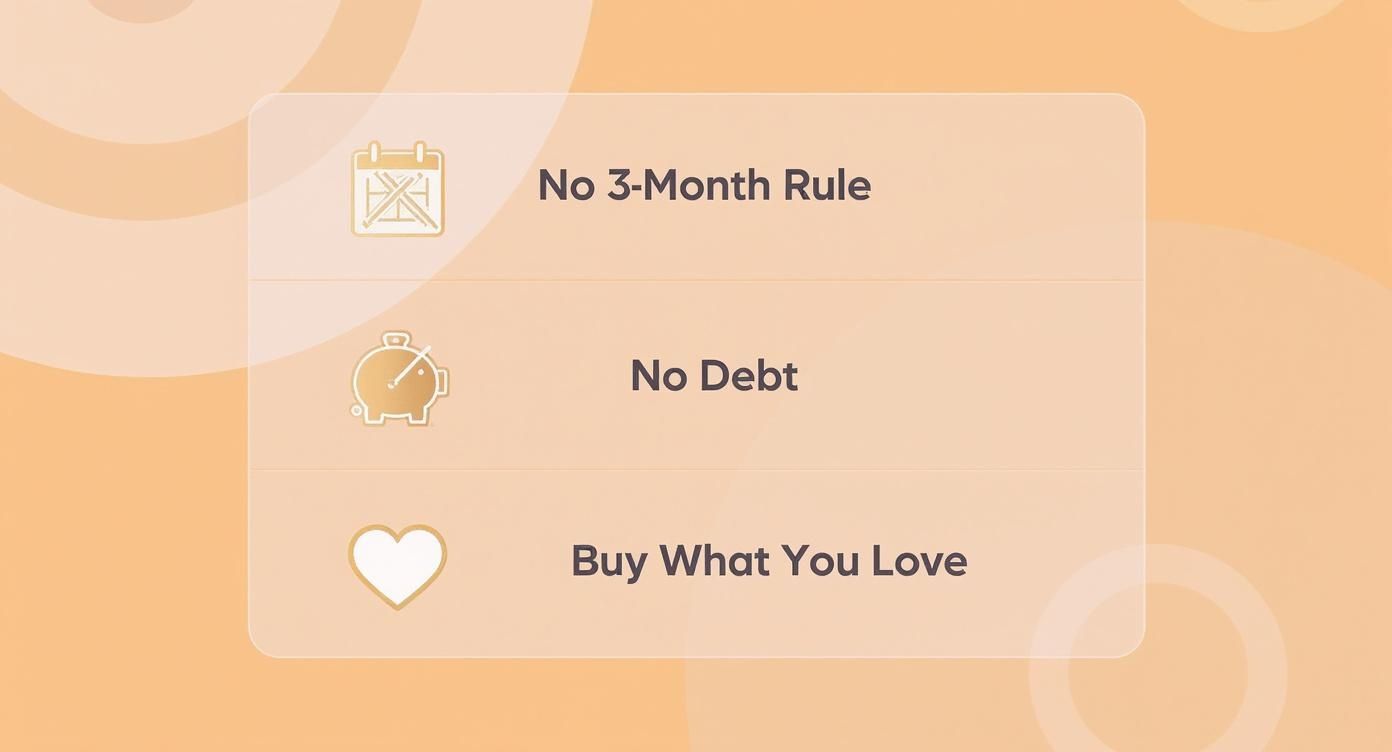
Ultimately, the best financial decision is one made with love and personal comfort in mind, not societal pressure.
Natural Diamond vs Lab-Grown Diamond vs Moissanite
One of the biggest conversations we have with clients today is about the centre stone's origin. The choice between a diamond mined from the earth, one created in a lab, or a moissanite often comes down to personal values, budget, and priorities.
To make things clearer, here’s a straightforward comparison of the three most popular options.
| Feature | Natural Diamond | Lab-Grown Diamond | Moissanite |
|---|---|---|---|
| Origin | Mined from the Earth, formed over billions of years. | Created in a lab using advanced technology. | Lab-created silicon carbide gemstone. |
| Composition | Pure carbon. | Pure carbon. | Silicon carbide (SiC). |
| Brilliance | High (Refractive Index: 2.42) | High (Refractive Index: 2.42) | Exceptional (Refractive Index: 2.65-2.69) |
| Hardness | 10/10 on the Mohs scale. The hardest natural substance. | 10/10 on the Mohs scale. Identical to natural. | 9.25/10 on the Mohs scale. Extremely durable. |
| Cost | Highest price point. Considered a traditional investment. | Typically 30-50% less than a natural diamond of the same quality. | Most affordable. Priced per millimetre, not carat weight. |
| Best For | The traditionalist who values rarity and natural origin. | The modern couple seeking value, size, and a guaranteed conflict-free origin. | The buyer who prioritises maximum sparkle and size for their budget. |
Each stone has its own story and appeal. Natural diamonds are geological marvels, carrying the romance of their ancient, earthly origins. Lab-grown diamonds are physically and optically identical to their natural counterparts—the only difference is where they were born. This makes them a fantastic, sustainable option that offers more size for your budget. Finally, moissanite is its own unique gemstone, beloved for its fiery, rainbow-like sparkle that outshines even a diamond.
Ultimately, there's no "right" or "wrong" choice here—only the one that feels right for you.
Exploring Beautiful Gemstone Alternatives
While diamonds get most of the spotlight, a whole world of vibrant and durable gemstones is waiting to be discovered. Opting for a coloured gemstone is a wonderful way to express individuality and can offer incredible value.
Moissanite: The Brilliant Contender
If sparkle is at the very top of your priority list, you have to consider moissanite. This stunning, lab-created gemstone is famous for its exceptional fire and brilliance—it actually has more rainbow flash than a diamond. It scores a 9.25 on the Mohs scale of hardness (a diamond is a perfect 10), which makes it incredibly durable and perfectly suited for an everyday ring. Best of all, moissanite is just a fraction of the cost, meaning you can get a much larger, show-stopping stone for your budget.
Sapphires: A Royal and Resilient Classic
Made iconic by royalty, sapphires are a timeless and sophisticated choice. Known for their mesmerising deep blue hue, they symbolise wisdom and faithfulness, making them a beautiful sentiment for an engagement ring. Sapphires are also exceptionally tough, rating a 9 on the Mohs scale. While blue is the classic, they come in a whole spectrum of other colours—like pink, yellow, teal, and green—offering endless possibilities for a truly personal design.
Finding the Perfect Setting and Metal
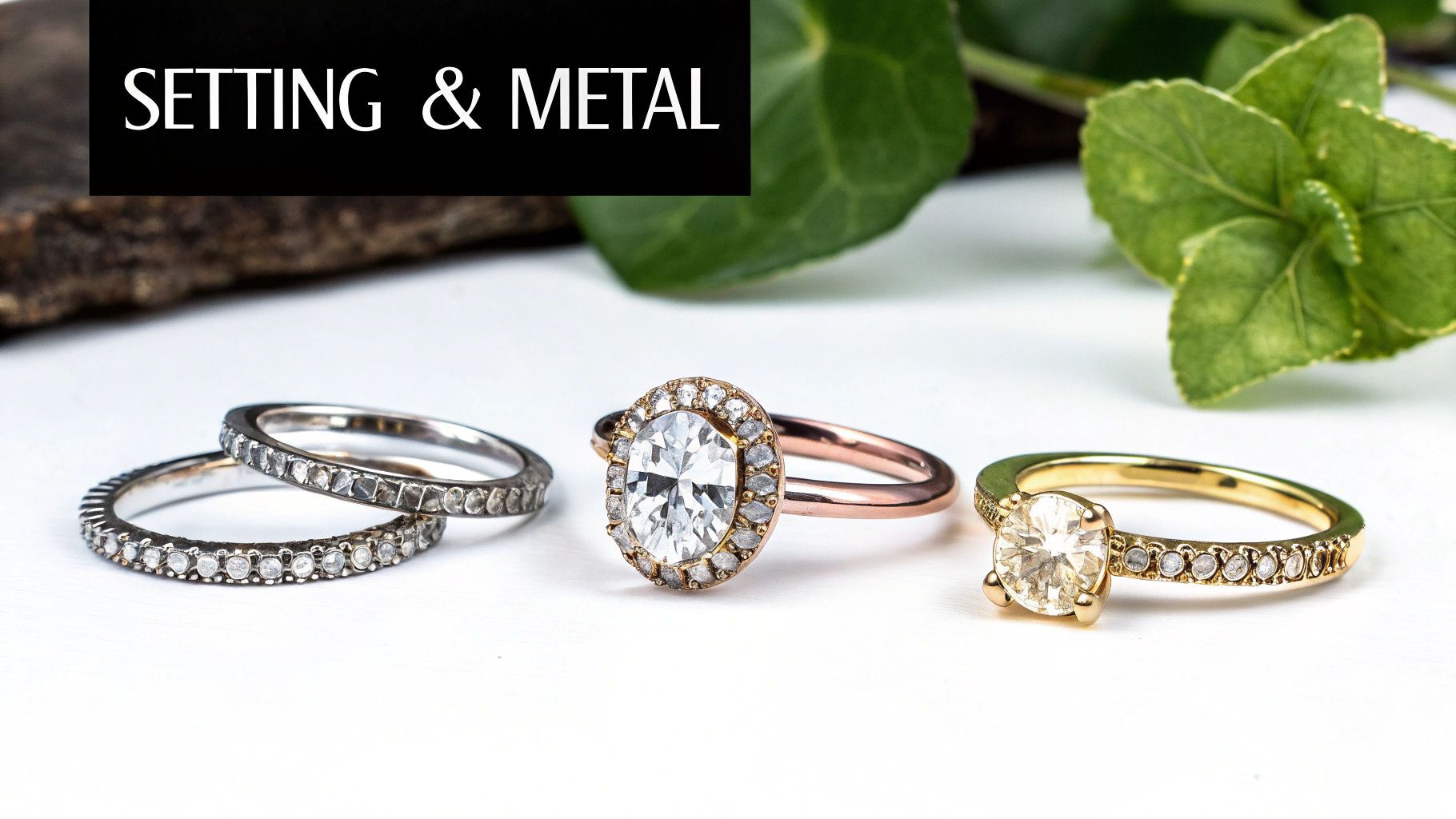
Alright, so you’ve got a good idea of the kind of centre stone you want. Now comes the fun part: building the framework that will make it sing. The setting and the metal aren't just there to hold the gem in place; they're what give the ring its soul and its entire personality. This is where you get to amplify the stone's brilliance and truly capture your partner's style.
Think of it this way: a great setting can make a diamond look bigger, brighter, and more impressive. The metal choice then sets the mood—from the cool, contemporary feel of platinum to the classic, warm glow of yellow gold. Let's dig into how to choose a combination that's not only gorgeous but also built to last a lifetime.
Choosing a Setting Style
The setting is what defines the ring's overall look. It can be a minimalist solitaire that's all about the diamond, or an elaborate halo that brings the sparkle. Each style tells a completely different story.
- The Solitaire: This is the icon, the quintessential engagement ring. A single, stunning stone held up by prongs (usually four or six) makes the diamond the undisputed star. It’s elegant, timeless, and designed to let the maximum amount of light hit the stone for breathtaking sparkle.
- The Halo: For those who believe more is more, a halo is the answer. It encircles the main stone with a ring of smaller pavé diamonds. Not only does this add an incredible layer of fire and brilliance, but it also creates the illusion of a much larger centre stone—a seriously high-impact look.
- The Three-Stone: This one is packed with meaning. A central gemstone is flanked by two smaller ones, representing a couple’s past, present, and future. It’s a deeply romantic choice and gives the ring a substantial, eye-catching presence on the finger.
A quick word of advice: The right setting is a balance of beauty and practicality. Think about your partner's lifestyle. If they're very active or work with their hands, a lower-profile bezel setting might be a safer bet than a high-set cathedral style.
Lately, we’ve seen a wonderful trend emerge in Australia, with a huge resurgence of vintage and antique-inspired designs. Couples are looking for something unique, and Art Deco styles with their bold, geometric lines or delicate Victorian filigree are hitting the mark. These are often paired with unique cuts like emerald or old European to really lean into that heritage feel. You can see more about these Australian engagement ring trends here. It’s a beautiful way to create a ring that feels both personal and completely timeless.
Selecting the Right Metal
The metal of the band is the foundation. It dictates the ring’s colour, how durable it is, and how much care it will need down the road. Each option has its own unique character.
Platinum and White Gold
At first glance, platinum and white gold look almost identical. Both offer that sleek, silvery-white finish that makes colourless diamonds pop. Platinum is the premium choice; it's a naturally white metal, incredibly durable, and hypoallergenic. White gold is pure gold mixed with white alloys and then plated with rhodium to get that bright white sheen. It’s a very popular and fantastic alternative, but just know it’ll need to be re-plated every few years to stay looking its best.
Yellow and Rose Gold
For a warmer, more traditional vibe, you can’t go past yellow gold. It’s a timeless classic with a rich hue that creates a stunning contrast, especially with diamonds in the G-J colour range. Rose gold has a romantic, pinkish tint that's become incredibly popular for its soft, almost vintage feel. Both are brilliant choices and look great on a wide variety of skin tones.
Here’s a quick rundown to help you compare:
| Metal | Durability | Colour & Look | Maintenance | Best For |
|---|---|---|---|---|
| Platinum | Extremely strong and dense. | Naturally bright, silvery-white. | Low; develops a natural patina over time. | Those with sensitive skin who want maximum durability. |
| White Gold | Very durable, but slightly less dense than platinum. | Bright white due to rhodium plating. | Requires re-plating every 2-3 years. | A classic, modern look at a more accessible price point. |
| Yellow Gold | Softer than platinum, durability depends on carat (18ct vs 14ct). | Classic, warm, rich yellow. | Minimal; polishing as needed to remove scratches. | A timeless, traditional aesthetic that enhances warmer skin tones. |
| Rose Gold | The copper alloy makes it surprisingly durable. | Soft, romantic, pinkish hue. | Low; its colour is stable and won't fade. | A unique, modern-vintage style that is universally flattering. |
Ultimately, bringing the setting and metal together is about creating a single, cohesive design that feels perfect for the person wearing it every day. This is the moment where all your thoughtful research pays off in a ring that’s a true reflection of them.
Uncovering Your Partner’s Ring Style
Let’s be honest, the "perfect" ring isn't just about the diamond or the price tag. The most breathtaking ring is the one that looks like it was created just for them, a piece that perfectly captures their personality. Getting this right isn’t about mind-reading; it's about becoming a bit of a detective. Your mission is to piece together the clues without blowing the surprise.
The easiest place to start is with the jewellery they already wear every day. Take a look. Is their collection full of fine, delicate pieces, or do they lean towards chunky, statement jewellery? Pay attention to the metal colour they favour. Are they strictly a yellow gold person, or do they mix it up with silver-toned metals like white gold or platinum? This is your first and best clue.
Become a Style Detective
To really nail their taste, you'll need to look beyond their current jewellery collection and consider their broader aesthetic. How they decorate their home, the art they love, the clothes in their wardrobe—it all tells a story.
- Listen for the little hints. People drop clues all the time, often without even realising it. They might casually mention a friend’s new ring or point something out in a shop window. These off-the-cuff comments are pure gold.
- Look at their wardrobe. If their style is all clean lines and minimalist colours, they’ll probably love a sleek, modern design like a solitaire on a simple band. On the other hand, if they're drawn to vintage fashion with lots of lace and intricate details, an antique-inspired setting might be the way to go.
- Do some social media sleuthing. You'd be surprised how many people have a not-so-secret Pinterest board titled "Dream Ring" or something similar. A quick, quiet scroll through their saved posts on Instagram or Pinterest can give you a very clear picture of the styles they've bookmarked.
When you pay attention to these parts of their life, you’re no longer just picking out a ring. You’re choosing a piece of jewellery that says, "I see you." That’s the feeling you want them to have when they open that little box.
Don't be afraid to bring in an accomplice. A trusted friend or sibling can be your secret weapon. They can casually bring up the topic, suggest "window shopping" for fun, or even ask direct questions without you ever being implicated. This is how you get invaluable inside information while keeping the whole thing under wraps.
Nailing the Ring Size on the Sly
Once you've got a good feel for their style, you've hit the final hurdle: the ring size. This can be the trickiest part of the surprise, but there are a few clever ways to figure it out.
By far the most reliable method is to "borrow" a ring they already wear on the correct finger and take it to a jeweller. If they don't have a ring for that specific finger, one they wear on their middle finger can also work; a good jeweller can make a pretty accurate estimate from there.
If sneaking a ring away feels too risky, here are a few other tricks:
- Trace it. When they're not looking, grab one of their rings, place it on a piece of paper, and carefully trace the inside and outside of the band with a sharp pencil. A jeweller can often work out the size from a precise drawing.
- Use a friend. Ask their best friend to suggest they try on rings together while out shopping. The friend can get their own finger sized and subtly find out your partner’s size in the process.
- Compare it to your own finger. If you have similarly sized hands, you can slip on one of their rings and just make a mental note of where it sits on your own finger.
With these style notes and sizing tricks, you're in a great position to choose a ring that’s not just beautiful, but deeply and personally theirs.
Working with a Jeweller and Finalising the Details
https://www.youtube.com/embed/AXEndi5xcE4
You've done the hard yards with your research, and now for the really exciting part: turning all those ideas into a tangible symbol of your love. This is where you bring in an expert to help pull everything together. Honestly, choosing the right jeweller is just as important as picking the perfect diamond.
Working with a bespoke jeweller, like our team at Daniel Fine, is a completely different world from buying a ring from a display case. A bespoke process isn't a transaction; it's a partnership. We go on a collaborative journey where your vision, your budget, and your partner's unique style become the blueprint for a ring that's truly one-of-a-kind.
You’re not limited to what's already in stock. Instead, you're an integral part of the creation process, which means every last detail is just how you imagined it. That personal touch and dedication to craftsmanship are what make a custom ring feel so incredibly special.
How to Choose a Reputable Jeweller
Finding a jeweller you can trust is absolutely essential. You’re not just buying a piece of jewellery; you’re placing your confidence in their expertise, their ethics, and their ability to bring your vision to life. A great jeweller is your guide, making the whole process feel clear and exciting, not overwhelming.
Here’s a quick checklist of what to look for:
- Transparency and a passion for education: They should genuinely enjoy answering your questions and explaining things like the 4Cs without making you feel pressured.
- GIA Certifications: Insist on GIA-certified diamonds. It’s the undisputed gold standard for quality and objective grading in our industry.
- Clear ethical sourcing policies: A good jeweller will be upfront about their commitment to conflict-free diamonds and responsible sourcing for all their materials.
- Glowing reviews and a strong portfolio: Look for real-world testimonials that talk about their craftsmanship, attention to detail, and customer service.
Choosing a jeweller is a bit like choosing a wedding photographer; you need to trust their artistic vision and feel a genuine connection with them. It ensures the final piece isn't just a ring, but a story you’ve built together.
This decision has a huge impact on the final quality and the sentiment behind your ring. It's interesting to see how tastes are changing, too. For example, on average, Australians now spend around $7,000 on an engagement ring, which is a big jump from just over $5,000 back in 2018. This trend really points to a growing desire for higher-quality, ethically made jewellery. In fact, about 8% of people are now investing over $15,000 for premium, custom-designed pieces. You can read more about these Australian engagement ring spending trends to get a feel for the market.
Timelines, Insurance, and Aftercare
Once you’ve found your jeweller, it’s time to nail down the final logistics. Getting a handle on the timeline for a custom ring is vital for planning your proposal, so don’t leave this conversation to the last minute. The creation process, from the first design chat and 3D mock-ups to the final casting and stone setting, can take anywhere from 6 to 12 weeks.
With the ring finished, the very next step is protecting it. Getting your engagement ring insured is non-negotiable—it’s the only way to have complete peace of mind against loss, theft, or damage. Your jeweller can usually recommend a specialist insurance provider, or you might be able to add it to your existing home and contents policy.
And finally, always ask about aftercare. A reputable jeweller will be proud to offer complimentary cleaning and regular inspections to make sure your ring stays as brilliant as the day you proposed.
Have a Few Lingering Questions?
It's completely normal to have a few last-minute questions as you get ready to make the final call. After all, this is a huge decision! Let's clear up some of the most common things we get asked about.
How Can I Find Out Their Ring Size Without Giving Away the Surprise?
This is probably the number one worry we see, and for good reason! Getting the size right while keeping the proposal a secret can feel like a spy mission.
The absolute best way is to discreetly "borrow" a ring they wear on their ring finger and have a jeweller measure it. If they don't wear a ring on that finger, one from their middle finger is your next best bet – it'll get you very close.
If sneaking a ring out feels too risky, here are a couple of other tricks:
- The Trace Method: When they're not around, place one of their rings on a piece of paper. Use a very sharp pencil to trace the inside of the ring. It’s surprisingly accurate.
- Call in a Friend: Ask one of their close friends to orchestrate a casual shopping trip. They could suggest popping into a jewellery store "just for fun" and getting their fingers sized.
What's the Real Difference Between 18ct and 14ct Gold?
Great question. The "ct" (carat) tells you how much pure gold is in the metal.
18ct gold is 75% pure gold. This higher purity gives it that beautiful, rich, deep colour that people associate with classic gold jewellery.
14ct gold, on the other hand, is 58.3% pure gold, with the rest being a mix of stronger alloys. This makes the metal a bit harder and more resistant to dings and scratches from daily wear, though the colour is slightly less intense. The right choice really depends on balancing that lustrous colour against your partner's lifestyle.
Are lab-grown diamonds real diamonds? Yes, absolutely. Lab-grown diamonds are chemically, physically, and visually identical to natural diamonds. The only difference is their origin—one formed deep within the Earth, the other created in a controlled environment. They are a fantastic, often more affordable and sustainable, alternative.
Bringing your vision to life is our specialty. At Daniel Fine, we guide you through every question and detail to create a bespoke ring that tells your unique story. Start your custom design journey with us today.