Choosing between moissanite and a lab-grown diamond really comes down to one simple thing: what kind of sparkle speaks to you? Moissanite is known for its incredible, fiery rainbow brilliance, a dazzling display of colour that catches the eye. On the other hand, a lab-grown diamond is chemically identical to a mined diamond, offering that classic, crisp white sparkle and unmatched durability for those who value tradition.
An Overview of Moissanite and Lab Diamonds
When we're designing a bespoke piece here at Daniel Fine, understanding the essence of your centre stone is the first step. While both are fantastic, ethically-conscious alternatives to mined diamonds, it’s important to know they aren't the same. They are entirely different gemstones, each with its own unique personality.
A lab-grown diamond is pure carbon, a perfect mirror of a natural diamond in every conceivable way—from its atomic structure to the way it handles light. Moissanite, which is made from silicon carbide, is a completely distinct gem celebrated for its exceptional fire and vibrant flashes of colour.
Moissanite vs Lab Diamond At a Glance
To make things a little clearer, here’s a quick side-by-side look at the most important factors that set these two stones apart.
| Attribute | Moissanite | Lab Diamond |
|---|---|---|
| Composition | Silicon Carbide (SiC) | Carbon (C) |
| Brilliance | Intense, fiery rainbow sparkle | Strong, crisp white light sparkle |
| Hardness | 9.25 on the Mohs Scale | 10 on the Mohs Scale |
| Price | Significantly lower per carat | More affordable than natural diamonds but more expensive than moissanite |
| Origin | Lab-created | Lab-created |
This snapshot helps frame the decision, but the real story is in the details of how each stone behaves and feels in a piece of jewellery.
This image from Wikipedia shows the unique hexagonal crystal structure of moissanite.
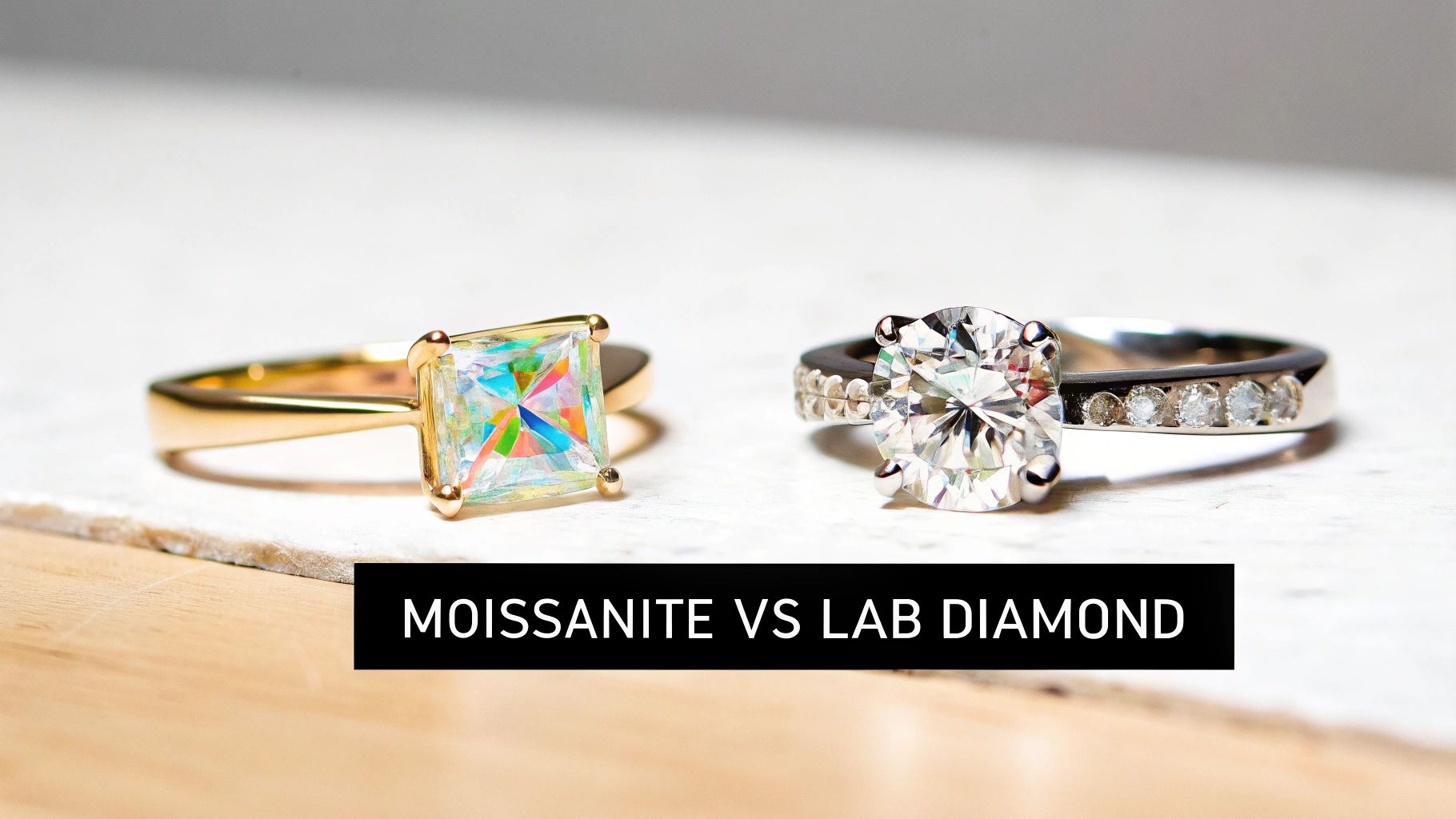
It’s this very structure that causes moissanite’s signature double refraction. This optical property splits light into two rays, creating those vivid, rainbow-like flashes that are so different from the clean, single refraction of a diamond.
Key Takeaway: The choice isn't about which stone is "better"—it's about which one fits you. Do you lean towards the dynamic, colourful fire of moissanite, or does the timeless, icy brilliance of a lab diamond better reflect your personal style?
Think of this as your starting point. Now, we’ll dive deeper into the nuances of sparkle, durability, and long-term value to give you all the information you need to choose the perfect stone for your custom jewellery.
Where Do These Gemstones Come From?
To really get to the heart of the moissanite vs. lab diamond debate, we have to start with what they actually are. They might both be beautiful, lab-created stones, but they aren't the same thing at all. Their unique origins are what define everything about them, from how they sparkle to how they feel on your finger.
A lab-grown diamond is, for all intents and purposes, a real diamond. It’s made of the exact same stuff as a mined diamond—pure, crystallised carbon. The only thing that separates them is how they were made.
Instead of taking billions of years to form under the Earth's crust, scientists have figured out how to recreate that intense environment in a lab. They use highly advanced methods like High-Pressure High-Temperature (HPHT) or Chemical Vapour Deposition (CVD) to grow a diamond crystal from a tiny diamond "seed."
- HPHT basically copies nature’s recipe, using massive pressure and heat to crystallise carbon.
- CVD is a bit different; it involves layering carbon atoms from a gas onto the seed in a vacuum chamber.
What you get at the end is a stone that's physically, chemically, and optically identical to a natural diamond. There's no difference.
The Cosmic Story of Moissanite
Moissanite is a whole different ball game, with a pretty cool backstory. It’s made of silicon carbide (SiC) and was first found back in 1893 by a French chemist, Dr. Henri Moissan, inside a meteor crater. He thought he’d stumbled upon diamonds, but quickly realised it was a completely new mineral from outer space.
Natural moissanite is ridiculously rare—we’re talking microscopic crystals found in meteorites and a handful of unusual rock types. So, every piece of moissanite you see in jewellery today is created in a lab. The process involves growing large silicon carbide crystals using a patented thermal method, which are then expertly cut and polished into the finished gem.
Because it’s made from silicon carbide, moissanite has a completely different crystal structure to a diamond. This is the science behind its signature, fiery rainbow sparkle that so many people love.
A Growing Australian Preference
The fact that we can now create such incredible gems in a lab has completely changed the game, especially here in Australia where shoppers are savvy about ethics and value. The demand for lab-grown diamonds, in particular, has absolutely skyrocketed locally.
This isn't just an Aussie trend; it's happening worldwide. The lab-grown diamond market is expected to hit a staggering AU$90 billion by 2032, which shows a massive shift in how we think about luxury. You can read more about this market shift to see just how much consumer attitudes are reshaping the industry. The rising popularity of both lab diamonds and moissanite really points to a shared desire for beautiful, ethical, and smart choices in fine jewellery.
Comparing Sparkle, Fire, and Brilliance
When you're choosing the centre stone for a bespoke piece, the way it plays with light is often what captures your heart. This visual performance—its sparkle, fire, and brilliance—is where the personalities of moissanite and lab-grown diamonds really come to life. It's not a question of which one is "better," but rather which kind of beauty resonates with your personal style.
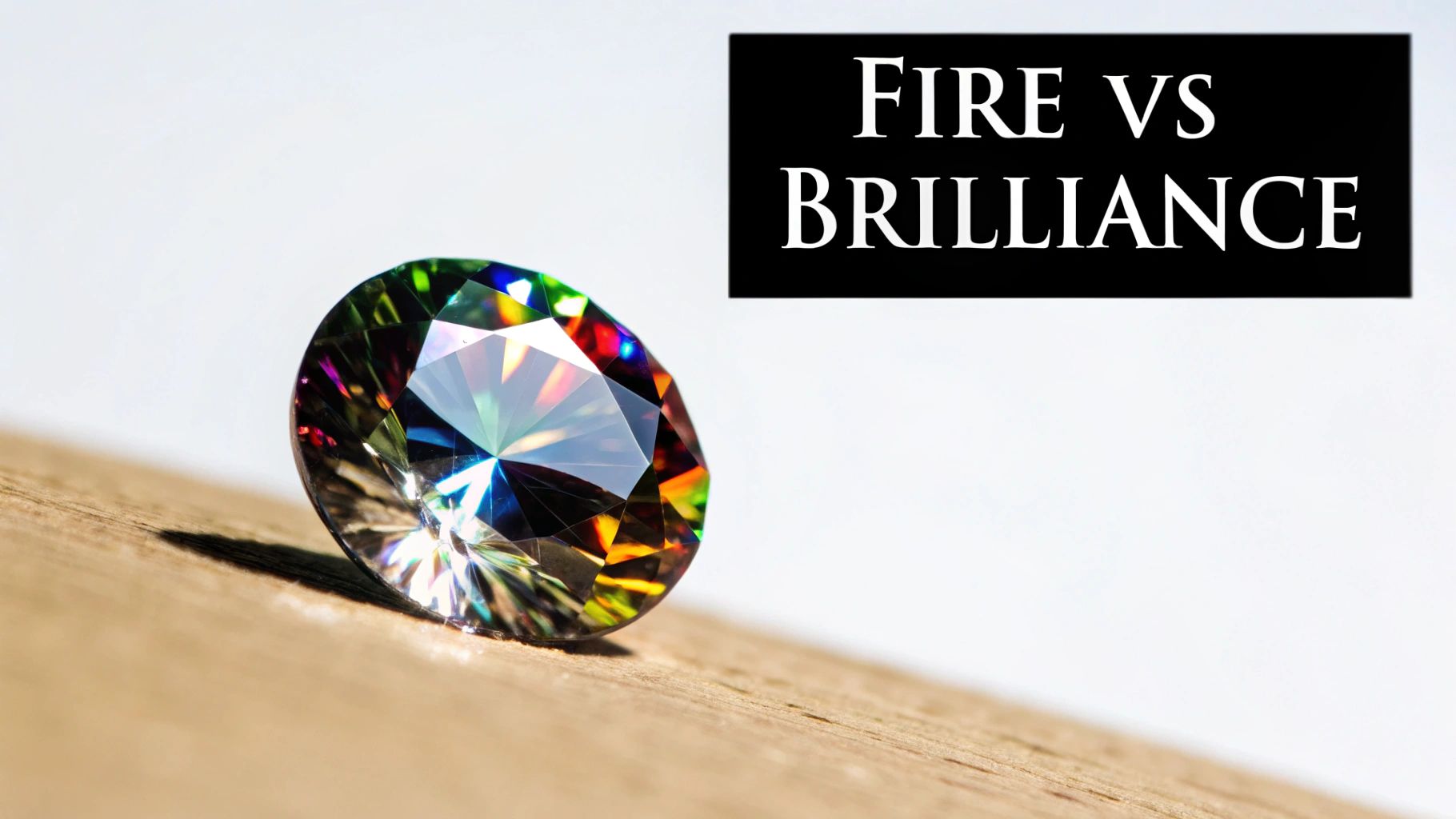
Lab-grown diamonds are adored for their balanced and sophisticated light return. Their sparkle is a beautiful blend of brilliance (the white light that reflects back), fire (the flashes of colour), and scintillation (the play of light you see as the stone moves). A well-cut lab diamond gives off a crisp, almost icy display that feels timeless and classic.
Moissanite, however, is a different story altogether. Thanks to its unique silicon carbide composition, it has a much higher refractive index (2.65–2.69) compared to a diamond’s 2.42. This single technical detail is the secret behind its legendary fire.
Moissanite: The Fiery Rainbow Effect
Moissanite is famous for an intense, fiery sparkle that's often described as a "disco ball" effect. Because it's doubly refractive, it splits any beam of light entering the stone into two, creating an incredible display of rainbow colours. You'll really notice this in direct sunlight or under the focused spotlights of a restaurant, where it throws off vibrant, colourful flashes.
If you love a bold, eye-catching stone that demands attention, the intense fire of moissanite is a perfect match. It has a dazzling, lively appearance that’s as beautiful as it is distinct.
The most obvious difference is that moissanite’s fire is far more pronounced than a diamond's. While a diamond produces elegant flashes of colour, moissanite creates a dramatic, expansive rainbow sparkle that is impossible to miss.
Lab Diamond: The Classic White Brilliance
In contrast, a lab-grown diamond offers a more refined and traditional sparkle. Being singly refractive, it manages light with clean, sharp precision. The result is that classic, balanced interplay between bright white light (brilliance) and coloured flashes (fire).
This is what gives lab diamonds their signature look: a crisp, bright, and deeply scintillating sparkle that so many of us associate with the classic engagement ring. If you value a timeless aesthetic and prefer a stone that gives off brilliant white flashes with subtle pops of colour, a lab diamond is your ideal choice.
Here’s a simple way to think about their light performance:
- Moissanite: Known for its exceptional fire. It produces intense, broad-spectrum rainbow flashes. Its brilliance is high, but the colourful sparkle is what really defines its character.
- Lab Diamond: Celebrated for its balanced brilliance. It offers a crisp return of white light, punctuated by more subtle, delicate flashes of fire.
Ultimately, your choice comes down to the visual story you want your jewellery to tell. Do you lean towards the dynamic, colourful light show of a moissanite, or the elegant, classic brilliance of a lab-grown diamond? At Daniel Fine, we're here to help you select the stone whose sparkle truly speaks to you, ensuring your custom piece is a perfect reflection of who you are.
Tough Enough for a Lifetime: Durability for Daily Wear
An engagement ring isn’t just for special occasions; it’s on your hand through everything. From carrying groceries to typing at a desk, it has to stand up to daily life. This is where durability becomes one of the most important factors in your decision. Thankfully, both moissanite and lab-grown diamonds are incredibly tough, but there are some nuances to understand for your long-term peace of mind.
We measure gemstone hardness using the Mohs scale, a simple 1-to-10 ranking of scratch resistance. A lab-grown diamond is a perfect 10 on the Mohs scale because it's chemically identical to a natural one. It’s quite literally the hardest substance on Earth, meaning it offers the best possible defence against scratches.
What Does the Hardness Difference Mean in Real Life?
Moissanite comes in at a very respectable 9.25 on the Mohs scale. This score puts it right near the top of the list, second only to diamond itself. In practical terms, moissanite is more than capable of handling the bumps and scrapes of everyday life without getting scratched by things like keys or granite benchtops.
So, what’s the real-world impact of that tiny 0.75 difference?
- Lab Diamond: It's essentially scratch-proof. The only thing that can reliably scratch a diamond is another diamond, giving you the ultimate confidence in its resilience.
- Moissanite: Extremely resistant to scratches and absolutely durable enough for a lifetime of wear. It will hold its own against almost anything you'll encounter.
While a lab diamond is technically harder, you’d be hard-pressed to notice the difference in daily life. Both stones are exceptionally tough choices for an engagement ring that’s going to be worn constantly. It’s also worth noting that no gemstone is invincible—a hard enough knock at the wrong angle can chip any stone, including a diamond.
The bottom line is this: both moissanite and lab-grown diamonds are fantastic choices for durability. A diamond's perfect 10 rating is the gold standard for hardness, but moissanite's 9.25 is more than enough to guarantee a beautiful, resilient stone for life.
Keeping Your Stone Sparkling: Long-Term Care
Durability isn’t just about resisting scratches; it’s also about how well a stone keeps its sparkle between cleanings. Here, the two gems have slightly different personalities.
Because it's made of silicon carbide, moissanite tends to attract oils from your skin, hand lotions, and soaps a little more easily than a diamond does. This can sometimes create a thin film over the stone, making it look a bit cloudy. Don't worry, this isn't permanent at all.
A quick, regular clean is all it takes to keep either stone looking incredible. All you need is a soft toothbrush, some warm water, and a drop of gentle dish soap to bring back that brilliant shine. With a moissanite, you might just find you want to give it a quick scrub a little more often—maybe once a week—to keep its famous fiery sparkle at its best. Lab diamonds are less prone to this, so they often stay looking crisp and clean for longer.
At Daniel Fine, we design every setting to not only be beautiful but also to protect the stone within it. Whether you go for the unparalleled hardness of a lab diamond or the resilient fire of a moissanite, you can be sure your bespoke ring is crafted to be cherished for a lifetime.
Evaluating Cost And Long-Term Value
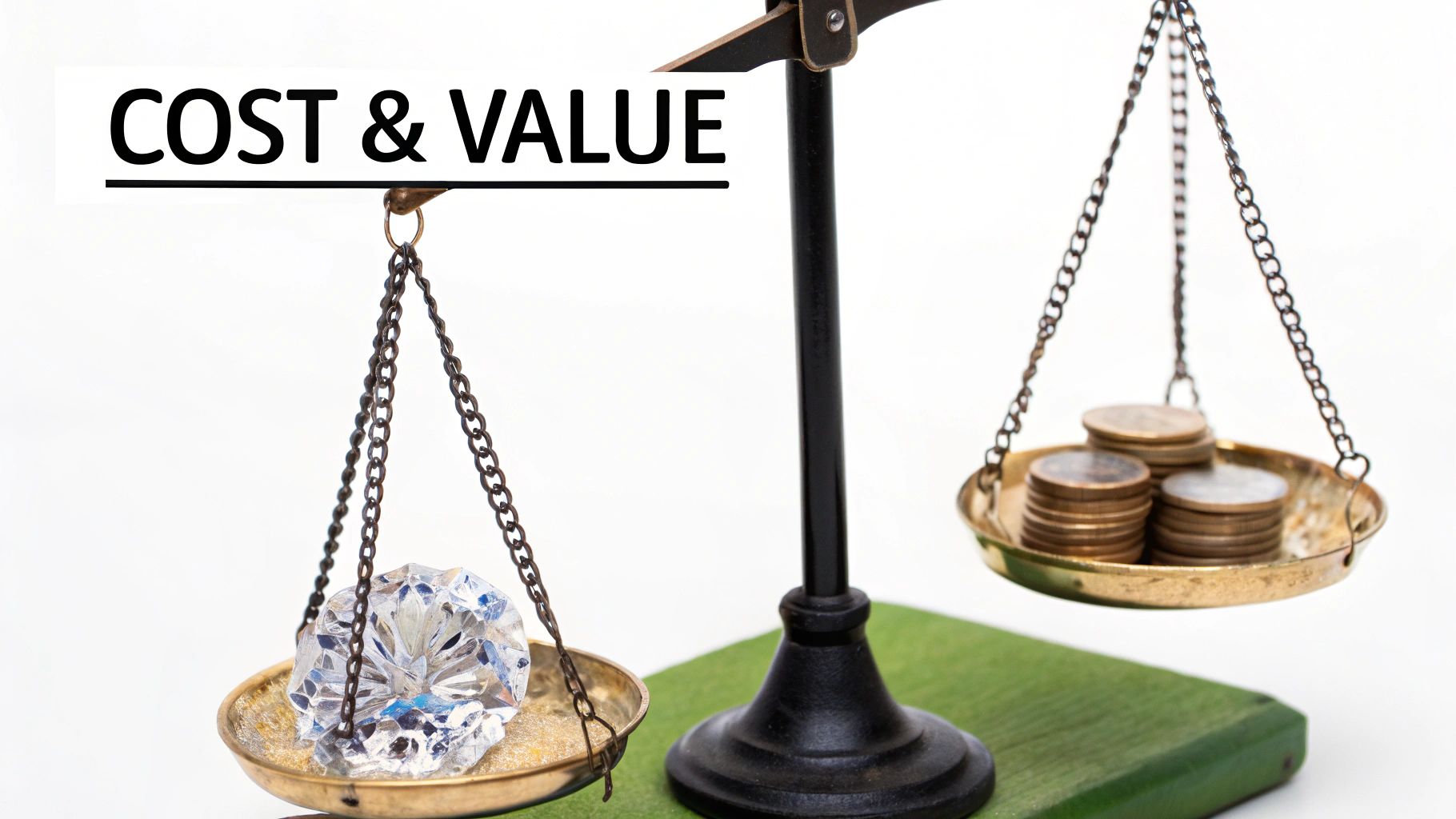
Naturally, budget plays a starring role when you’re designing a one-off engagement ring or a bespoke piece at Daniel Fine. In the showdown between moissanite and lab-grown diamonds, price isn’t just about the sticker—it shapes everything from carat size to setting detail.
For many clients, moissanite’s standout appeal lies in its remarkable affordability. That means you could choose a larger, dazzling centrepiece without stretching your budget.
- Upfront Savings: Moissanite often costs less than one-third of a lab diamond at the same carat weight.
- Size Maximisation: You can go bigger without compromise—perfect if you dream of a bold, statement design.
- Design Flexibility: Freed-up funds let you invest in an intricate setting or accent stones.
Breaking Down The Price Per Carat
When you compare larger sizes, the gap really opens up. A 2- or 3-carat moissanite stays comfortably within reach, whereas a similarly sized lab diamond demands a far heftier outlay. Consider the typical Australian market:
- A 1-carat moissanite sits around AU$500–AU$600, while a lab-grown diamond of equal quality will set you back AU$1,800–AU$2,000.
- As you move to 2- and 3-carat stones, the disparity balloons—freeing you to channel extra funds into the design itself.
This screenshot from Caratbee provides a clear visual breakdown of the price differences as carat weight increases.
Average Cost for 1-Carat and 3-Carat Stones
A look at current Australian market prices for moissanite and lab diamonds.
| Carat Weight | Moissanite (AU$) | Lab Diamond (AU$) |
|---|---|---|
| 1-Carat | 550 | 1,900 |
| 3-Carat | 1,500 | 5,700 |
In practical terms, these figures highlight why many couples opt for moissanite when they want that extra sparkle without an extravagant price tag.
Understanding Long-Term Value And Resale Potential
It’s easy to celebrate the immediate cost savings, but it’s also wise to consider how your stone holds up as an asset. Lab-grown diamonds carry a modest resale market—after all, they share the same chemistry as their natural counterparts. Moissanite, by contrast, shines brightest as a symbol of beauty and personal meaning rather than a financial investment.
Key Financial Insight: A lab-grown diamond offers some resale traction over time. Moissanite delivers maximum sparkle for your spend but isn’t designed to regain value on the secondary market.
If retaining monetary value interests you, a lab-grown diamond is the stronger pick. On the other hand, if you prioritise a breathtaking centrepiece and ethical sourcing—while keeping within budget—moissanite stands out as an unbeatable choice. Align your decision with what matters most: long-term financial value or presenting an everyday work of art that captures your vision.
So, Which Gemstone Is Right for You?
Deciding between moissanite and a lab-grown diamond isn't about which stone is "better"—it's about finding the one that fits your story, your style, and what you truly value. We've talked sparkle, durability, and cost, but now let's ground those details in real-world choices. This is where you find your perfect match.
Ultimately, the choice boils down to what you want your stone to say. Are you after the timeless allure that only a diamond can offer, or the show-stopping fire of a modern marvel?
Choose Moissanite If You Love a Dazzling Display
When it comes to pure, unadulterated fire, moissanite is the undisputed champion. Its intense, rainbow-like sparkle is for the person who wants their ring to turn heads and start conversations. If your style is bold and you want a stone that puts on a serious light show, moissanite is your clear winner.
Consider moissanite if these points hit home:
- You want to maximise your budget. Your priority is getting the largest, most impressive centre stone you can. With moissanite, a stunning 2 or 3-carat stone is suddenly within reach for a fraction of what a lab diamond would cost.
- You live for that fiery sparkle. While the classic white light of a diamond is beautiful, you're captivated by the vibrant, colourful flashes of moissanite's famous "disco ball" effect. You want a stone with a personality all its own.
- The "diamond" label isn't a must-have. You appreciate a gemstone for its unique beauty and intrinsic qualities, not just its name. You’re confident choosing a gorgeous, tough, and ethical stone that stands proudly on its own merits.
The Moissanite Wearer: This person is confident, loves making a statement, and is a savvy buyer who cares about visual impact and value. They want a breathtaking ring that reflects their vibrant personality without the eye-watering price tag.
Choose a Lab Diamond If You Value Timeless Tradition
Let's be clear: a lab-grown diamond is a real diamond. It has the same iconic beauty, unmatched hardness, and classic sparkle that has symbolised love for generations. If you’ve always dreamed of a diamond but want a more ethical and accessible path to owning one, a lab diamond is the perfect choice.
A lab diamond is probably your ideal stone if this sounds like you:
- You cherish classic elegance. You prefer the balanced, sophisticated sparkle of a diamond—that crisp, white light return balanced with subtle fire. Your personal style is more timeless than trendy.
- Having a "real diamond" is important to you. You value the fact that your stone is chemically and physically identical to one from the earth. The heritage and deep-rooted symbolism of a diamond are a meaningful part of your story.
- You want absolute peak durability. While moissanite is incredibly tough, nothing beats a diamond. A perfect 10 on the Mohs scale gives you the ultimate peace of mind that your stone is built to withstand a lifetime of wear.
For a bespoke piece from Daniel Fine, either choice will result in a beautifully crafted ring you’ll love forever. The decision simply comes down to whether your heart is set on the brilliant fire of moissanite or the classic legacy of a diamond.
Frequently Asked Questions
Even after weighing up the pros and cons, a few common questions always seem to pop up when it's time to make that final decision. We've put together some straight-to-the-point answers to help you feel completely sure about the stone you choose for your bespoke piece.
Can People Tell the Difference Between Moissanite and a Diamond?
Honestly, to the naked eye, telling a moissanite and a lab diamond apart is almost impossible. They look incredibly similar. A trained gemologist could spot the difference using specialised tools, but a casual observer likely won't.
The only real giveaway might be moissanite's signature fire—that intense, rainbow-coloured sparkle that flashes under certain lighting conditions. It's beautiful, but it's a bit more dramatic than a diamond's classic shimmer.
Is Moissanite a Fake Diamond?
Absolutely not. Moissanite is not a "fake" or "imitation" anything. It's a completely distinct gemstone in its own right, composed of silicon carbide.
Think of it this way: a sapphire isn't a "fake diamond," and neither is moissanite. It's simply a popular and beautiful alternative with its own unique properties and appeal.
This decision tree infographic can help you visualise which path might be right for you, focusing on key factors like budget and personal style.
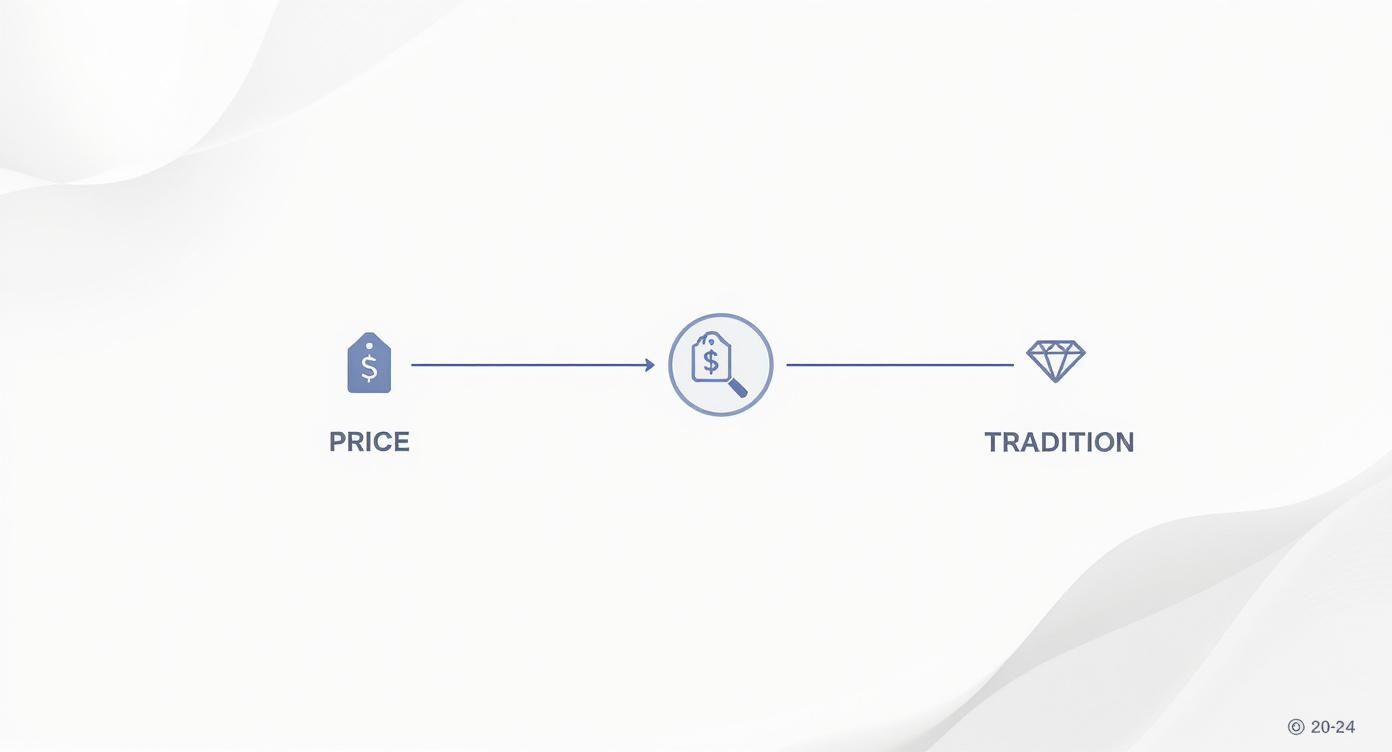
As the infographic shows, the choice often comes down to what you value most. If your budget is the main driver, moissanite is a fantastic choice. If you're drawn to tradition and that classic diamond sparkle, a lab-grown diamond is the perfect fit.
A common myth we hear is that moissanite will "cloud" or lose its sparkle over time. This is simply untrue. Moissanite is incredibly durable and, with a bit of regular cleaning, will maintain its brilliant fire for a lifetime.
Which Stone Holds its Value Better?
When it comes to resale value, a lab-grown diamond tends to hold a modest advantage over moissanite. Because it's chemically identical to a natural diamond, a small secondary market exists for it.
Moissanite, on the other hand, should be seen for its upfront value—its stunning beauty and affordability—rather than as a financial investment for the future.
At Daniel Fine, we specialise in creating custom jewellery that tells your unique story, whether you choose the fiery brilliance of moissanite or the timeless elegance of a lab diamond. Explore our bespoke design process and begin your journey today.