When you’re weighing up moissanite vs a lab diamond, the decision really comes down to one simple fact: a lab diamond is a real diamond, and moissanite is not.
While both are absolutely stunning, ethical, and lab-created gemstones, they're made from completely different materials. This fundamental difference in their chemical makeup is the source of every other distinction you'll see in their sparkle, durability, and price tag.
Understanding The Fundamental Difference
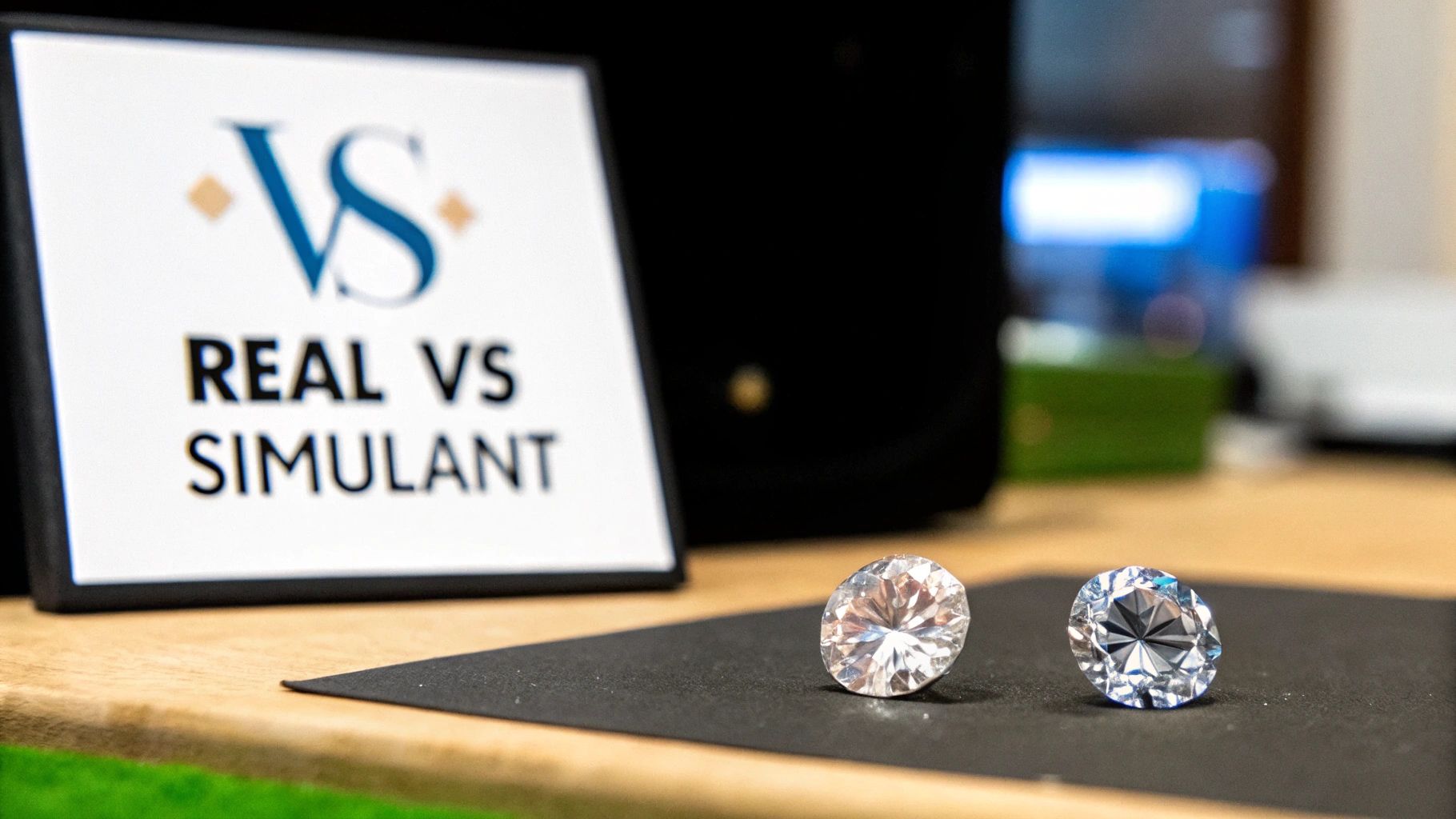
Before we get into the nitty-gritty of brilliance and cost, it's essential to grasp what these two gemstones actually are. At their core, the main difference is their chemical composition, which then dictates all their other characteristics.
A lab-grown diamond is pure carbon, crystallised in an isometric cubic structure. In simple terms, this means it's chemically, physically, and optically identical to a diamond pulled from the Earth. The only thing that sets them apart is where they came from.
On the other hand, moissanite is made of silicon carbide (SiC). It's a completely different compound that was first discovered in a meteor crater. Natural moissanite is exceptionally rare, so virtually all the stones you see in jewellery today are created in a lab. It’s best described as a diamond simulant—a stone that looks a lot like a diamond but is fundamentally different.
This is the key takeaway: a lab diamond is a genuine diamond, just with a modern origin story. Moissanite is a brilliant and durable gemstone in its own right, but it's best seen as a beautiful diamond alternative, not a type of diamond.
What This Means For You
Knowing this makes your choice a lot clearer. If owning a true diamond is important to you—whether for its symbolism, tradition, or that specific kind of sparkle—then a lab-grown diamond is the obvious way to go.
But if your goal is to find a brilliant, durable, and more affordable stone that gives you the diamond look, moissanite is an outstanding option.
Both gemstones offer some serious advantages over mined diamonds, too:
- Ethical Sourcing: Because they’re made in controlled environments, both are guaranteed to be 100% conflict-free.
- Environmental Sustainability: They sidestep the massive ecological footprint that comes with traditional diamond mining.
- Exceptional Value: You get incredible beauty and quality from both, but at a far more accessible price than their mined equivalents.
To help you see how they stack up at a glance, the table below summarises the key differences we'll explore in more detail.
Quick Comparison Moissanite vs Lab Grown Diamond
| Attribute | Moissanite | Lab Grown Diamond |
|---|---|---|
| Composition | Silicon Carbide (SiC) | Pure Carbon (C) |
| Brilliance | Intense, fiery rainbow sparkle | Balanced white light and coloured fire |
| Hardness | 9.25 (Extremely tough) | 10 (The hardest mineral on Earth) |
| Price | Significantly more affordable per carat | More expensive than moissanite, but less than mined |
This table gives you a great starting point, but the real choice comes down to personal preference, which we'll dive into next.
Comparing Visual Properties: Brilliance, Fire, and Colour
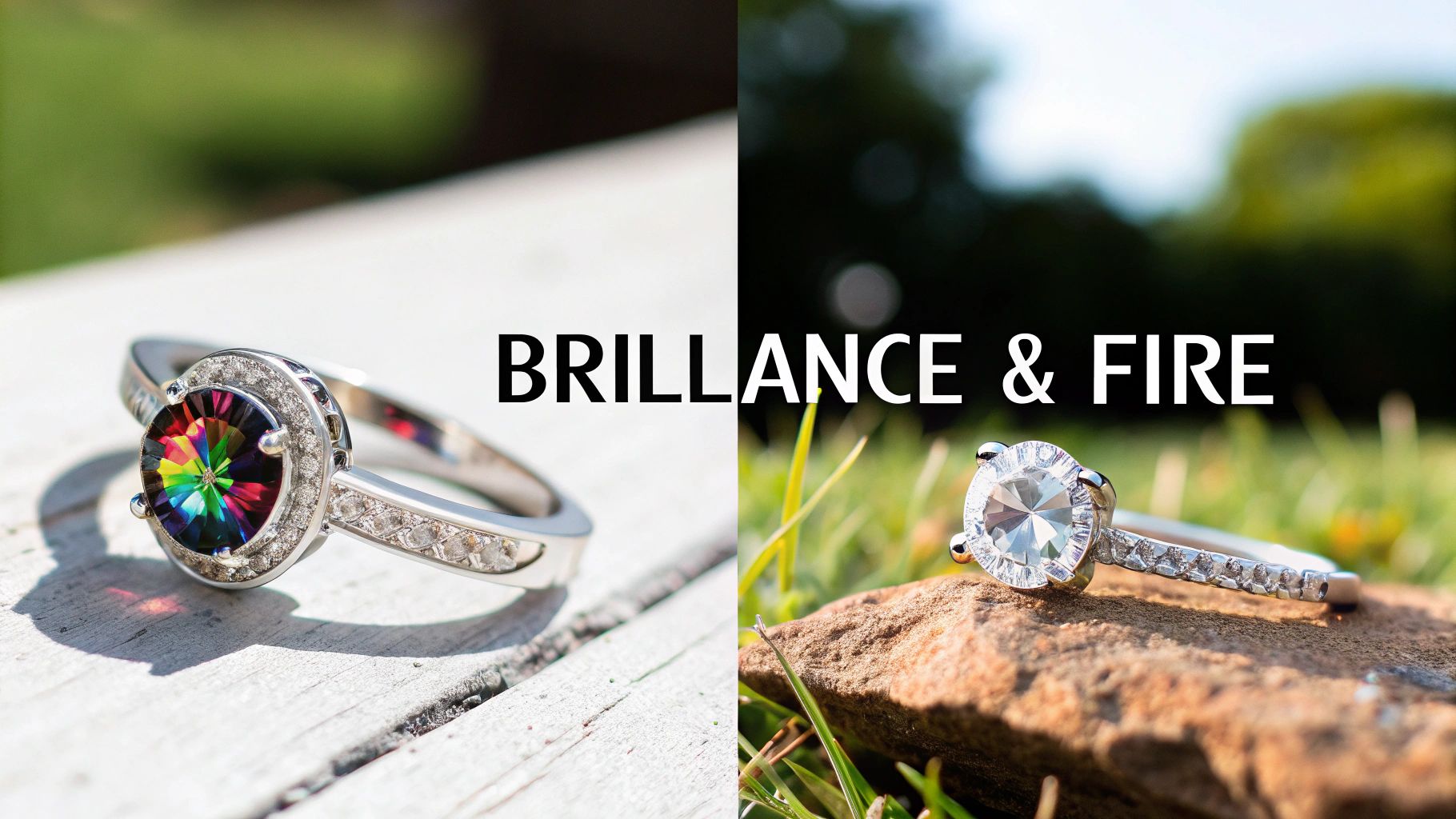
When you place a moissanite and a lab diamond side-by-side, the visual differences are subtle at first glance, but they are absolutely there. It all comes down to how each stone plays with light, which gives them their unique personality and charm. Your choice really depends on which kind of beauty you’re drawn to.
A stone's sparkle is really a combination of two things: brilliance and fire. Brilliance is that crisp, white light that returns to your eye, giving the stone its brightness. Fire, on the other hand, is the beautiful rainbow of colours that flash as the stone moves. While both gems have these qualities, the way they balance them is what truly sets them apart.
The Dazzling Fire of Moissanite
Moissanite is famous for one thing above all else: its incredible fire. Thanks to its silicon carbide composition, it has a very high refractive index of 2.65 to 2.69. In simple terms, this means it bends and breaks up light far more intensely than a diamond does.
The result is a spectacular, fiery explosion of rainbow colours. When a moissanite catches the light, particularly in the sun, it creates what many describe as a "disco ball" effect. This intense sparkle is what makes moissanite so captivating for many; it’s a bold look that demands to be noticed.
Picture a moissanite ring on your hand at a sunny outdoor café in Melbourne. Every slight movement would send powerful, colourful sparks flying. That’s the signature look of moissanite—vibrant, fiery, and full of life.
The Classic Brilliance of a Lab Diamond
A lab-grown diamond, made of pure carbon, has a slightly lower refractive index of 2.42. While it certainly has fire, its light performance is more of a balanced act between the white light of brilliance and the colourful flashes of fire. This is what creates that classic, timeless sparkle everyone knows and loves.
A lab diamond’s sparkle feels more crisp and subtle. It returns a huge amount of white light, giving it a bright, almost icy look that’s punctuated by elegant flashes of colour. It’s the quintessential look for a traditional engagement ring.
Practically speaking, a lab diamond under office lights will give off a sharp, scintillating shimmer. It’s a sophisticated sparkle that’s bright without ever feeling over the top.
The core visual difference is all about balance. A lab diamond offers a beautiful harmony of white and coloured light, creating a classic sparkle. Moissanite goes all-in on its fiery, rainbow-like flashes for a more dramatic and colourful show.
Addressing the Colour Question
One of the oldest myths in the moissanite vs. lab diamond debate revolves around colour. Years ago, it's true that some moissanite could show noticeable yellow or greenish tints, especially in larger sizes. But modern technology has completely changed the game.
Today, high-quality moissanite, like the stones we use at Daniel Fine, is engineered to be completely colourless. These gems fall within the D-E-F colour range, the very top tier for diamond grading, which means you get a pure, icy-white look. You can now choose a large, brilliant moissanite without worrying about any unwanted warmth.
Let’s put that in perspective:
- Modern Moissanite: Routinely created to be colourless (D-E-F equivalent), guaranteeing a bright white appearance.
- Lab-Grown Diamonds: Graded on the same D-to-Z scale as mined diamonds. While colourless options are easy to find, they cost more than near-colourless grades like G-H-I.
This is a massive leap forward because it removes one of moissanite’s historical downsides. You no longer have to trade colour for fire. A modern moissanite gives you both that incredible sparkle and a crisp white body, making it a serious contender to a lab diamond on looks alone. The choice isn't about which stone is "whiter" anymore; it's about which style of sparkle you love most.
Analysing Durability For Everyday Wear
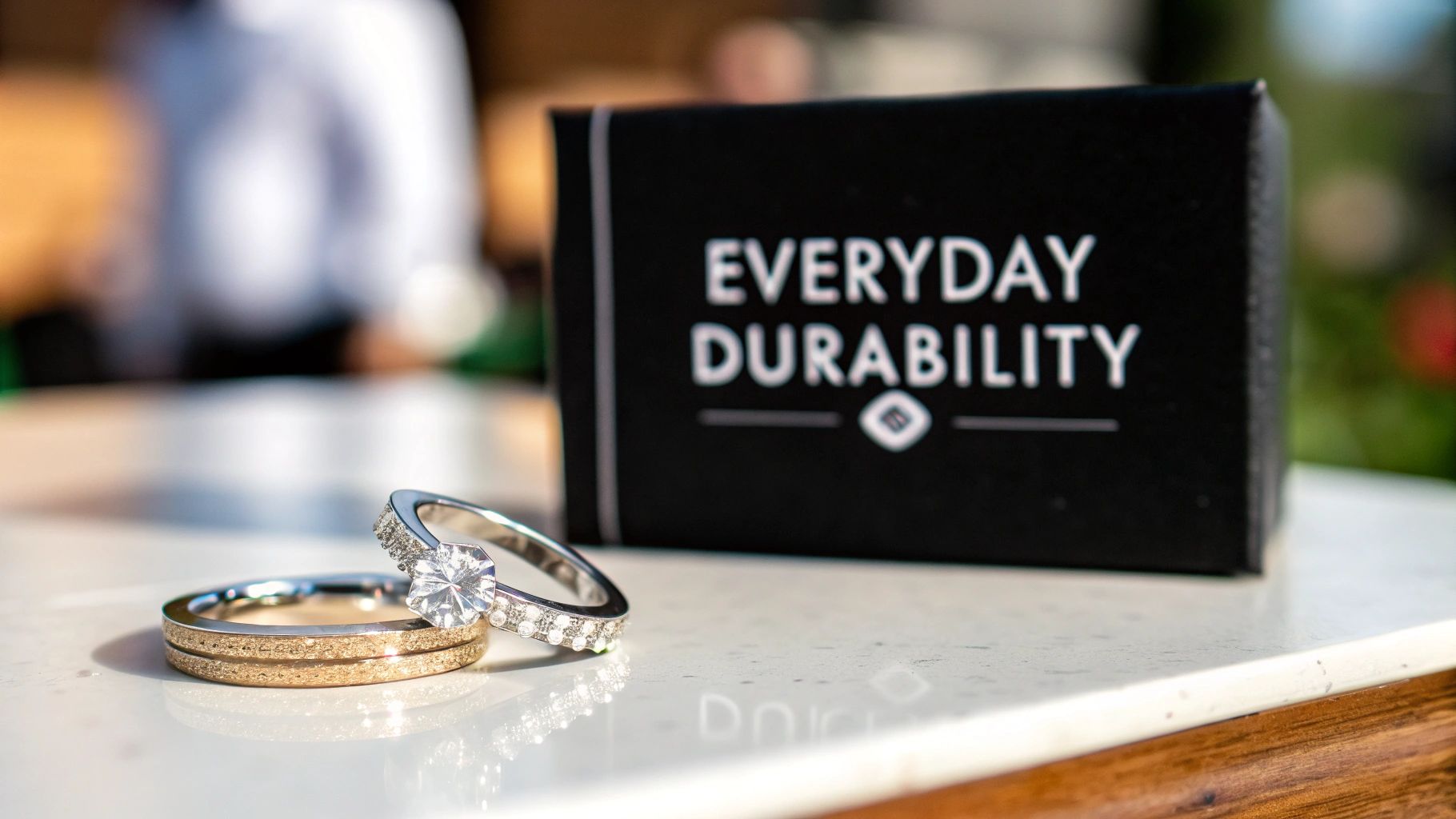
When you’re choosing a stone for an engagement ring—or any piece you intend to wear every day—durability is everything. You need something that can stand up to the reality of daily life, from accidental knocks against a desk to a scrape on a brick wall, without losing its lustre.
Both moissanite and lab-grown diamonds are fantastic contenders in this department. They're both exceptionally resilient, but their subtle differences are worth understanding to make sure your choice fits your life perfectly. The go-to metric for this is the Mohs scale of hardness, a simple 1 to 10 scale measuring a mineral's resistance to scratching. A higher number can scratch anything below it.
The Unmatched Hardness of a Lab Diamond
Lab-grown diamonds are the undisputed champions here, clocking in at a perfect 10 on the Mohs scale. This isn't just a high score; it's the top of the charts, making diamond the hardest known mineral on Earth. What this means for you is unparalleled scratch resistance.
A lab diamond is incredibly tough to damage. Think about all the things your hands come into contact with daily:
- Metal keys rattling in your purse
- Rough granite benchtops
- Sandy textures at the beach
- Brushing against a brick wall
A diamond can handle all of that and more, maintaining its sharp facets and brilliant polish for a lifetime. If you lead a very active lifestyle or work with your hands, the peace of mind that a diamond offers is hard to beat.
Moissanite's Remarkable Resilience
So, a diamond is the hardest. But moissanite is right on its heels with an impressive 9.25 on the Mohs scale. This puts it squarely in second place among popular gemstones, easily surpassing other durable choices like sapphire and ruby.
For all intents and purposes, moissanite is more than tough enough for daily wear. It will confidently stand up to the rigours of an active life without showing scratches or signs of wear. While a diamond could theoretically scratch a moissanite, you'd have to be pretty unlucky for that to happen in the real world.
The practical reality is that both stones are incredibly tough. While a lab diamond holds the title of 'hardest,' moissanite's 9.25 rating provides more than enough durability for an engagement ring designed to last a lifetime. The difference in scratch resistance is minimal in real-world scenarios.
Toughness: The Resistance to Chipping
Hardness tells us about scratching, but what about chipping or breaking from a direct hit? That’s where toughness comes in. The great news is that both moissanite and lab diamonds have excellent toughness. Neither has natural cleavage planes—weak spots where a gem can split—so they aren't prone to fracturing.
You can wear either stone with confidence, knowing they are built to last. This is where moissanite’s value really shines, especially for Australian buyers. It delivers incredible practicality for everyday wear at a much friendlier price point, with 1-carat stones typically ranging from AU$450 to AU$900. Compare that to lab diamonds, which can range from AU$1,500 to AU$7,500. As you can see on sites like azurajewelry.com, moissanite provides amazing durability without the premium price tag.
Ultimately, you’re choosing between two excellent options. A lab diamond gives you the absolute pinnacle of hardness and that extra bit of assurance. But moissanite’s resilience is so high that it easily meets the demands of daily life, making it a brilliant and practical choice for any forever piece.
What About Price, Value, and How People See Them?
Let’s be honest: while the sparkle is what catches your eye, the conversation about moissanite versus lab diamonds almost always circles back to price. And that's fair enough. While both are significantly more accessible than mined diamonds, they occupy completely different worlds when it comes to value and perception. Getting your head around this is the key to choosing a stone that not only fits your budget but also feels right for you.
The most obvious difference is the price tag. Moissanite is, without a doubt, a lot friendlier on the wallet. For a one-carat, colourless moissanite, you might be looking at a few hundred dollars. A lab diamond of the same size and quality? That'll set you back several thousand.
This huge gap isn't about one being "better" than the other. It comes down to what they're made of and how they're made. Crafting silicon carbide into a moissanite is a more straightforward and less energy-hungry process than recreating the intense heat and pressure needed to form pure carbon into a diamond.
Understanding What 'Value' Really Means
This price difference forces a really important question: what do you actually value in a gemstone? The answer is deeply personal.
For a lab-grown diamond, its value is tied directly to the fact that it is a real diamond. It has the same chemical structure, the same cultural weight, and can earn the same prestigious certifications (from labs like GIA or IGI) as a stone dug from the earth. This identity gives it a place in the secondary market.
- Lab Diamond Value: Its value comes from being a certified diamond. You get all the prestige and symbolism of a traditional diamond, just at a more attainable price point.
- An Emerging Resale Market: The resale value for lab diamonds is still finding its feet and is lower than for mined diamonds, but a market does exist. You can sell or trade in a lab diamond, but it's wise not to expect to get back what you originally paid.
This makes a lab diamond the perfect choice for someone who values the "diamond" name and wants a stone that holds at least some long-term financial potential.
The Smart, Practical Appeal of Moissanite
Moissanite’s value proposition is completely different. It's not trying to be a diamond; it's a stunning, tough, and brilliant gemstone in its own right that just happens to look a lot like one, for a fraction of the cost. The value here is practical and immediate.
The savings with moissanite are significant, and that opens up a lot of doors. You could:
- Go for a much larger, more impressive centre stone than you could otherwise afford.
- Invest in a higher-quality or more elaborate setting, like upgrading from gold to platinum.
- Put the money you saved towards other major life goals, like the wedding itself or a house deposit.
Moissanite's value is in delivering that jaw-dropping look and lifetime durability without the financial pressure. The one thing to be crystal clear on, however, is that moissanite has virtually no resale value. You buy it for its beauty and affordability, not as a financial asset.
At its core, the psychology is simple. People often choose a lab diamond as a 'smarter diamond'—they get the real deal without the ethical baggage or financial hit of a mined stone. Moissanite, on the other hand, is chosen as a 'brilliant diamond alternative,' a pragmatic move to get the most impressive look for a given budget.
How They’re Seen in the Australian Market
The way these gems are positioned in Australia really highlights this split. Lab-grown diamonds are sold as a premium, modern luxury. The marketing often hammers home that they are "identical to natural diamonds," which helps them command higher prices and shapes what buyers want—the prestige of owning a true diamond. This clever positioning has a huge impact on their market value. You can dig deeper into these consumer trends and the differences between moissanite and lab diamonds here.
Ultimately, when you're weighing up price and value, the moissanite vs. lab diamond question isn't about which stone is better. It’s about which proposition makes more sense for your life. Do you value the identity and future potential of a true diamond, or do you value the immediate financial freedom and stunning aesthetics that moissanite offers? Your answer will point you straight to the perfect stone for you.
Making The Right Choice For Your Priorities
Choosing between moissanite and a lab-grown diamond can feel a little overwhelming. But it all gets much clearer when you stop asking "which stone is better?" and start asking, "which stone is better for me?". The right choice is the one that lines up perfectly with your budget, your personal style, and what you truly value in a piece of fine jewellery.
This isn't about picking a winner. It's about matching a gemstone's personality to your own. Once you understand what’s driving your decision—be it symbolism, sparkle, or savings—you can feel completely confident in your choice.
Choose A Lab Diamond If…
You should lean towards a lab-grown diamond if the timeless identity and classic elegance of a true diamond are what you’re really after. It’s the right fit if these priorities sound like you:
- Symbolism is Paramount: The tradition and cultural weight of owning a real diamond mean something to you. Its pure carbon makeup is significant, and you want a stone that is chemically identical to one pulled from the Earth.
- You Prefer Classic Sparkle: You’re drawn to a more sophisticated sparkle—that beautiful balance of crisp white light (brilliance) and subtle flashes of colour (fire). The over-the-top rainbow effect of moissanite might be a bit much for your taste.
- Resale Value Matters: While it's not a financial investment, you’d like your gemstone to hold onto some value over time. Lab diamonds have a growing secondary market, giving them a modest resale potential that moissanite simply doesn't have.
In the end, a lab diamond is for someone who wants a genuine diamond in every sense of the word—just one that’s created ethically and priced more approachably.
This decision tree can help you visualise where each stone fits, depending on whether you're focused on the financials or the aesthetics.
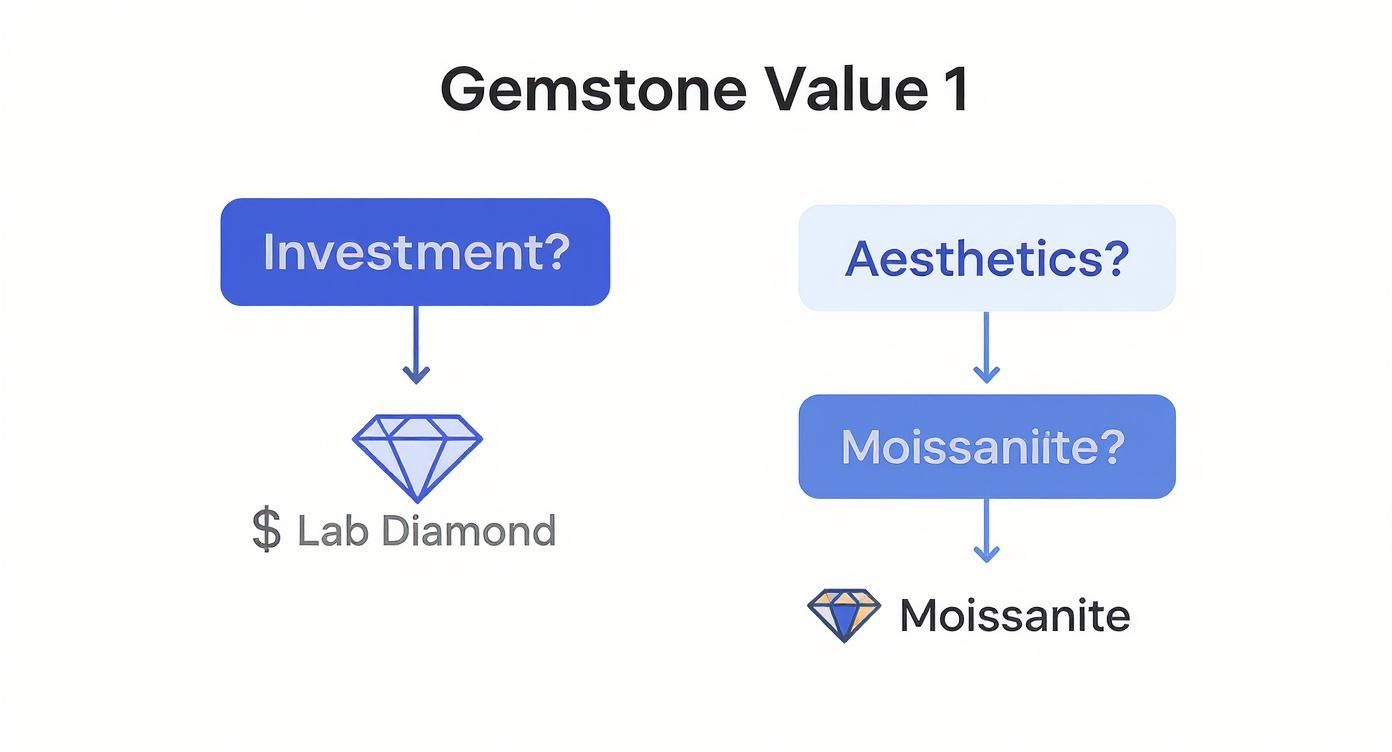
As you can see, if long-term value is a key factor, a lab diamond is the logical way to go. If it's all about pure visual impact for your dollar, then the path points straight to moissanite.
Choose Moissanite If…
Moissanite is a brilliant choice if your main goal is to get the most visual punch and sparkle for your budget. This gemstone is probably the perfect match for you if these points hit home:
- Size and Sparkle are Top Priorities: You want the biggest, most brilliant stone you can get for your money. The fiery, rainbow-like sparkle of moissanite is what you find exciting, and you love a gem that makes a bold, dazzling statement.
- You Are Budget-Conscious: Your focus is on getting a stunning look without the hefty price tag of a diamond. The significant savings mean you could afford a more detailed setting, upgrade your ring's metal to platinum, or simply put that money toward other life goals.
- You Value Practicality Over Tradition: You love how a diamond looks but aren't tied to the name or what it’s made of. You see moissanite as a smart, practical alternative that delivers incredible beauty and durability without the premium cost.
Choosing moissanite is a decision based on pragmatism and a love for dazzling aesthetics. It's for the buyer who wants a breathtaking look and appreciates moissanite for its own unique, fiery charm.
Why Australians Are Choosing Ethical Alternatives
Beyond the sparkle and the price tag, there’s a deeper conversation happening about jewellery in Australia. People are thinking hard about where their pieces come from, wanting something that reflects not just their style, but their values too. This is exactly why both moissanite and lab-grown diamonds have found their moment.
These stones offer a guilt-free way to own something beautiful. By sidestepping the environmental and ethical controversies of traditional mining, they give you peace of mind. Both are guaranteed to be 100% conflict-free and avoid the massive ecological footprint left by digging gems out of the ground.
A Growing Demand For Conscious Luxury
This shift towards responsible buying isn't just a niche trend; it's reshaping the entire Australian market. Globally, the lab-grown diamond market is expected to hit a staggering AU$90 billion by 2032. Australia is right at the heart of this growth, with projections showing the market volume could reach 19.2 million carats by 2030.
This boom makes one thing clear: for many of us, knowing a stone's origin story is just as critical as its appearance. You can read more about this surging market at Forbes.com.au.
This isn’t simply about avoiding the downsides of mining. It’s about making an active choice for a more transparent and sustainable future in fine jewellery—aligning a symbol of love with genuinely positive principles.
While both moissanite and lab diamonds are fantastic ethical choices, it's the lab-grown diamond that has seen a particularly strong surge in mainstream popularity. The reason for this often boils down to a single, powerful idea: identity.
The Power of a 'Real' Diamond
For many Australian buyers, a lab-grown diamond is the perfect compromise. It delivers everything a mined diamond does—it's chemically, physically, and optically identical—but without the ethical baggage or the eye-watering price.
This allows couples to honour the powerful tradition and symbolism of a diamond while making a choice that feels both modern and responsible. Moissanite is a stunning and equally ethical alternative, of course, but the 'real diamond' status of a lab-grown stone has been a major driver of its widespread acceptance.
Ultimately, choosing between moissanite and a lab diamond is more than just a matter of taste; it’s a reflection of a growing desire for luxury that’s built on integrity from the ground up.
A Few Final Questions Answered
Even after weighing up all the differences, it's natural to have a few lingering questions. Let's tackle some of the most common ones we get asked, giving you that final bit of clarity to make a decision you'll love.
Can People Tell the Difference Between Moissanite and a Lab Diamond?
Honestly, for most people, no. When a moissanite or a lab diamond is beautifully set in a ring and on someone's finger, the average person won't be able to spot the difference. It takes a keen, trained eye to notice.
The biggest giveaway, if you're looking for it, is the sparkle. A moissanite throws off a vivid, rainbow-like fire, whereas a lab diamond has a more balanced sparkle with both white and coloured light. A jeweller can tell immediately with a diamond tester, but your friends and family? It's highly unlikely they'll know unless you tell them.
Will Moissanite Get Cloudy Over Time?
Absolutely not. A quality moissanite is built to last and will never become cloudy or lose its sparkle from the inside. It's an incredibly tough and stable gemstone, so its internal clarity and brilliance are permanent.
If your moissanite ever looks a bit dull, it's just doing what every other piece of jewellery does—picking up a bit of grime. A thin film of skin oils, hand lotion, or soap scum is usually the culprit. A quick, simple clean is all it takes to bring back that signature fire and have it looking brand new again.
The old myth about moissanite turning cloudy comes from early, lower-grade diamond imitations. Today's lab-created moissanite is a completely different beast—engineered for a lifetime of brilliance.
Which Stone Has Better Resale Value?
When it comes to resale, lab-grown diamonds hold their value better than moissanite. Because they are chemically identical to mined diamonds, a secondary market for them is growing. It's worth remembering, though, that their resale value is still less than that of a natural diamond.
Moissanite, on the other hand, has almost no resale market. You should think of moissanite as a purchase for its beauty and incredible upfront value, not as a financial investment. The real "value" is in what you save, which allows you to get a much larger, show-stopping stone for your budget right now.
Are Lab Diamonds Actually Real Diamonds?
Yes, 100% real diamonds. This is a key point to understand. They aren't fakes or look-alikes; they share the exact same chemical makeup, hardness, and optical qualities as a diamond that came out of the ground.
The only difference is where they came from. One was created by nature over millions of years, the other was grown by science in a matter of weeks. Leading gemological labs like the GIA (Gemological Institute of America) and IGI (International Gemological Institute) grade and certify them as real diamonds, cementing their place in the world of fine jewellery.
Whether you're captivated by the classic elegance of a lab-grown diamond or the dazzling fire of moissanite, Daniel Fine is here to create a bespoke piece that feels uniquely yours. Explore our collections or get in touch to design a symbol of love that truly reflects your story. Start your bespoke jewellery journey with us today.