When you're choosing between moissanite and a lab-grown diamond, it really comes down to what matters most to you. If you're after the most impressive sparkle and size your money can buy, moissanite is an incredible option. But if what you really want is the legacy and pure carbon structure of a traditional diamond, then a lab-grown diamond is the way to go.
Moissanite vs Lab Diamond: The Deciding Factors
There’s no "better" stone here—just the one that fits your style, budget, and personal values perfectly. To make a decision you'll feel great about for years, it helps to understand what truly sets these two beautiful, ethical gemstones apart.
While both are created in a lab, offering a responsible choice over mined gems, their fundamental properties are quite different. This guide will take you beyond the basics, exploring everything from the way they sparkle in the light and their toughness for everyday wear, to their Australian pricing and long-term value.
Let's dive in, starting with a quick overview to get our bearings.
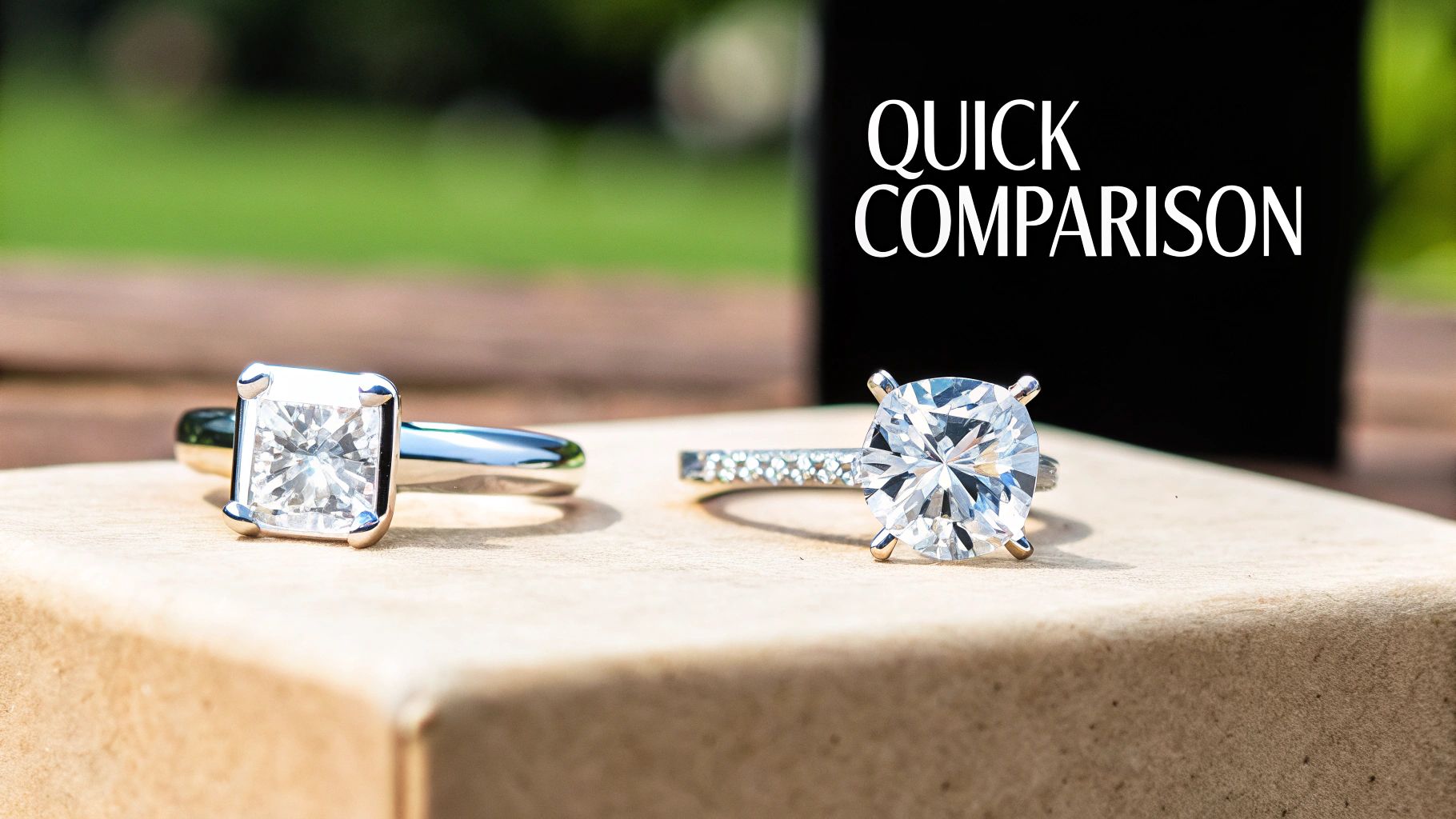
At a Glance Comparison: Moissanite vs Lab Diamond
This table gives you a snapshot of the most important distinctions between moissanite and lab-grown diamonds. Think of it as a starting point before we get into the finer details.
| Characteristic | Moissanite | Lab-Grown Diamond |
|---|---|---|
| Composition | Silicon Carbide (SiC) | Pure Carbon (C) |
| Brilliance (Sparkle) | Exceptional, rainbow-like fire (Refractive Index: 2.65-2.69) | Classic, balanced white and coloured light (Refractive Index: 2.42) |
| Hardness (Mohs Scale) | 9.25 (Extremely durable, suitable for daily wear) | 10 (The hardest known mineral, exceptionally scratch-resistant) |
| Colour Grade | Typically colourless (D-F equivalent), can show slight undertones | Graded on the official GIA D-Z colour scale, same as natural diamonds |
| Average Cost (1-Carat in AUD) | ~$600 – $1,000 | ~$2,000 – $4,500+ |
| Ethical Sourcing | Lab-created, conflict-free, and sustainable | Lab-created, conflict-free, and sustainable |
| Resale Value | Little to no resale value | Retains a portion of its original value, though not an investment |
As you can see, the core differences in their chemical makeup, hardness, and how they handle light lead to a very different experience on your finger. Now, let’s explore what these characteristics actually mean for you.
Understanding the Origins and Makeup of Each Gemstone
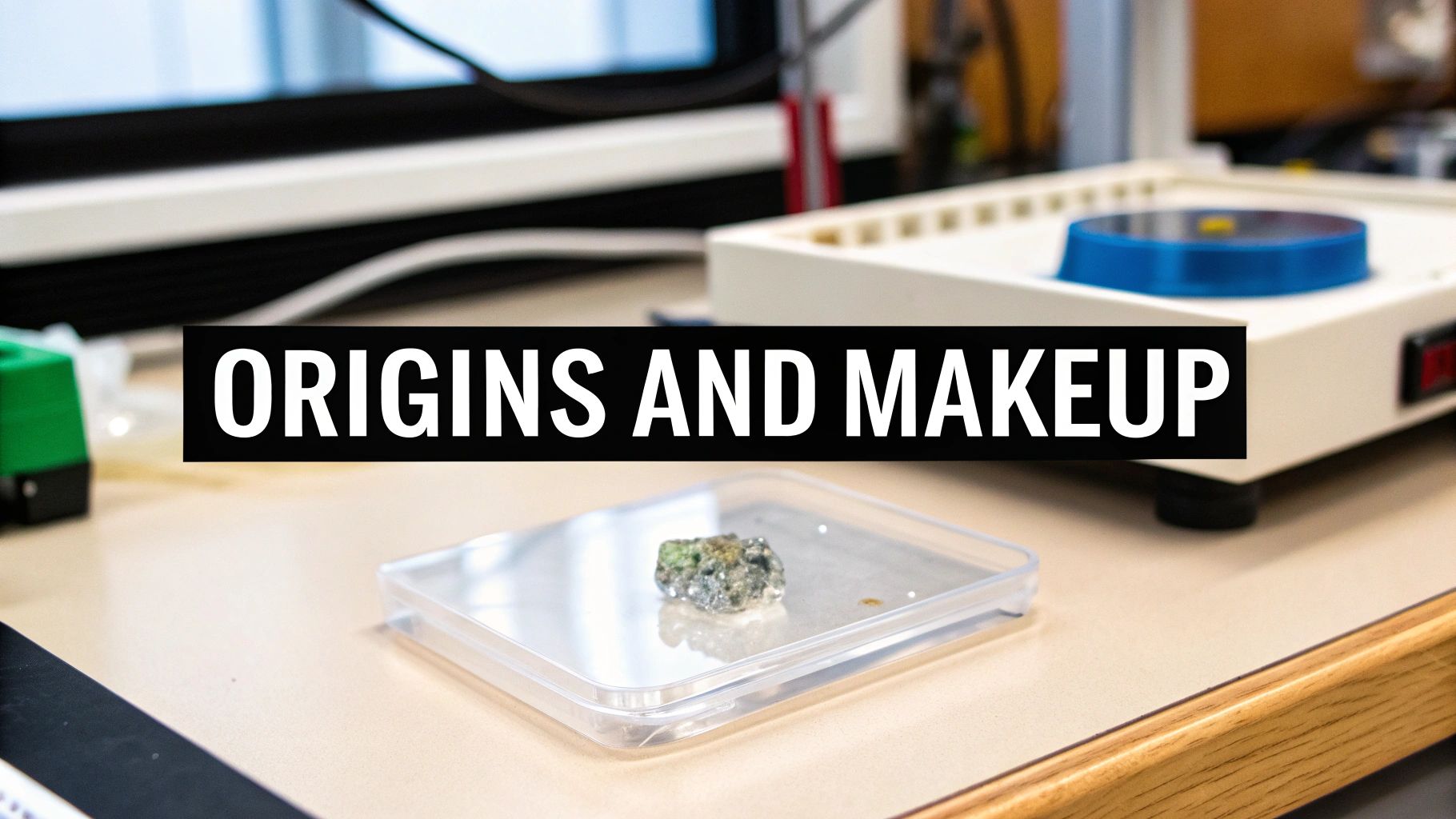
To really get to the heart of the moissanite vs lab diamond debate, we need to look past the sparkle and understand what these stones actually are. While they both come from a lab, that’s where the similarities in their origin stories end. Their chemical makeup is completely different, and that’s the most important distinction to grasp.
At its core, a lab-grown diamond is a real diamond. It’s made of pure carbon, arranged in the exact same crystal structure as a diamond pulled from the earth. The only thing that sets them apart is where they were born.
The Creation of a Lab Diamond
Think of the process for creating a lab diamond as a high-tech re-creation of what happens deep inside the Earth’s mantle. Scientists take a tiny carbon "seed" and use incredible technology to mimic those intense natural conditions, growing it into a beautiful gemstone.
There are two main ways they do this:
- High Pressure/High Temperature (HPHT): This method literally crushes a carbon source under immense pressure and blasts it with extreme heat. This forces it to melt and crystallise around a diamond seed, just like it would in nature.
- Chemical Vapour Deposition (CVD): Here, a diamond seed is put into a special chamber filled with carbon-rich gases. The gases are heated until they break apart, and carbon atoms rain down, attaching to the seed one layer at a time.
No matter which method is used, the result is the same: a gemstone that is chemically, physically, and optically identical to a mined diamond. It's not a "fake" or a "simulant"—it’s a genuine diamond, just one with a fully traceable and ethical backstory. This shift has had a massive impact on the Australian jewellery scene.
The market for lab-grown diamonds in Australia has been exploding, growing at a compound annual rate of 25% since 2020. In 2023, sales hit an estimated $150 million. This boom is all about changing values, with over 60% of major Aussie retailers now stocking them—a huge jump from just 20% back in 2018. You can dive deeper into this trend over at Gemsociety.org.
The most important takeaway is this: A lab-grown diamond is not a 'diamond-like' stone. It is a diamond, full stop. Its value, beauty, and durability are inherent to its pure carbon structure.
This is where moissanite enters the picture with a completely different story.
The Cosmic Story of Moissanite
Moissanite is a stunning gemstone in its own right, and it’s important to know it’s not a type of diamond at all. Chemically, it’s silicon carbide (SiC), a compound that is incredibly rare in nature.
The discovery of moissanite sounds like something out of a sci-fi novel. Back in 1893, French scientist Dr. Henri Moissan was examining a meteorite crater in Arizona when he found microscopic, glittering particles. At first, he thought they were diamonds, but he quickly realised he'd stumbled upon something new to science.
Because it’s so rare to find naturally, all moissanite used in jewellery today is lab-created. This gives us total control over the process, resulting in a consistently brilliant and ethical gemstone without any of the environmental baggage of mining. The silicon carbide is grown into large, perfect crystals before being cut and polished, ready for a bespoke Daniel Fine creation.
So, here’s the bottom line: a lab diamond is a recreation of a natural gem, while moissanite is a lab-perfected version of a rare, cosmic mineral. It's not trying to be a diamond; it's succeeding at being moissanite. Understanding this difference—real diamond versus a distinct gemstone—is the key to making a choice you’ll love for a lifetime. Each has its own identity and appeal, offering different things for your custom piece.
A Closer Look: Appearance and Everyday Durability
When you see a moissanite and a lab-grown diamond side-by-side, the unique character of each stone really shines through. While both are absolutely beautiful, they play with light in distinctly different ways and have their own structural strengths. Getting to know these nuances is the key to picking the one that you’ll fall in love with.
The way your gemstone looks and how it holds up to everyday life are probably the most important things on your mind. So, let's get into the specifics of how a moissanite and a lab diamond really stack up in sparkle, colour, and toughness.
The Battle of Brilliance and Fire
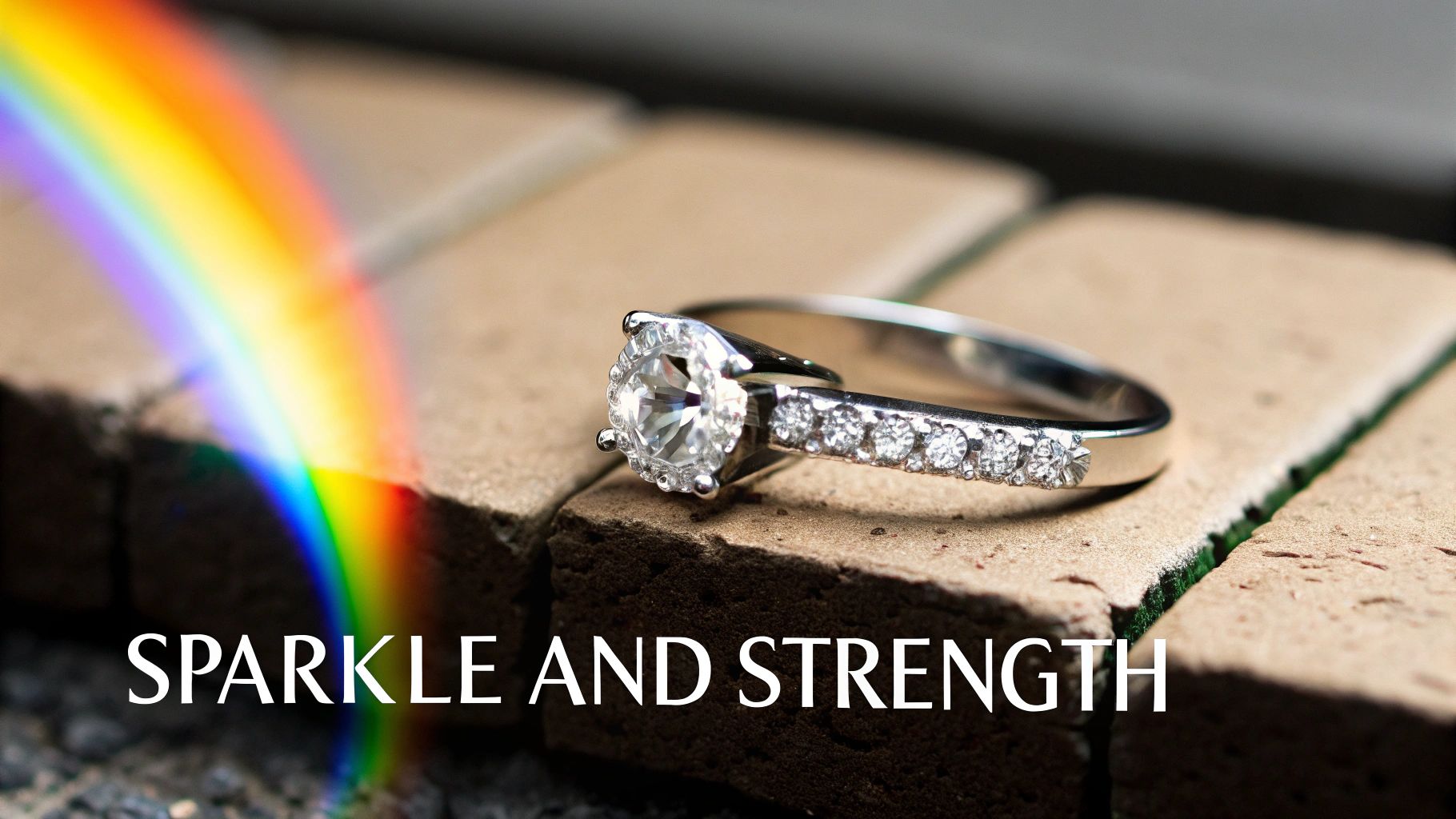
A gemstone’s sparkle comes down to two things: brilliance (the return of brilliant white light) and fire (those mesmerising flashes of rainbow-coloured light). This is where you’ll see the biggest difference in personality between a moissanite and a lab diamond.
Moissanite is what we call "doubly refractive," which means it splits light into two separate rays as it passes through the stone. This gives it a very high refractive index of 2.65-2.69, which is quite a bit higher than a diamond's 2.42. The result? An electrifying, fiery sparkle that's impossible to miss.
People often describe this intense, colourful sparkle as a "disco ball" effect. If you love vibrant, rainbow flashes and want a stone that makes a serious statement, the incredible fire of a moissanite will be a huge plus for you. It’s a bold look that really comes alive in sunlight or under bright lights.
A lab-grown diamond, on the other hand, is "singly refractive." Its sparkle is a more balanced mix of brilliant white light and fiery rainbow flashes. This is the classic diamond sparkle everyone knows and loves—crisp, deep, and utterly elegant. A lab diamond’s beauty is in its sophisticated and timeless performance, which has been the benchmark for centuries.
Choosing between them really just comes down to personal taste. Are you drawn to the vibrant, fiery light show of a moissanite, or the classic, balanced brilliance of a lab-grown diamond? There’s no right answer—only what feels right for you.
Understanding Colour Grades and Undertones
When it comes to colour, both stones offer beautiful, colourless options. However, the way they're graded and how they can appear in different lighting conditions are not quite the same.
Modern, high-quality moissanite, like the ones we use in our Daniel Fine bespoke pieces, is created to be colourless, which would be equivalent to the D-F range on the diamond colour scale. That said, because of its silicon carbide makeup, you might occasionally notice subtle, warm undertones of yellow or grey in some larger stones, particularly in certain light. This isn't a flaw; it's just a natural characteristic of the gem.
Lab-grown diamonds are graded with the exact same stringent D-Z colour scale used by the GIA (Gemological Institute of America) for natural diamonds. This means you can choose a lab diamond with a precise, certified colour grade—like a D for absolutely colourless or a G for near-colourless—and know exactly what you're getting. This level of precision is perfect for matching stones in a setting.
To help clarify these differences, here’s a quick breakdown of how their visual and physical properties compare.
Visual and Durability Characteristics Breakdown
| Attribute | Moissanite (Silicon Carbide) | Lab-Grown Diamond (Carbon) |
|---|---|---|
| Brilliance (White Light) | Very high; refractive index of 2.65-2.69 creates exceptional sparkle. | High; refractive index of 2.42 delivers the classic, brilliant diamond look. |
| Fire (Coloured Light) | Extremely high; "disco ball" effect with intense, rainbow-like flashes. | Balanced; a sophisticated mix of white light and colourful fire. |
| Colour | Typically colourless (D-F equivalent), but can show slight warm or grey undertones in some lighting. | Graded on the GIA D-Z scale, allowing for precise, certified colour selection. |
| Mohs Hardness | 9.25 / 10; exceptionally hard and resistant to scratching. | 10 / 10; the hardest known mineral, offering maximum scratch resistance. |
| Toughness | Excellent; highly resistant to chipping and breaking during daily activities. | Excellent; incredibly tough and durable, ideal for lifelong wear. |
As the table shows, both options are top-tier choices. The decision really hinges on whether you prefer moissanite's fiery brilliance or the diamond's iconic, balanced sparkle.
Resilience for Real Life: Daily Durability
An engagement ring is for life, so it needs to handle the reality of daily wear—from accidental knocks to everyday bumps. We measure this durability using the Mohs scale of hardness, which ranks minerals from 1 (softest) to 10 (hardest).
Here's how they measure up:
- Lab-Grown Diamond: Scores a perfect 10/10 on the Mohs scale. Being pure carbon, it's the hardest mineral on Earth, making it incredibly resistant to scratches and scuffs. This unmatched hardness is why diamonds have always been the go-to for heirloom jewellery meant to last forever.
- Moissanite: Scores an impressive 9.25/10 on the Mohs scale. This makes it the second-hardest gemstone used in jewellery, tougher than sapphires and rubies. It’s more than capable of standing up to the demands of daily wear without showing scratches.
For all practical purposes, both gemstones are exceptionally tough and perfect for an engagement ring you’ll wear every day. While a lab diamond offers that ultimate peace of mind with its top-of-the-scale rating, a moissanite is anything but delicate and will hold its own against almost anything life throws at it.
Price, Long-Term Value, and Resale Potential
When you're weighing up moissanite against a lab diamond, the financial side of things is often front and centre. It's easy to focus on the initial price tag—and the difference is significant—but it's just as important to think about what your choice means for the future. Let’s get into the numbers and see how they really stack up.
The most obvious difference hits you right away: the upfront cost. For anyone shopping in Australia, moissanite opens the door to a much larger, more impressive-looking stone for a fraction of what you'd spend on a lab-grown diamond of the same size. We're not talking about a small saving, either; it's a gap wide enough to completely change how you approach designing your perfect ring.
The Initial Cost: A Tale of Two Stones
One of the biggest reasons for moissanite's surge in popularity across Australia is its incredible affordability, especially for younger couples who are smart with their money. A good quality 1-carat synthetic moissanite will generally set you back between $600 and $1,000 AUD.
Now, compare that to a 1-carat lab-grown diamond of similar quality, which can run anywhere from $2,000 to over $4,500 AUD. This accessibility is exactly why you're seeing more moissanite in the Australian jewellery market. You can read more about moissanite's place in the industry over on Brilliant Earth.
This price difference gives you so much more creative freedom. Choosing moissanite could mean having the budget for a more detailed, substantial setting from a bespoke jeweller like Daniel Fine. Or, you could simply go for a much larger centre stone than you ever thought possible with a lab diamond.
Key Insight: For what you’d spend on a standard 1-carat lab-grown diamond, you could likely get a 2 or 3-carat moissanite and still have money left over for a beautiful, custom-designed setting. It makes moissanite a fantastic option if you want maximum visual impact without breaking the bank.
Long-Term Value and What Happens if You Sell
The initial savings with moissanite are undeniable, but it pays to look down the road. What happens to the value of your stone after you’ve bought it? This is where the two gems really part ways, particularly when it comes to resale. It's best to be realistic here: neither a lab diamond nor a moissanite is a financial investment that's going to grow in value.
That said, how they perform on the second-hand market is completely different. A lab-grown diamond is, chemically and physically, a real diamond. Because of this, it holds onto a portion of its original value. If you ever decide to sell or upgrade, you can expect to get a percentage of what you paid back, though it will be considerably less than the retail price.
Moissanite, on the other hand, has virtually no resale value. Its main draw is the low initial cost, so there just isn't a market for pre-owned stones. Once it's yours, its financial value is almost completely gone.
This is a really important point to consider if you can see yourself wanting to upgrade your ring for a big anniversary or if your personal style changes down the track.
A Practical Scenario: Comparing Resale
Let's walk through a real-world example. Say you have a budget of around $5,000 AUD for a 1.5-carat engagement ring from a custom jeweller.
-
Option 1: The Moissanite Ring
- You could find a stunning 1.5-carat moissanite for about $1,200 AUD.
- This leaves you with $3,800 AUD to create an intricate, high-quality bespoke platinum setting.
- Future Resale: If you tried to sell this ring in ten years, you'd get a bit back for the platinum, but the moissanite stone itself would be worth next to nothing.
-
Option 2: The Lab Diamond Ring
- A 1.5-carat lab-grown diamond might cost around $4,000 AUD.
- This leaves $1,000 AUD for a simpler, but still beautiful, gold setting.
- Future Resale: You wouldn’t get your full $5,000 back, but you could realistically expect to recover a percentage for the lab diamond, plus the value of the gold. This could easily be hundreds, or even over a thousand dollars, depending on the market at the time.
In the end, it all comes down to what matters most to you. If your goal is to get the most breathtaking ring you can for your current budget with no plans to ever sell it, moissanite offers value that's impossible to beat. But if having an asset that holds some monetary worth for a potential future upgrade is important, the lab-grown diamond is the smarter financial choice.
How to Choose the Right Gemstone for You
Deciding between a moissanite and a lab-grown diamond is less about specs and more about your personal story, style, and what you truly value. Forget a simple pro-and-con list; the best choice is the one that just feels right for you and the piece you’re creating.
Let’s move beyond the technical jargon and look at real-world scenarios. By figuring out what matters most to you in a piece of jewellery, you’ll find it much easier to select the perfect centrepiece for your bespoke creation.
The Moissanite Candidate: Maximum Impact and Dazzling Fire
You should lean towards a moissanite if your top priority is getting the biggest, most visually stunning stone for your budget. This gem is for someone who loves an intense, fiery sparkle and isn't afraid of turning heads.
Picture this: your budget comfortably fits a 1-carat lab diamond, but you’re dreaming of a show-stopping 2.5-carat ring. With moissanite, that dream isn’t just possible—it’s easily achievable. It’s the perfect choice for an engagement ring where the sheer size and brilliance are the main event.
If your heart is set on a large, dazzling stone that commands attention and you love its vibrant rainbow flashes, moissanite offers unparalleled value. It allows you to invest more in an elaborate, custom setting from a jeweller like Daniel Fine without compromising on the size of your centre stone.
This decision tree helps simplify things, showing how your main priority—budget or long-term value—points to a clear choice.
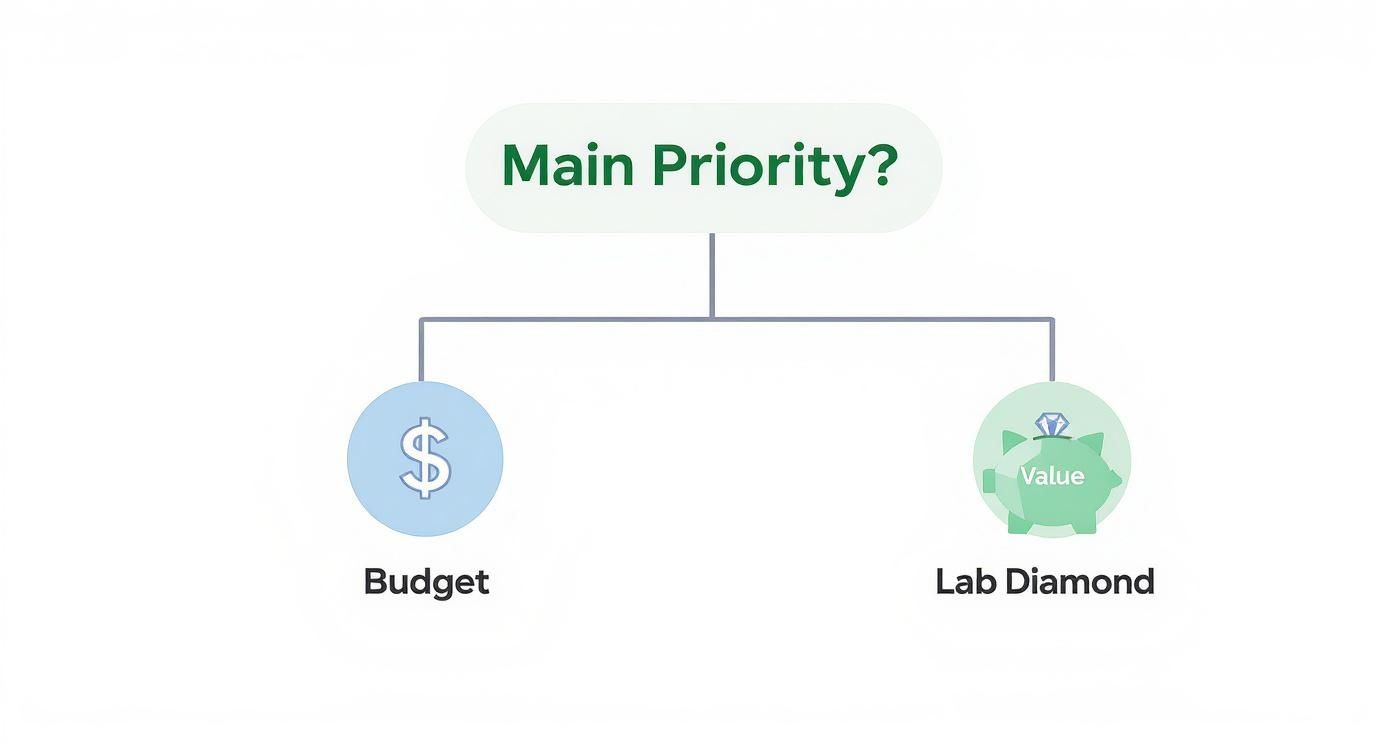
As you can see, if getting the most for your money is the goal, moissanite is the recommended path. If holding onto some intrinsic value is more important, a lab diamond is the way to go.
The Lab Diamond Candidate: Timeless Tradition and Lasting Value
On the other hand, a lab-grown diamond is your stone if you value the heritage and chemical identity of a true diamond. It’s for the person who prefers a classic, crisp sparkle and wants a piece that feels like a future heirloom.
If the thought of passing your ring down through generations resonates with you, a lab diamond is the clear winner. It's chemically identical to a mined diamond, carrying the same sense of prestige and history that has been cherished for centuries. Its modest resale value also offers a practical edge if you ever think about upgrading down the line.
Let's break down when each stone really shines for specific types of jewellery.
- For Daily Wear Engagement Rings: Both are fantastic options. A lab diamond’s 10/10 hardness provides the ultimate defence against scratches, but a moissanite’s 9.25/10 is more than tough enough for a lifetime of wear.
- For Large Statement Pendants or Earrings: Moissanite is often the smarter choice. Its lower price point makes those grand, multi-carat designs accessible without an eye-watering cost.
- For Intricate Eternity Bands: Lab diamonds are usually preferred here. Their precise GIA colour grading ensures a perfect, seamless match between stones, which is crucial for a unified look.
- For Custom, Iced-Out Watches: Moissanite is the pragmatic pick. The sheer number of stones required would make lab diamonds prohibitively expensive for most, while moissanite delivers an equally brilliant finish for a fraction of the cost.
Making a Confident Decision
Ultimately, there’s no single winner in the "moissanite vs lab diamond" debate—only what’s right for you. Take a moment to think about what really excites you when you imagine your finished piece.
Is it the idea of a huge, fiery gem that lights up every room you walk into? If so, moissanite is your clear answer. It delivers a breathtaking visual experience and frees up your budget for more creative freedom in the ring’s design.
Or is it the quiet confidence of wearing a stone that is, in every way that matters, a real diamond? If you’re drawn to the timeless elegance and enduring legacy of a diamond, then a lab-grown option gives you that authenticity, but ethically and more affordably. Both are beautiful, durable, and responsible choices for celebrating life’s biggest moments.
Answering Your Lingering Questions
As we wrap up this detailed comparison, you might still have a few questions floating around. That’s completely normal. This final section is all about clearing up those last few doubts, so you can feel 100% confident in your choice between moissanite and a lab diamond. Let’s get into the questions we hear most often.
Can a Jeweller Tell the Difference?
Yes, absolutely. While moissanite and lab diamonds can look remarkably similar to the naked eye, a trained jeweller can easily distinguish between them. It’s not about just looking, though; it’s about using the right tools that pick up on their different physical and optical properties.
For instance, a standard diamond tester measures how well a stone conducts heat. Diamonds—both natural and lab-grown—are fantastic heat conductors, so they’ll get a positive reading. Moissanite, which is silicon carbide, reacts differently. More sophisticated testers also check for electrical conductivity, which is a dead giveaway—moissanite has it, diamonds don't. A jeweller can get a definitive answer in seconds.
Will My Moissanite Get Cloudy Over Time?
This is a common misconception, but the answer is a hard no. The incredible sparkle of a moissanite is there to stay; it won't fade, cloud up, or lose its colour over a lifetime. Its chemical structure is exceptionally stable and doesn't react to its environment.
If a moissanite (or any gemstone, for that matter, including diamonds) ever looks a bit dull, it's almost always just a buildup of everyday grime—oils from your skin, lotions, or soap residue. The good news is that this is completely temporary. A quick, gentle clean with a soft brush and some mild soapy water will bring back its fiery brilliance in no time.
Your moissanite's sparkle is an inherent part of the stone and will never diminish. Regular, gentle cleaning is all that's needed to keep it looking as brilliant as the day you first wore it.
Which Stone is More Ethical or Sustainable?
Both lab-grown diamonds and moissanite are fantastic ethical choices, side-stepping the conflict and environmental damage associated with traditional diamond mining. Because they are both created in controlled lab settings, you get a clear conscience and a fully traceable stone.
There are, however, slight differences in how they’re made. The processes for creating lab diamonds (HPHT and CVD) are designed to mimic the intense heat and pressure deep within the earth, and that takes a huge amount of energy. Creating moissanite is generally a less energy-intensive process.
- Lab-Grown Diamond: Requires a lot of energy to create but completely avoids land displacement and mining pollution.
- Moissanite: Typically has a smaller carbon footprint because its production process is less demanding on energy.
When it comes down to it, both are vastly more sustainable options than their mined counterparts. The difference between their environmental footprints is pretty small when you compare it to the impact of traditional mining.
Is One Gemstone "More Real" Than the Other?
This question really gets to the core of what makes each stone unique. The best way to look at it is that both are real gemstones, but they are fundamentally different. Neither is a "fake" version of the other.
A lab-grown diamond is a real diamond. It has the exact same chemical makeup (pure carbon), crystal structure, and physical properties as a diamond pulled from the ground. It’s not an imitation; it’s just a diamond with a modern, lab-based origin story.
Moissanite, on the other hand, is a real, distinct gemstone in its own right, composed of silicon carbide. It isn't trying to be a diamond—it has its own unique qualities, like that signature rainbow fire, that make it special. It's like comparing a sapphire to a ruby; both are beautiful, authentic gemstones with their own distinct identities.
At Daniel Fine, we celebrate the unique beauty of both moissanite and lab-grown diamonds. Whether you are drawn to the fiery brilliance of moissanite or the timeless elegance of a lab diamond, our bespoke process ensures your final piece is a perfect reflection of your story. Explore our custom design journey and let's create something extraordinary together.