Designing a custom engagement ring is so much more than a simple transaction. It's about bringing a story to life, crafting a symbol of your relationship that is yours and yours alone. This guide is here to walk you through that entire journey, demystifying every step from that first spark of an idea to the moment you see the finished ring.
The Journey to a One-of-a-Kind Ring
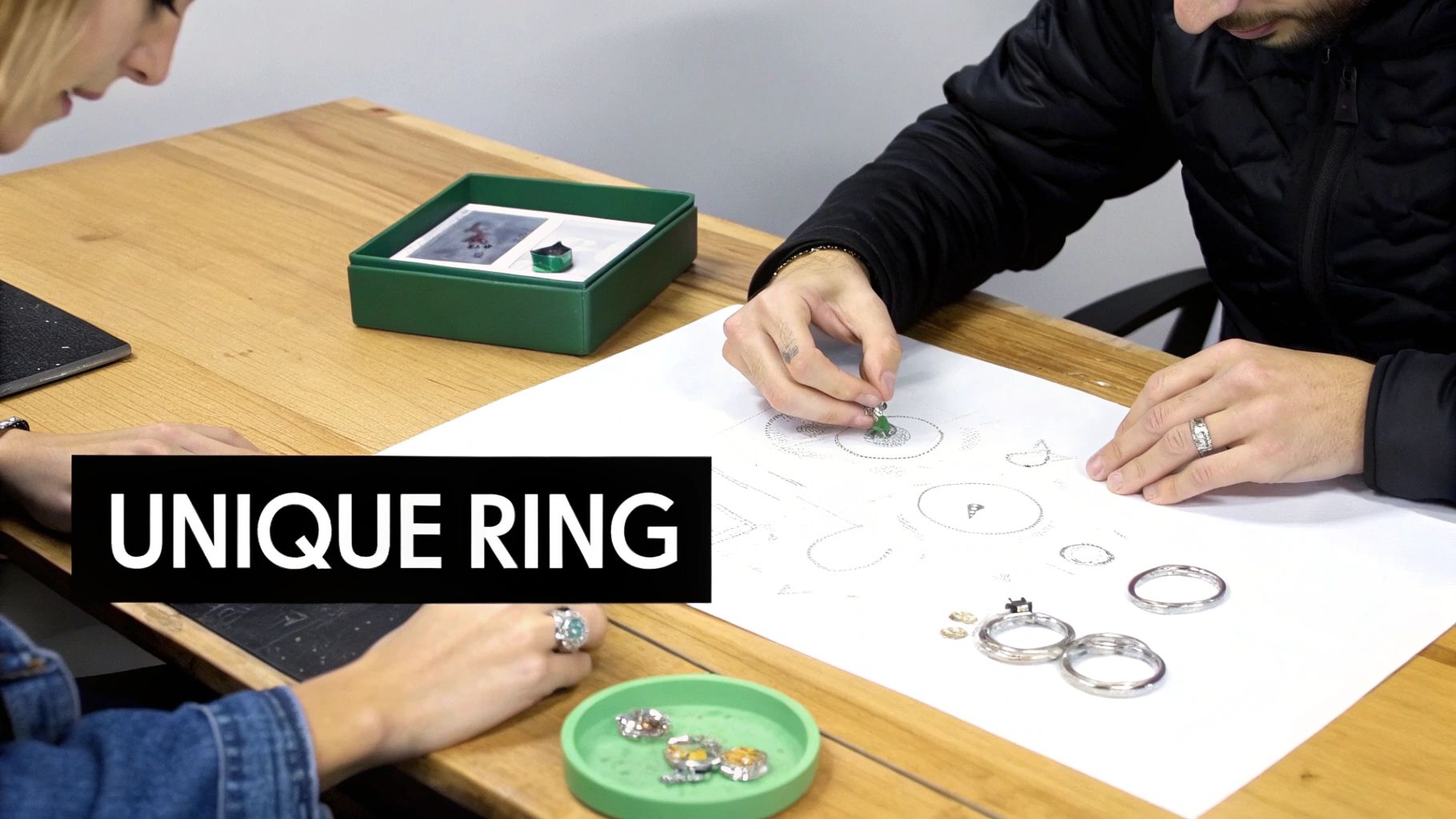
When you decide to create your own engagement ring, you’re taking the driver's seat. It's an empowering choice. Instead of settling for what's already in a display case, you get to build a piece of your legacy from scratch. It's no wonder this approach has become so popular for couples wanting something truly unique and meaningful.
This isn't just a niche trend anymore; it's a fundamental shift in how people think about this major purchase. The move to create your own engagement ring has really taken off in Australia. We've seen a huge jump, with around 35% of couples in 2025 expected to choose custom designs, a big leap from just 20% back in 2015. This trend points to a real desire for personalisation, and you can find more insights on what an engagement ring costs at ddsdiamonds.com.au.
Why Choose a Bespoke Ring
Going custom gives you a level of creative freedom and personalisation that you just can't get from an off-the-shelf ring. It’s an opportunity to weave elements of your story right into the design itself—maybe it's a hidden engraving of a meaningful date, a particular gemstone that holds special significance, or a tiny detail inspired by a shared memory.
The real advantages of designing your own ring boil down to a few key things:
- Total Personalisation: You can perfectly capture your partner’s style. Whether they love clean, modern lines, intricate vintage details, or something completely out of the box, the design is up to you.
- Deeper Sentimental Value: Because you've been a part of every single decision, the ring holds a much deeper story. It becomes a tangible representation of your journey together, not just a beautiful object.
- Complete Budget Control: You’re in charge of where the money goes. You can decide to put more of your budget towards a higher-quality diamond in a simple setting, or you might choose a stunning moissanite and invest in a more complex, detailed band. It’s all about what matters most to you.
The whole point of a bespoke process isn't just to make a ring; it's to create an heirloom. Every choice, from the metal you pick to the way the stone is cut, adds another layer to a story that will be told for generations.
This guide will take you through the entire process, making sure you feel confident and clear every step of the way. We’ll kick things off by helping you define your vision and set a realistic budget. Then, we’ll dive into choosing the perfect materials, working closely with your jeweller, and handling all the final details like sizing and aftercare. By the time you're done reading, you’ll be ready to start this incredibly exciting journey.
Defining Your Vision and Setting a Budget
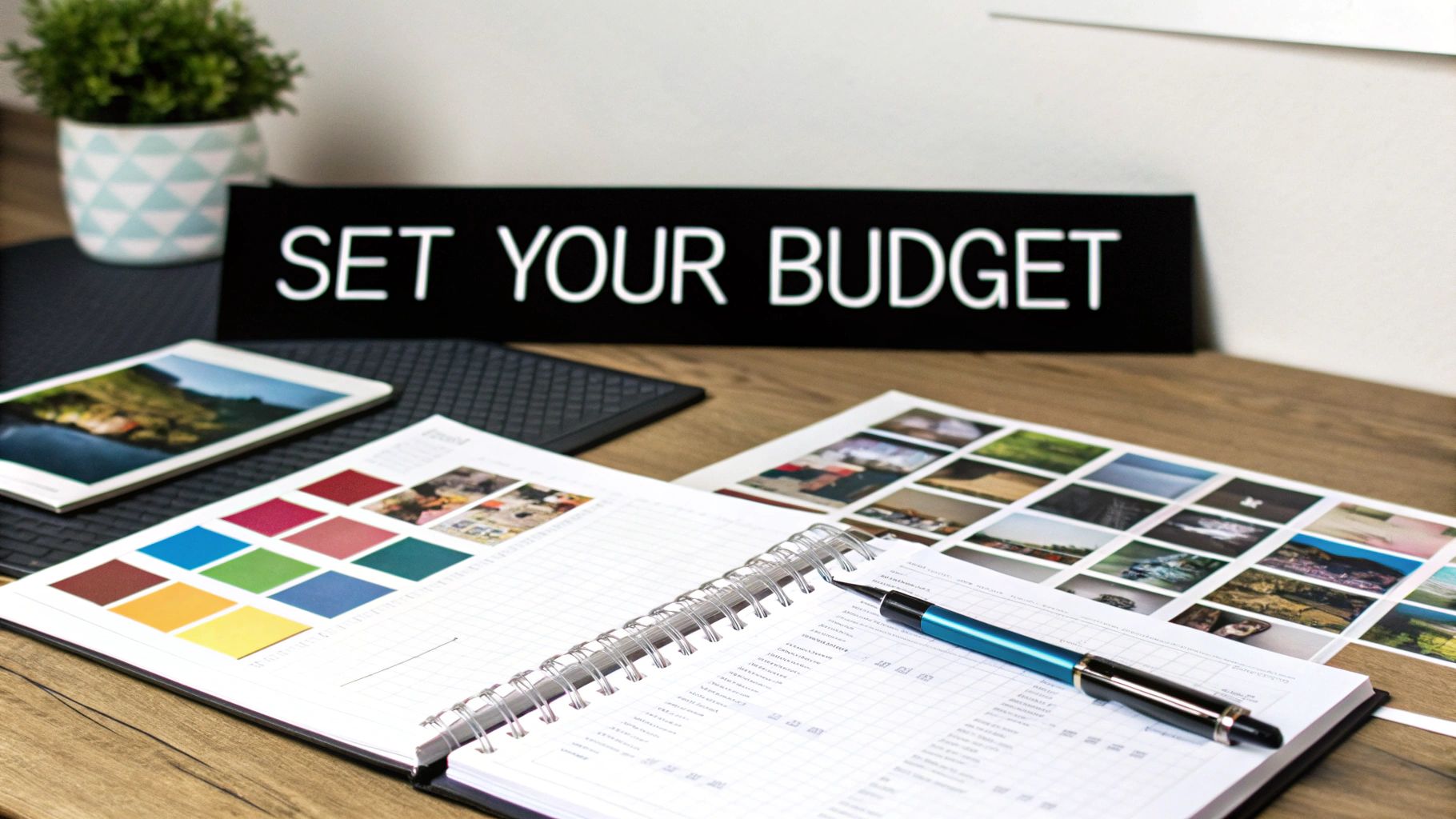
Before you get lost in the brilliant world of gemstones and settings, there are two foundational steps that will shape your entire journey: clarifying your vision and setting a realistic budget. Think of them as two sides of the same coin. Your budget provides the practical framework, while your creative vision breathes life, personality, and meaning into the design.
Getting the numbers sorted out first removes so much of the stress from the process. It's all about landing on a figure you’re genuinely comfortable with—one that fits your financial picture without adding any pressure. Forget the old "three months' salary" rule; it's completely outdated and irrelevant. The right budget is simply the one that feels right for you.
If you're creating this ring as a couple, an honest chat about finances is the perfect place to start. Getting on the same page about what you’re comfortable spending makes the whole experience a true partnership right from the get-go.
How to Set a Realistic Ring Budget
Your budget isn’t a limitation; it’s a creative tool. Knowing your financial boundaries helps you and your jeweller focus on what matters most, ensuring you make the biggest impact with your design choices. For instance, it might help you decide to choose a spectacular lab-grown diamond, which could free up funds for an intricate, hand-finished setting you’ve fallen in love with.
To give you an idea of where the money goes when you create your own engagement ring, we’ve put together a typical breakdown.
Engagement Ring Budget Allocation Guide
Here’s a general guide to how a custom engagement ring budget is often distributed. Keep in mind that these are just starting points, and the beauty of a bespoke process is the flexibility to adjust these allocations to reflect your unique priorities.
| Component | Typical Percentage of Budget | Key Considerations |
|---|---|---|
| Centre Stone | 50% – 70% | This is usually the largest portion of the cost, driven by the 4Cs (Cut, Colour, Clarity, Carat) and your choice of a natural diamond, lab-grown diamond, or moissanite. |
| Setting & Metal | 20% – 40% | Covers the cost of the precious metal (like platinum or gold) and the skilled labour involved in crafting the ring. More detailed designs with pavé stones or engraving will sit at the higher end. |
| Accent Stones | 5% – 10% | If your design includes smaller stones on the band or in a halo, they will fall into this category, adding extra sparkle and influencing the overall cost. |
| Buffer | 5% – 10% | It’s always smart to keep a small buffer in reserve for any last-minute design tweaks, shipping, or insurance costs that might pop up. |
While this table offers a helpful overview, working with a bespoke jeweller like Daniel Fine means you’re in control. If a highly detailed setting is your top priority, we can adjust the plan to make that happen.
Finding and Refining Your Design Inspiration
With a budget in place, the real fun begins: gathering inspiration. Your goal here isn't to find an existing ring to copy, but to collect images and ideas that capture a certain feeling, a particular mood, or an aesthetic that you love. For a truly personal result, look well beyond just other engagement rings.
Inspiration is everywhere.
- Architecture: The sleek, clean lines of a modern building or the ornate details on a heritage facade.
- Nature: The gentle curve of a leaf, the rough texture of tree bark, or the perfect symmetry of a snowflake.
- Art: The rich colours in a favourite painting or the flowing form of a sculpture.
- Personal Style: Your partner’s favourite fashion era, their everyday jewellery, or the patterns they always seem to gravitate towards.
Creating a mood board is a brilliant way to pull all these ideas together. You can use a platform like Pinterest or just a simple folder on your desktop. In the beginning, don't edit yourself—just save everything that catches your eye.
Let your collection sit for a week or two, then come back to it. You’ll be surprised by the patterns that emerge. Maybe you’ve pinned lots of delicate, thin bands, or perhaps you’re consistently drawn to bold, geometric shapes. This is your unique style revealing itself.
This visual brief is worth its weight in gold when you sit down with your jeweller. It communicates a feeling and an aesthetic far more powerfully than words ever could. For example, instead of just saying, "I want something vintage," a mood board filled with Art Deco filigree, milgrain edging, and strong geometric patterns gives the designer a clear, actionable vision. It’s the best way to ensure your idea is understood perfectly, paving the way for a design that is truly and authentically yours.
Picking Your Perfect Stone and Metal
This is where the magic really starts to happen. Choosing the centre stone and the precious metal is like picking the heart and soul of your ring. These two decisions set the entire tone, defining its personality, how it will stand up to daily life, and the overall feeling it gives off.
Forget chasing trends. The right choice is all about what fits your partner’s style, your lifestyle, and, of course, your budget. The stone you land on will dictate the ring's mood—from the fiery, rainbow flashes of a moissanite to the classic, deep brilliance of a natural diamond. The metal is its foundation, providing the colour and strength that will carry it through the decades.
The Great Stone Debate: Natural Diamond vs. Lab-Grown vs. Moissanite
The centre stone is always the star of the show. And today, you’ve got more stunning options than ever before. Deciding between a natural diamond, a lab-grown diamond, or a moissanite is a big deal, as it influences everything from the ring's origin story to its price.
-
Natural Diamonds: These are the real deal, formed billions of years ago deep inside the Earth. Their rarity and unique story are a huge part of their charm; each one is a tiny, one-of-a-kind piece of our planet's history. As the traditional choice, they’re prized for their unmatched hardness (10 on the Mohs scale) and iconic sparkle.
-
Lab-Grown Diamonds: Don’t let the name fool you—these are 100% real diamonds, identical to their natural cousins in every way that matters (optically, chemically, physically). The only difference? They’re grown in a high-tech lab that mimics the earth's natural process. This means you often get a bigger or better-quality stone for your money, and it’s a more sustainable choice.
-
Moissanite: First discovered in a meteor crater (how cool is that?), the moissanite used in jewellery today is created in a lab. It’s famous for its incredible fire and brilliance—often throwing off more rainbow flashes than a diamond. It’s also exceptionally tough, scoring a 9.25 on the Mohs scale, which makes it a fantastic, durable choice for a ring you’ll wear every day.
So, what does this mean for your budget? Let’s say you have a set amount to spend. You might be looking at a 1-carat natural diamond, a 1.5-carat lab-grown diamond, or a fiery 2-carat moissanite. It all comes down to what you value most: the romance of a natural stone, the modern value of a lab-grown diamond, or the dazzling brilliance of a moissanite.
Speaking Diamond: A Quick Guide to the 4Cs
Whether you go for a natural or lab-grown diamond, its quality is always measured by the 4Cs. This is the universal grading system that tells you exactly what you're getting.
- Cut: I always tell my clients this is the most important 'C'. A diamond's cut determines how it plays with light. A masterfully cut diamond will explode with sparkle, while a poorly cut one will just look a bit flat and lifeless, no matter how good its other specs are.
- Colour: Diamonds are graded from D (completely colourless) to Z (light yellow or brown). For that classic, bright white look, most people aim for a stone in the D-G range.
- Clarity: This refers to the tiny imperfections, called inclusions, found in almost every diamond. A truly 'flawless' stone is incredibly rare and expensive. Most diamonds have inclusions that are completely invisible without magnification.
- Carat: This is simply the diamond's weight, not its size. A bigger carat number doesn't always mean a bigger-looking stone—the shape and cut have a huge say in how large it appears on the finger.
Choosing the Right Metal for the Band
The metal you choose does so much more than just hold the stone; it’s the supporting act that sets the entire stylistic stage. Your choice here impacts the ring's colour, its heft, and how it will need to be cared for over the years.
Platinum
This is the top-tier choice. Platinum is naturally white, so it will never fade or change colour. It's also dense, durable, and hypoallergenic, making it perfect for sensitive skin. When it gets scratched, the metal just moves aside instead of being worn away, developing a beautiful soft finish, or patina, over time.
White Gold
A hugely popular and timeless option, white gold is created by mixing yellow gold with white metals like palladium. To get that bright, silvery shine, it’s plated with rhodium. This looks fantastic, but the plating will need to be redone every few years to keep it looking its best.
Yellow Gold
You can't beat yellow gold for a warm, classic glow. It has a rich, traditional feel and looks especially stunning against warmer skin tones. It is a bit softer than platinum, so it can show scratches more easily, but a quick trip to the jeweller for a polish makes it look brand new.
Rose Gold
This romantic, pinkish metal gets its beautiful hue from adding a copper alloy to yellow gold. It’s a very durable and stylish choice that looks great on virtually every skin tone, offering a look that feels both modern and a little bit vintage.
Ultimately, the best metal often comes down to personal taste and day-to-day life. If your partner is very active or works with their hands, the rock-solid durability of platinum might be the way to go. If they adore a warm, classic vibe, yellow gold is a perfect match.
When you work on a bespoke ring with Daniel Fine, we can play with all these combinations. Seeing how different stones look against each metal in real life is the best way to find that perfect harmony—a piece you’ll both be thrilled with for a lifetime.
Bringing Your Ring Design to Life
This is where all your ideas, a collection of saved photos, and late-night conversations finally start to become something real. Working with a jeweller to bring your vision to life is a creative partnership. It’s all about translating the feelings and styles you love into a tangible piece of art, and clear communication is what makes it all work.
The whole bespoke journey is broken down into clear stages, so you always feel in control and confident about what's happening next. It all kicks off with turning your inspiration into an initial concept.
From Sketch to Digital Perfection
First things first, we need to get your ideas out of your head and onto paper (or a screen). A skilled jeweller, like our team at Daniel Fine, will take your design brief and mood board and begin sketching out some initial concepts. Think of this as a creative brainstorming session. We'll play around with different shapes, proportions, and tiny details without locking anything in. It's the perfect way to explore a few directions and zero in on what you truly love.
Once we’ve nailed down a concept, we move from artistic sketches to precision engineering with the help of Computer-Aided Design (CAD). This is where your jeweller creates an incredibly detailed 3D digital model of your ring. It's much more than just a picture; it's a perfect, to-scale blueprint showing every angle, curve, and dimension. You'll see exactly how the stone sits in its setting, the thickness of the band, and how all the little details look from every possible viewpoint.
The CAD rendering is without a doubt the most important approval stage when you create your own engagement ring. This is your final chance to request tweaks before the ring is physically crafted. Don’t hold back—zoom in, ask questions, and make sure every last element feels absolutely right to you.
The core decisions you've made up to this point are the essential building blocks for this final design.
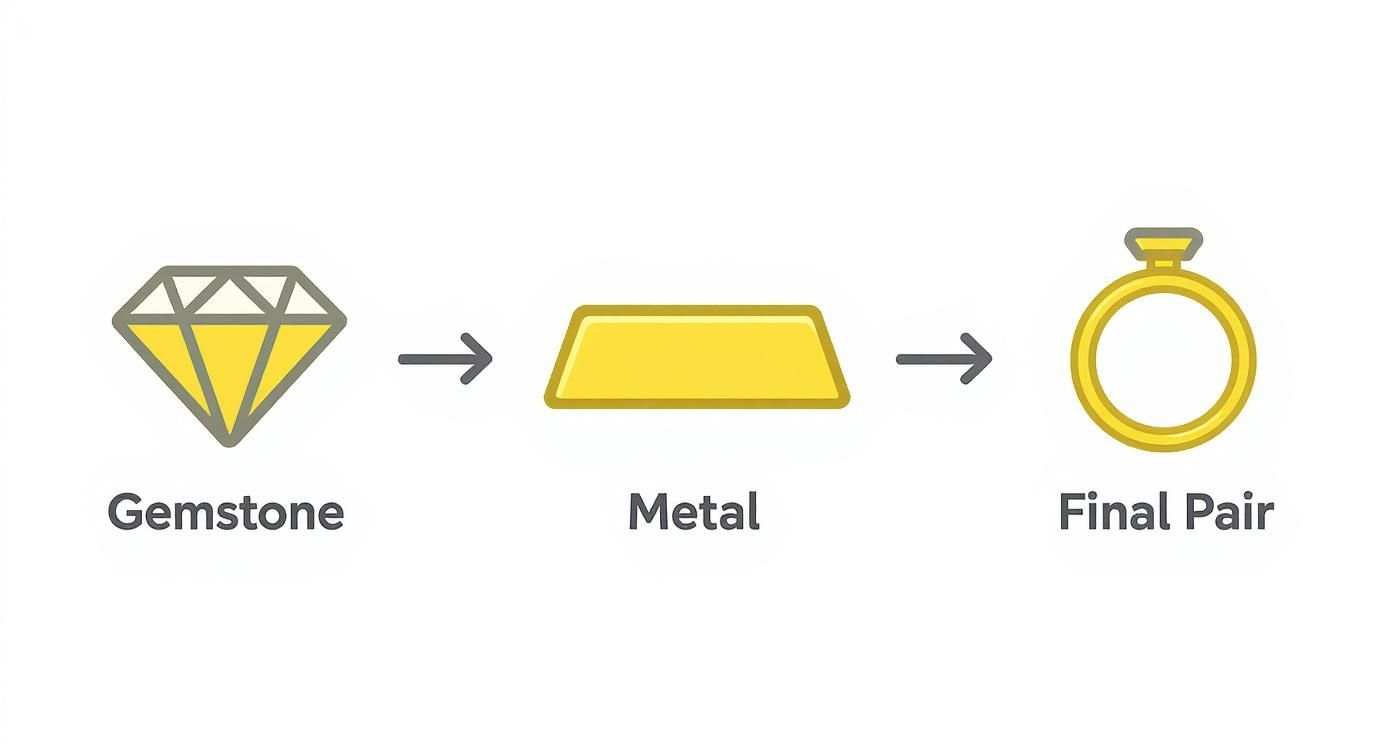
This just shows how those two foundational choices—the gemstone and the metal—come together to create a final, cohesive piece.
The Hands-On Crafting Process
Once you’ve given the final thumbs-up on the CAD design, the real magic begins. That digital file is used to 3D print a perfect wax or resin model of your ring. Holding this model for the first time is often a pretty amazing moment for our clients. It's the first time you get to feel the ring’s true shape and size, making the whole project feel incredibly real.
This physical model is then used to create a plaster mould for casting. Molten precious metal—whether it's platinum, yellow gold, or rose gold—is poured into the mould, which creates the raw casting of your ring. It’s a process that demands incredible skill and precision, turning liquid metal into the solid foundation of a future heirloom.
From there, the ring is passed into the hands of a master jeweller for the delicate finishing work. This is where true craftsmanship shines.
- Refining and Pre-polishing: The raw casting is meticulously filed, sanded, and cleaned up. Every surface is smoothed and the shape is perfected, getting it ready for the main event.
- Stone Setting: This is a highly skilled art form. The jeweller carefully cuts the seats for the gemstones and secures each one in place, making sure they’re perfectly level, secure, and positioned to catch the most light.
- Final Polish and Finishing Touches: The ring gets a final, intensive polish to bring out that brilliant shine. If you've requested any special finishes, like a matte texture or milgrain detailing, they're applied now before a final quality check ensures every detail is flawless.
A great bespoke jeweller will keep you in the loop throughout this entire process. At Daniel Fine, we believe in being completely transparent, often sharing progress photos or videos so you can watch your ring come to life. This partnership ensures the final piece isn't just something you bought, but something you genuinely helped create—the perfect symbol of your story, ready for its next chapter.
The Finishing Touches: Sizing, Timing, and Aftercare
Once you’ve signed off on the design, the excitement really starts to build. While our artisans get to work crafting your ring, we can turn our attention to the final, crucial details that will make the proposal seamless and ensure the ring is cherished for a lifetime.
Getting these last few things right is just as important as picking the perfect stone. It’s all about making sure the ring not only fits perfectly on the day but stays just as stunning for all the years to come.
Nailing the Perfect Ring Size
This can be the trickiest part of a surprise proposal, a real Mission: Impossible moment. An ill-fitting ring can throw a slight wrench in the works, and we want that moment to be perfect. Too tight, and it’s uncomfortable; too loose, and there's the constant worry of it slipping off.
If you're planning a surprise, you'll have to do a bit of detective work. Here are a few methods I’ve seen work time and time again:
- Borrow a ring they already wear. If you can, discreetly borrow a ring they often wear on the correct finger and bring it to a jeweller. Just make sure it’s one they won't miss right away!
- Trace the inside circle. Can’t sneak the ring away? No problem. Place it on a piece of paper and carefully trace the inside of the ring with a very sharp pencil. A good jeweller can usually get a precise measurement from a clean tracing.
- Recruit an accomplice. A close friend or a family member can be your secret weapon. They might suggest trying on rings for fun while out shopping or cleverly bring up ring sizes when talking about a gift for someone else.
Just remember that fingers can swell and shrink a little throughout the day depending on the temperature or what you’ve been doing. The best time to get a measurement is when their hands are a normal temperature—not right after a gym session or first thing in the morning.
A little insider tip: It's almost always easier to make a ring smaller than it is to make it bigger, particularly with delicate pavé bands. If you're genuinely torn between two sizes, going slightly larger is the safer move.
Understanding the Production Timeline
When you create your own engagement ring, you’re commissioning a piece of art. Good things take time, and rushing the intricate work of a master jeweller is never a good idea. Knowing the timeline helps you plan everything else without any last-minute panic.
Typically, from the moment you approve the final CAD design, you can expect the crafting process to take between four to eight weeks. This window can shift slightly based on how complex your design is.
Here’s a quick look at what’s happening behind the scenes during that time:
- Casting & Assembly (1-2 weeks): Your ring is cast in your chosen precious metal, and all the individual components are carefully pieced together.
- Stone Setting (1-3 weeks): This is where the magic happens. It’s a painstaking process where our jewellers securely set each stone by hand. It requires incredible precision, especially for intricate halo or pavé settings.
- Finishing & Polishing (1 week): The ring gets its final polish and finishing touches before going through a meticulous quality control check to ensure every single detail is perfect.
Always let your jeweller know your ideal proposal date right from the start. Here at Daniel Fine, we map out a clear timeline with you from our very first conversation, making sure your ring is ready for your special day.
Aftercare for a Lifetime of Sparkle
Your ring is made to be worn and enjoyed every day, but a little bit of care will go a long way in keeping it as brilliant as the day you first saw it. Taking care of it properly protects your investment and makes sure it never loses its fire.
We always suggest a simple at-home cleaning routine every few weeks. All you need to do is soak the ring in a bowl of warm water with a couple of drops of gentle dish soap for about 30 minutes. Then, use a soft-bristled baby toothbrush to gently scrub away any build-up, especially behind the stones. Rinse it, pat it dry with a lint-free cloth, and you’re done.
Of course, nothing beats a professional service. We recommend bringing the ring in for a professional clean and inspection at least once a year. During this check-up, your jeweller will:
- Check that all the prongs are tight and the stones are secure.
- Inspect the band for any signs of wear.
- Give it a deep, ultrasonic clean that restores its showroom shine.
One last thing—and it’s important—is to get your ring insured. A good jewellery insurance policy gives you peace of mind against loss, theft, or damage. Your jeweller will provide you with a detailed appraisal for insurance purposes, which documents the ring's unique characteristics and value. It’s a small step that protects your beautiful, custom-made symbol of love for life.
Got Questions? Let's Talk Custom Rings
Jumping into the world of custom jewellery for the first time? It's completely normal to have a few questions. The decision to create your own engagement ring is a huge one, and you want to feel totally confident before you start. Let's walk through some of the most common things people ask when they're just getting started.
How Long Will It Take to Make My Ring?
This is usually the first question on everyone's mind, especially when there's a special date circled on the calendar! As a general rule, you should plan for the entire custom process to take between six to twelve weeks.
That timeline isn’t just a random number; it covers every meticulous step. We spend the first two to four weeks in the design phase—chatting with you, sketching ideas, and perfecting the 3D CAD model until you're thrilled with it. Once you give the final thumbs-up, our jewellers get to work. The actual hands-on crafting, from casting the metal to setting the stones and the final polish, takes another four to eight weeks.
My best advice? Start the conversation at least three months before you plan to propose. It gives us all a comfortable buffer and ensures the craftsmanship is never, ever rushed.
Does a Custom Ring Cost More Than a Ready-Made One?
This is a big misconception I'm always happy to clear up. It’s easy to assume "custom" means "more expensive," but that’s rarely the case. In fact, going bespoke often gives you more control over your budget, not less.
You’re in the driver’s seat. You decide where to allocate your funds. For instance, you could pour your budget into a spectacular, high-clarity lab-grown diamond and set it in a simple, elegant solitaire band. Or, you could opt for a brilliant moissanite, which frees up money for a really intricate, hand-engraved setting with tiny pavé diamonds.
Often, a custom-designed ring ends up costing about the same as a similar quality designer ring off the shelf, but it comes with something you can't put a price on: your personal story.
The real value of a bespoke ring isn’t just in the metal and stones. It’s in the story it tells. You're not buying from a catalogue; you're investing in a piece that is uniquely yours.
What if I Have No Idea What I Want?
Perfect! Seriously, that’s a great place to start. You don’t need to walk in with a detailed architectural drawing of your dream ring. A good bespoke jeweller is a bit of a design detective—we’re experts at uncovering a beautiful design from your partner's style, your memories, and your feelings.
Bring anything and everything that inspires you. It could be a Pinterest board, a photo of a building with cool Art Deco lines, or even just a feeling you want the ring to evoke. We'll ask the right questions, show you different elements, and piece it all together. Think of it as a creative workshop where we turn abstract thoughts into a design you'll both fall in love with.
Can I Use a Family Gemstone in the Ring?
Without a doubt. Using an heirloom stone is one of the most meaningful things you can do. It’s a powerful way to weave your family's history into your future, and the sentimental value is just incredible.
Before we start designing, our gemmologist will carefully inspect the stone. We need to check its condition—looking for any tiny chips or internal weaknesses that could make re-setting it risky. As long as it's sound, we'll design a new setting that's made-to-measure, perfectly protecting and showcasing its unique character. It's about creating a modern classic that honours your legacy.
Ready to begin your own story in gold and stone? At Daniel Fine, we live for turning a personal vision into a timeless piece of art. Take a look at our bespoke process and let's start the journey together.