When you think of a garnet, what colour comes to mind? For most people, it’s a deep, dramatic red. And while that classic crimson is undeniably beautiful, it’s only a tiny glimpse into the true world of this incredible gemstone.
Garnet isn't actually a single stone at all; it’s a diverse family of gems that comes in almost every colour of the rainbow.
Discovering the True Colours of Garnet
Welcome to the vibrant world of garnet, January's birthstone. Let’s set aside the idea of it being just a simple red gem. Instead, think of it as a whole collection of different stones, each with its own unique personality and chemical recipe. This guide will walk you through its incredible and often surprising colour palette.
From the fiery reds of Pyrope, to the lush, vibrant greens of Tsavorite, and the warm sunset oranges of Spessartine, the garnet family offers a versatility that few other gemstones can match. We’ll explore what gives each variety its signature hue and show you why this amazing range makes garnet such a compelling choice for bespoke jewellery.
More Than Just a Pretty Stone
Garnet has been treasured for centuries, steeped in symbolism and history, especially as the birthstone for January. Its traditional red colour has long been linked to protection, deep commitment, and friendship—qualities that resonate strongly, from Western Australian Indigenous culture to the broader Australian heritage.
It's no surprise that garnet remains a top seller for birthstone jewellery in Australia, with consumer interest jumping by up to 30% every January. You can dive deeper into the fascinating history of January's birthstone on borsheims.com.
By exploring the full garnet colour spectrum, you can find a gem that does more than just represent a birth month—it can perfectly capture a unique personality or style.
Whether you're drawn to its timeless symbolism or its stunning modern array of colours, garnet truly offers something for everyone. Its journey from an ancient talisman to a contemporary design staple makes it a gem that's always ready to be rediscovered.
Meet the Entire Garnet Family of Gemstones
To think of garnet as just one type of stone is like saying all music is just one song. In reality, the garnet is a surprisingly large and diverse family of related minerals. Each member shares a common crystal structure, but it’s their unique chemical makeup that gives each one a distinct colour and personality.
Think of it like this: nature is the artist, the basic garnet structure is the canvas, and trace elements like iron, manganese, and chromium are the pigments. A dash of this, a touch of that, and nature paints an incredible array of gemstones, turning the garnet family into a true masterpiece of variety.
The Famous Red Garnets
When most people picture a garnet, they’re usually thinking of one of these two classic varieties. They're the most common and accessible members of the family, known for those rich, warm tones that have been adored for centuries.
- Pyrope Garnet: Its name comes from the Greek for "fire" and "eye," which is a perfect fit for its fiery, crimson-red hue. This is the quintessential garnet colour, often with a slight brownish tint that gives it a timeless, classic look.
- Almandine Garnet: As the most common type of garnet, Almandine is typically a deeper, more purplish or brownish-red than Pyrope. This gives it a sophisticated, almost moody character, making it a durable and beautiful choice for any jewellery.
And when Pyrope and Almandine mix? You get one of the most beloved garnet varieties of all: Rhodolite. This popular gem shows off a gorgeous raspberry or purplish-red colour that’s noticeably brighter and more vibrant than its parent stones.
This infographic highlights garnet's core symbolism as January's birthstone, connecting it to powerful themes of friendship and protection.
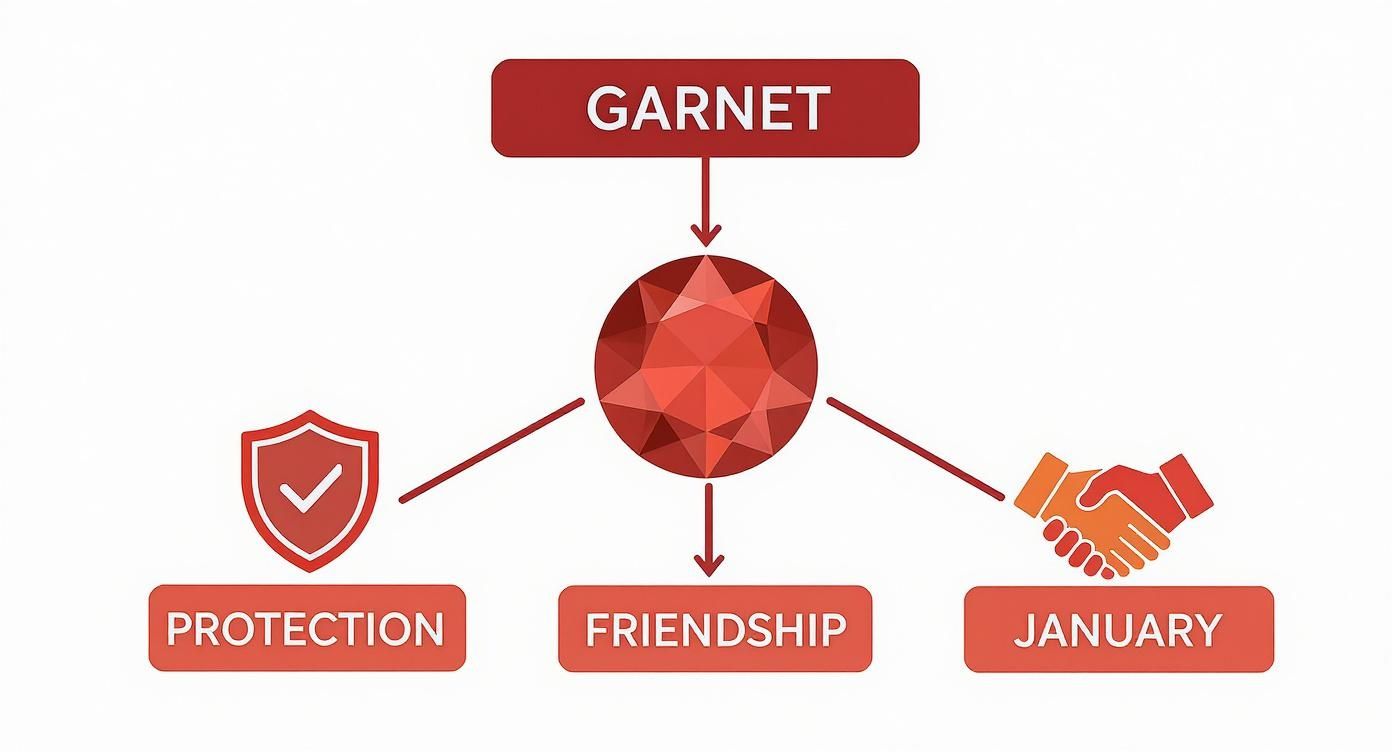
As you can see, the garnet's identity is deeply rooted in its roles as both a birthstone and a symbol of meaningful human connections.
The Vibrant Oranges and Greens
Step away from the traditional reds, and the garnet family tree branches out into some truly spectacular colours. We're talking everything from sunny oranges to lush greens. These varieties are often rarer and highly prized by collectors and jewellery designers looking for something special.
Spessartine Garnet is famous for its brilliant orange to reddish-orange hues. The most sought-after variety is the electric Mandarin Garnet, which practically glows with an intense orange colour that brings a sunset to mind.
Then you have the Grossular Garnet group, which is perhaps the most colourful branch of the entire family, containing several incredibly important varieties.
Grossular garnets really show off the incredible versatility of this gemstone family. They prove that garnets can go toe-to-toe with the finest green and orange stones on the market, like emeralds and orange sapphires.
Here are a few of the standouts:
- Hessonite Garnet: Often called the "Cinnamon Stone," it’s known for its warm, honey-yellow to brownish-orange colour.
- Tsavorite Garnet: A stunning and rare green garnet that rivals the finest emeralds with its pure, vivid green. It was only discovered in the 1960s but has quickly become one of the most desirable garnets out there.
- Demantoid Garnet: Another rare and valuable green variety, Demantoid is treasured for its incredible brilliance and fire—a sparkle that can actually exceed that of a diamond. It’s truly the superstar of the garnet family.
A Guide to the Garnet Family Colors and Varieties
With so many incredible options, it helps to see them side-by-side. This table offers a comparative look at popular garnet varieties, their signature colours, and the key features that will help you identify each one.
| Garnet Variety | Primary Colors | Distinguishing Feature | Common Association |
|---|---|---|---|
| Pyrope | Fiery crimson-red, often with brownish tints | The classic "pomegranate seed" red | Timelessness & Passion |
| Almandine | Deep purplish or brownish-red | The most common and widely available red garnet | Strength & Durability |
| Rhodolite | Vibrant raspberry to purplish-red | A beautiful blend of Pyrope and Almandine | Inspiration & Love |
| Spessartine | Bright orange to reddish-orange | Known for its "Mandarin" variety's electric glow | Creativity & Confidence |
| Hessonite | Honey-yellow to brownish-orange ("Cinnamon") | Often has a treacly, liquid-like internal appearance | Success & Good Fortune |
| Tsavorite | Vivid, pure green | A rare and brilliant alternative to emerald | Vitality & Prosperity |
| Demantoid | Bright green with exceptional sparkle | Has a fire and brilliance greater than a diamond | Rarity & Prestige |
From the deep, familiar reds to the exotic, fiery greens, the garnet family offers a world of colour to explore. Each variety has its own story and charm, ensuring there's a perfect garnet out there for every personality and occasion.
Uncovering Garnet's Rich History and Symbolism
Garnet is so much more than just a beautiful stone; it's a gem woven right through the fabric of human history. Its story starts thousands of years ago, with roots stretching back to ancient civilisations that were captivated by its deep, glowing colour. Long before it was the January birthstone, garnet was a powerful symbol of life, power, and protection.
The ancient Egyptians, for instance, adorned their pharaohs with garnet necklaces. They believed the stone held protective qualities that would see them safely through not just life, but the afterlife too. That rich red hue was, to them, the very symbol of lifeblood.
This belief in garnet's protective power wasn't unique to Egypt. Roman leaders had intricately carved garnets set into signet rings. These weren't just for show; they were practical tools used to press into wax and seal important documents, making the garnet's image a stamp of authority.
From Ancient Talisman to Modern Gemstone
As history marched on, the meaning attached to garnet only deepened. During the Middle Ages, it was common for travellers and crusaders to carry garnets, trusting the gem to light their path and shield them from harm on long, dangerous journeys. It was often called the "Carbuncle," a name given to red gems thought to glow with their own inner fire.
This deep-rooted connection to light, guidance, and safety really cemented its reputation as a stone of steadfastness and resilience.
Garnet evolved into a powerful symbol of trust, eternal friendship, and unwavering commitment. Friends and lovers would often exchange them as a promise to meet again, turning the gem into a deeply personal and meaningful gift.
This rich history of loyalty and connection is precisely what made garnet the perfect choice for the birthstone of January, a month that's all about new beginnings and firm resolutions.
A Global Story with a Local Australian Connection
While the garnet's story spans the globe, Australia plays a surprisingly big part in its modern chapter. In fact, Australia is a major source, producing nearly 50% of the world's industrial garnet supply. On top of that, beautiful gem-quality garnets are also found in smaller commercial fossicking sites across the country.
Places like Queensland's Mount Garnet area yield not only the classic reds but also rarer green varieties, showcasing the incredible diversity of the garnet colour birthstone found right here. These local deposits are usually linked to the intense volcanic and metamorphic activity that shapes a garnet's final colour and character. You can learn more about Australia's unique garnet deposits on the Geoscience Australia website.
From an ancient pharaoh’s talisman to a locally sourced treasure, garnet’s incredible journey through time gives it a depth and meaning that few other gemstones can match.
How Colour and Clarity Shape a Garnet's Value
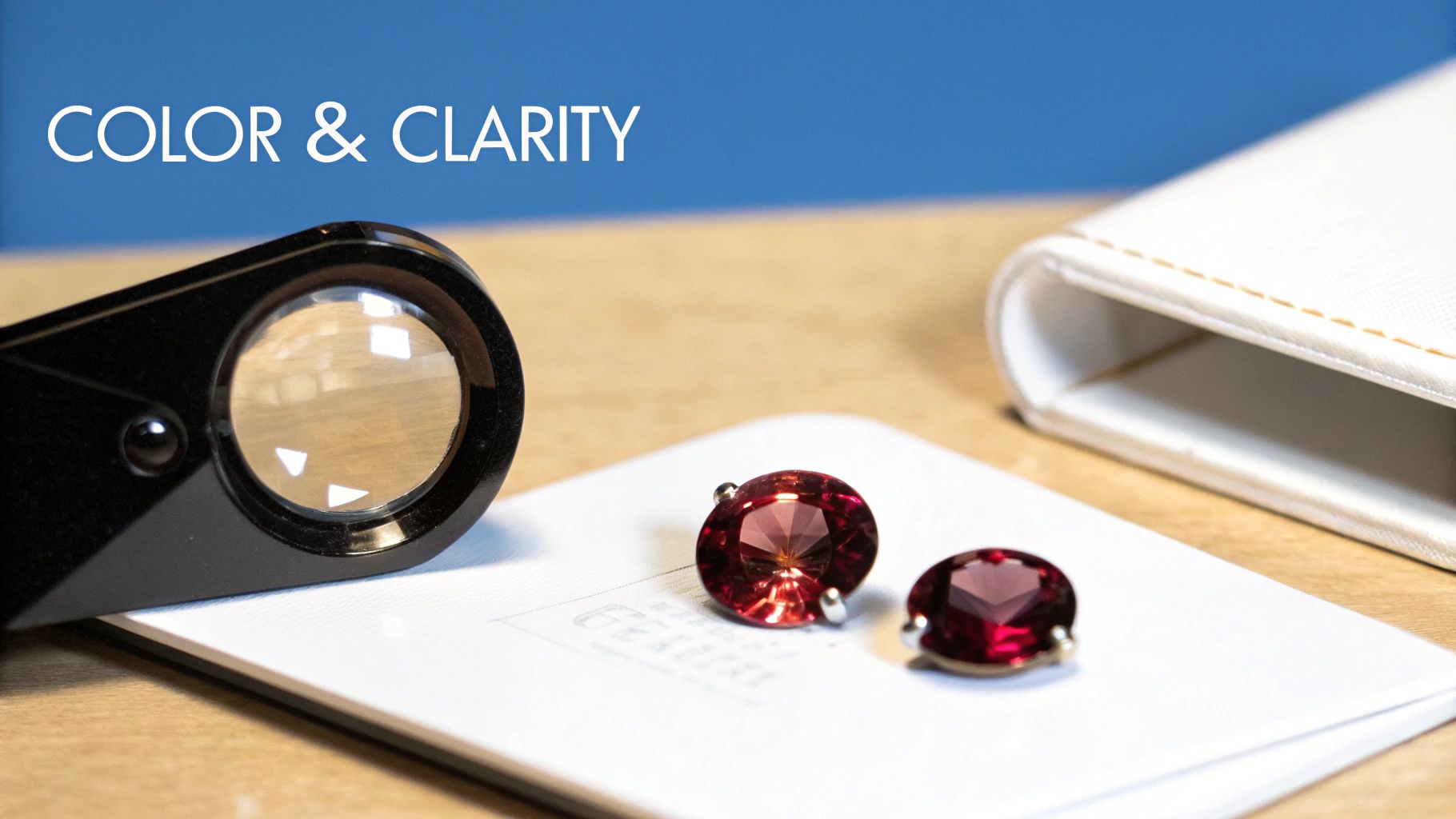
Ever wonder what makes one garnet catch the light just so, or why its price tag might be surprisingly high? While a few things come into play, it really boils down to its unique blend of colour, clarity, and cut. We often hear about the '4Cs' for diamonds, but for garnets, the rules are a bit different—here, the vibrancy and rarity of the hue take centre stage.
Think of it like this: two paintings might be the same size, but the one with deeper, more intense colours is the one that truly captivates you. It's the same with garnets. A stone's value is driven first and foremost by the sheer quality of its colour.
Colour Is King
In the world of garnets, nothing matters more than colour. The classic deep red Almandine is undeniably beautiful and quite common, but the truly valuable stones are the ones flaunting rarer shades. A gem's price can skyrocket based on the saturation and intensity of its hue.
For instance, a vivid green Tsavorite or a fiery orange Mandarin garnet can fetch many times the price of a red garnet of the same size and quality. These exotic colours are simply harder to come by, making them coveted by collectors and designers alike. A garnet with a dull, brownish tone will always be less valuable than one with a pure, vibrant crimson fire.
The rule of thumb is simple: the purer, more intense, and rarer the colour, the higher the value. A top-quality Demantoid garnet, for example, is one of the most precious gems in the world, often eclipsing the price of exceptional diamonds.
This intense focus on colour means that a smaller garnet with incredible saturation can easily be worth more than a larger stone with a less impressive hue.
The Importance of Clarity and Cut
Once colour is assessed, clarity is the next big factor. Thankfully, most garnets are naturally "eye-clean," which means you won't see any distracting inclusions just by looking at them. While some varieties, like Hessonite, are known for their unique internal textures, a crystal-clear appearance is generally what you want, and it certainly adds to the gem's value.
Finally, the cut is what truly brings a garnet to life. A masterful cut isn't just about creating a shape; it's about engineering precise angles that guide light into the stone, let it bounce around inside, and return it to your eye as a dazzling sparkle.
A well-cut garnet will have:
- Excellent Light Performance: The stone will look bright and alive, with no dull or dark patches.
- Symmetrical Facets: Every facet should be perfectly aligned and polished to maximise that brilliant flash.
- Enhanced Colour: The cut must be deep enough to show off the richness of the garnet's colour without letting it look too dark or moody.
A clumsy cut can make even the most stunning rough stone appear lifeless. On the flip side, an expert cut can elevate a good stone into something truly spectacular, dramatically boosting its beauty and its worth.
How to Choose Your Perfect Garnet Jewellery
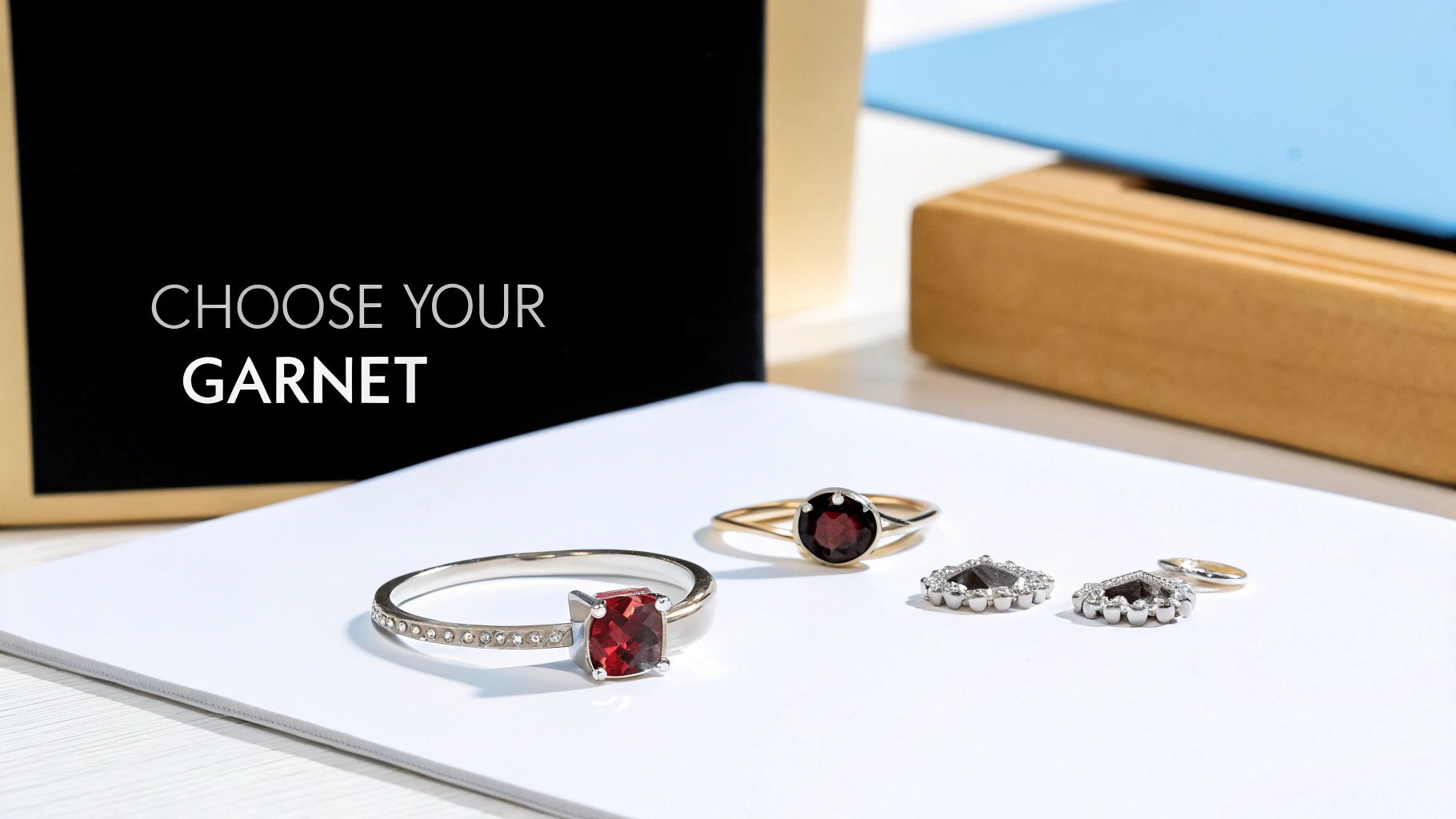
This is where the magic happens—turning your newfound appreciation for the garnet into a piece of jewellery you’ll treasure forever. The real artistry lies in selecting the right design elements to make your chosen gemstone sing. The cut, the metal, and the setting all play a crucial role, working in harmony to highlight the stone’s unique beauty and create something that truly reflects your personal style.
It all starts with the cut. Think of it as the key that unlocks a garnet’s inner fire. A masterfully executed cut is far more than just a shape; it's a precise arrangement of facets that act like tiny mirrors, bouncing light around inside the stone to maximise its sparkle and intensify its colour.
Finding the Right Cut for Your Garnet
Different cuts bring out the best in different types of garnets. While you can never go wrong with a classic round brilliant cut—it's designed for maximum sparkle in any gem—some shapes are a particularly perfect match for specific varieties.
- Oval and Pear Cuts: These elegant, elongated shapes have a wonderful way of making a gemstone look larger. They’re fantastic for showcasing the vibrant, saturated hues of a Rhodolite or the fiery orange of a Spessartine garnet.
- Emerald Cut: This cut is all about clean lines and quiet confidence. Its long, stepped facets create a mesmerising "hall of mirrors" effect, making it the perfect choice for a green Tsavorite, where exceptional clarity and deep, pure colour are the stars of the show.
- Cushion Cut: With its soft, rounded corners and vintage charm, the cushion cut feels romantic and timeless. It’s an absolutely beautiful match for the deep, passionate reds of Pyrope and Almandine garnets.
Matching Metals and Settings to Your Stone
The metal you choose for your setting can completely transform the look and feel of your jewellery. You can create a harmonious look or a striking contrast. For instance, the warmth of yellow gold beautifully complements rich red and orange garnets, creating a look that is both classic and luxurious. On the other hand, setting a cool green Tsavorite in bright platinum or white gold creates a stunning contrast that makes the gemstone’s colour truly pop.
The setting itself does two very important jobs: it holds your garnet securely in place, and it defines the overall style of the piece.
A setting isn't just a functional claw holding a gem; it's a vital part of the design narrative. It dictates how light interacts with the stone and how well-protected it is against the knocks of daily life.
A prong setting, for example, uses the least amount of metal possible, lifting the stone up to allow light to flood in from every angle. This creates breathtaking brilliance, perfect for a special occasion or statement piece. At the other end of the spectrum, a bezel setting fully encircles the gem with a thin metal rim. This offers maximum protection, making it an excellent, worry-free choice for a ring you plan to wear every day.
Here at Daniel Fine, we can walk you through all these options, helping you design a custom setting that perfectly suits both your garnet and your lifestyle.
Keeping Your Garnet Jewellery Beautiful for Life
Garnet is a pretty resilient stone, scoring between 6.5 and 7.5 on the Mohs hardness scale. This makes it tough enough for everyday wear, but like any piece of fine jewellery, a little bit of care will go a long way in keeping it pristine. Luckily, it’s not complicated.
The best way to bring back your garnet’s sparkle is with a simple at-home clean. All you need is a bowl of warm water with a few drops of mild dish soap. Let your jewellery soak for a couple of minutes, then use a soft toothbrush to gently clean around the setting and behind the stone where grime tends to build up.
Once you’re done, give it a good rinse under clean, warm running water and gently pat it dry with a soft, lint-free cloth. This quick and easy routine is perfect for washing away the daily build-up of oils and dust, restoring that beautiful fire without any harsh chemicals.
Cleaning and Storage Best Practices
While garnets are generally quite sturdy, it's wise to treat them with respect. Avoid exposing them to harsh chemicals like bleach and ammonia, and steer clear of sudden, extreme temperature changes, as this can put stress on the stone.
The secret to preserving your garnet isn't about intensive cleaning; it’s about gentle, consistent care. Think of it like a fine silk shirt – it doesn’t need rough handling to look its best.
How you store your jewellery is just as important as how you clean it. To keep your garnets from getting scratched, store each piece separately in a soft pouch or in a jewellery box with a fabric-lined compartment. This prevents harder gems, like diamonds or sapphires, from accidentally scuffing their surface.
Here are a few simple rules to keep in mind:
- Avoid Ultrasonic Cleaners: While they work wonders for some gemstones, they can be risky for garnets that might have internal fractures. It’s always safer to stick with soap and water.
- Remove During Strenuous Activity: Before you head into the garden, hit the gym, or tackle heavy chores, take off your garnet rings and bracelets. This will protect them from any hard knocks or impacts.
- Seek Professional Checks: It’s a great idea to have a professional jeweller, like us here at Daniel Fine, give your pieces a once-over every year or so. We can check that the settings are still tight and the stone is in perfect shape.
Common Questions About the Garnet Birthstone
After diving deep into the world of garnet, a few questions still tend to surface. Let's tackle some of the most common curiosities to round out your understanding of this incredible gemstone family.
Are All Red Gemstones Garnets?
It’s a great question, and the simple answer is no. While garnet is famous for its gorgeous reds, it shares the stage with other popular gems like rubies, spinels, and red tourmalines. Each has its own identity – rubies, for instance, are much harder and often command higher prices. An experienced jeweller can spot the difference in a heartbeat.
Even within the garnet family itself, the variety of reds is stunning. You have the fiery, almost orangey-red of a Pyrope garnet, which feels warm and vibrant. Then there's the deep, wine-red of Almandine, which has a richer, more purplish tone. Each one tells a slightly different story.
What Is the Rarest Garnet Colour?
This is where garnet really surprises people. The rarest and most valuable colours are actually the brilliant greens. Demantoid garnet is the stuff of legends, known for a fire and brilliance that can actually outshine a diamond. Its rival, Tsavorite garnet, is coveted for a pure, intense green that gives the finest emeralds a run for their money.
But the rarest of them all might just be the blue garnet, a phenomenal stone only discovered in the 1990s. This collector's dream is a colour-change gem, shifting from a captivating blue-green in daylight to a rich purplish-red under indoor lighting. It's truly a magical stone.
While red is the colour everyone knows, the real treasure hunt in the garnet world is for its spectacular greens and blues.
Is Garnet Durable Enough for Everyday Wear?
Absolutely. Garnet is a solid choice for jewellery you plan to wear often. It lands between 6.5 and 7.5 on the Mohs hardness scale, which is a measure of scratch resistance. While it's not as tough as a sapphire or diamond, it's more than resilient enough for daily life, as long as you treat it with a little common sense.
If you’re thinking about a garnet for a piece that will see a lot of wear, like an engagement ring, the setting makes all the difference. A bezel setting, which wraps a protective metal band around the stone's edge, is a fantastic option. A halo setting is another smart choice, as the surrounding smaller gems act as a buffer against bumps and knocks, keeping your garnet safe and sound.
At Daniel Fine, we're all about creating bespoke pieces that tell your story. Whether you're captivated by the timeless appeal of a classic red garnet or the rare beauty of a green Tsavorite, we can help you design something truly special. Explore our collection or commission a bespoke creation to begin your jewellery journey.