So, you’re ready to take the plunge and you’ve hit the big question: "How much should I actually spend on an engagement ring?" It’s one of the first and most common hurdles. Let's start by getting a feel for the landscape. While the final price tag is a deeply personal decision, knowing the averages gives you a solid place to begin your budgeting.
What Is the Average Cost of an Engagement Ring in Australia?
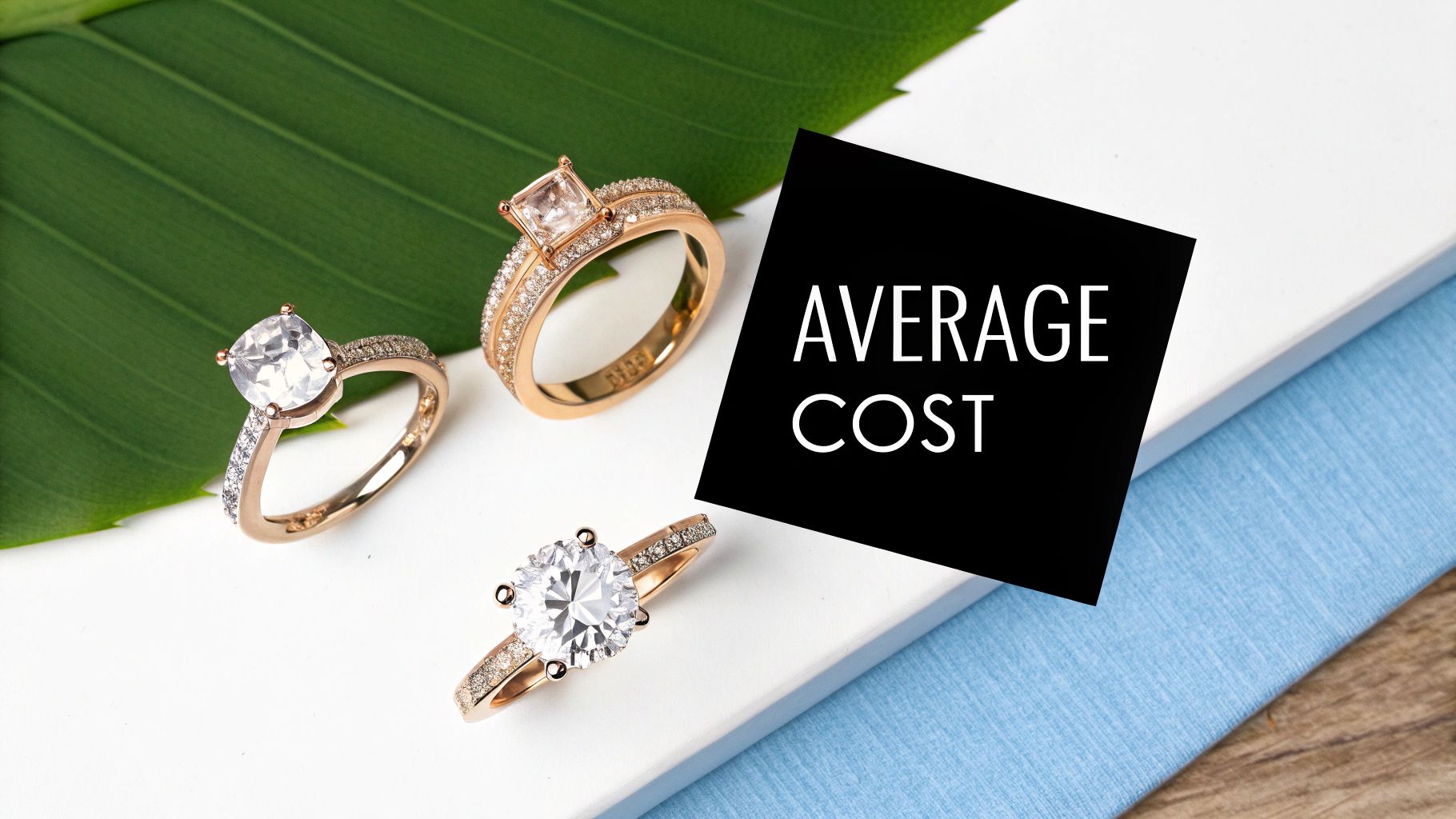
Before we get into the nitty-gritty of diamonds and designs, it's helpful to have a benchmark. Think of the average cost not as a rule you have to follow, but simply as a reference point—a snapshot of what other Australian couples are spending.
Recent industry reports show that the average cost for an engagement ring in Australia sits somewhere between $5,300 and $5,400. Many people find their perfect ring in that popular $5,000 to $7,000 sweet spot, which seems to hit the right balance between a beautiful, lasting piece and a sensible budget. If you're interested in the data, you can find more insights on Australian engagement ring spending habits here.
Of course, an average is just that—an average. The right amount for you will always come down to your personal finances, your partner’s style, and the story you want the ring to tell.
Finding Your Place in the Market
To give you a clearer idea of what different budgets can get you, let’s break down the common spending tiers. This isn't about pushing you into a box; it's more like a roadmap to help you find that perfect intersection of quality, beauty, and value for your investment.
Australian Engagement Ring Budget Tiers
Here's a quick look at typical spending ranges for engagement rings in Australia, from modest to premium budgets.
| Budget Tier | Typical Price Range (AUD) | What to Expect |
|---|---|---|
| Modest & Elegant | $2,500 – $4,500 | Beautiful rings featuring smaller, high-quality diamonds (around 0.5-0.7 carats) in classic settings like solitaires. This range is also perfect for stunning moissanite or lab-grown diamond options. |
| Popular Average | $5,000 – $8,000 | The sweet spot for many couples. Expect a beautiful natural diamond close to the 1-carat mark with good colour and clarity, or a larger, higher-grade lab-grown stone in a more detailed setting. |
| Premium & Detailed | $9,000 – $15,000 | This budget allows for larger, high-quality diamonds (over 1 carat) in more intricate settings like halos or pavé bands. Platinum bands and more complex, bespoke designs become readily accessible. |
| Luxury & Bespoke | $16,000+ | At this level, you can secure exceptional diamonds with premium grades across all 4Cs. This range opens the door to fully custom, one-of-a-kind designs with renowned craftsmanship. |
This table shows there’s a beautiful, meaningful ring available at every budget. It’s all about knowing where to focus your funds to get the most impact.
Key Takeaway: The "average" is a helpful guide, not a strict requirement. Your focus should be on finding a ring that represents your relationship and fits comfortably within your financial means, rather than trying to meet a national statistic.
The Core Elements of Cost
So, what are the moving parts that actually add up to that final number? It really boils down to a few key components. The centre stone is, without a doubt, the biggest driver, where its famous 4Cs—Carat, Cut, Colour, and Clarity—are the stars of the show.
But the stone is only part of the story. Other elements play a huge role in the final price:
- The Setting: A simple, elegant solitaire band will naturally cost less than an intricate halo setting glittering with dozens of tiny diamonds.
- The Metal: Precious metals have different price points. Platinum, for instance, is rarer and more expensive than beautiful and durable 14k or 18k gold.
- Craftsmanship: The level of skill, detail, and time invested in creating a bespoke ring is a crucial part of its value and cost.
Getting familiar with these variables is the first step toward making a really informed decision. It puts you in the driver's seat, allowing you to prioritise what matters most to you and create a ring that you and your partner will adore for a lifetime.
Ditching the Old-School Salary Rules
If you've spent any time Googling how much to spend on an engagement ring, you’ve probably run into the old "salary rule." You know the one—it says you should spend one, two, or even three months' salary. For decades, this idea has caused a whole lot of unnecessary stress. But have you ever wondered where it actually came from?
Here’s a little secret: it wasn't a romantic tradition passed down through generations. It was cooked up in a marketing boardroom. These "rules" were created in the 1930s by the diamond industry to sell more rings during the Great Depression. It was a clever sales pitch, but it has almost nothing to do with what makes sense for a couple today.
Thankfully, that pressure has really eased up here in Australia. Most modern jewellers and financial advisors will tell you to forget the old rules and focus on what feels right for you. If you absolutely need a benchmark, something closer to one month's salary is a more realistic starting point, but even that isn't set in stone. You can get a feel for this modern approach and find some practical advice on ring budgeting.
So, Why Are the Salary Rules Totally Irrelevant Now?
It just doesn't make sense to stick to a rule invented almost a century ago. Our financial lives look completely different, and what might have worked for a single-income household back in the 1940s is worlds away from today's reality.
Here’s why you can and should ignore it:
- Modern Financial Goals: Most couples are juggling multiple big-ticket savings goals at once. Think a house deposit, a dream trip, or starting a family. A rigid spending rule just doesn't fit into that complex picture.
- Dual Incomes are the Norm: With many couples both earning an income, basing a major purchase on just one person's salary feels completely arbitrary.
- Debt is a Reality: University loans and other debts are more common than ever. Kicking off your marriage by adding a huge new debt for a ring is hardly a great way to start.
Your Budget, Your Rules: The most important thing to remember is this: there are no rules. Your engagement ring budget should be a personal decision you make together, based on your shared finances and future plans—not on some dusty old marketing slogan.
A Better Way to Think About Your Budget
Instead of asking, "How much should I spend?" try asking, "What can we comfortably and happily afford?" That one simple switch changes everything. It takes the pressure off and turns a stressful financial hurdle into an exciting, collaborative part of your journey.
This is about making a smart, intentional choice that aligns with your values as a couple. It empowers you to put your money where it really matters. Maybe that means choosing a stunning, larger lab-grown diamond, commissioning a bespoke design that tells your story, or putting the extra cash towards an incredible honeymoon.
The whole point is to start your engagement feeling joyful and secure, not weighed down by a financial burden. By leaving the outdated salary rules behind, you and your partner get to decide what this ring truly represents and invest an amount that feels perfect for the future you're building together. It's a celebration of your love, not a test of your bank account.
What Actually Drives the Price of an Engagement Ring?
When you first look at an engagement ring, you see the sparkle, the design, the love it represents. But figuring out its price can feel like deciphering a secret code. The final cost isn't based on one single thing; it’s a delicate balance of several key factors, each adding to the ring's overall value and beauty.
Getting a handle on these components is empowering. It puts you in the driver’s seat, letting you decide where to allocate your budget to create a ring that’s perfect for you.
Think of it like commissioning a piece of art. The canvas, the type of paint, the artist’s time and skill—they all contribute to the final piece. An engagement ring is no different. The cost is a sum of its parts: the centre stone, the metal it’s set in, the intricacy of the design, and the craftsmanship that brings it all to life.
Let’s pull back the curtain and break down exactly what you're paying for.
The Four Cs: The Heart of a Diamond's Value
The biggest chunk of a diamond ring's cost is almost always the diamond itself. Its quality is universally graded using the 4Cs: Carat, Cut, Colour, and Clarity. While they all play a role, they don’t influence the price equally. Understanding how they work together is the first step to smart budgeting.
-
Carat Weight: This is simply a measure of how much a diamond weighs, not necessarily its visible size. As the carat weight goes up, the price tag doesn't just climb—it jumps exponentially. That’s because bigger diamonds are far rarer. A 2-carat diamond will always cost much more than double the price of a 1-carat diamond of the same quality.
-
Cut Quality: Many jewellers, myself included, will tell you this is the most important 'C' for pure beauty. The cut is all about how well a diamond's facets are angled to catch and reflect light. An expertly cut diamond explodes with brilliance and fire. A poorly cut one can look flat and lifeless, no matter how good its other stats are.
-
Colour Grade: For a classic white diamond, this grade actually refers to the absence of colour. The scale starts at D (absolutely colourless and the most valuable) and goes all the way to Z (noticeable yellow or brown hues). The secret? Many diamonds in the G-J range look perfectly white to the naked eye but come with a much friendlier price than their D-F counterparts.
-
Clarity Grade: This measures tiny imperfections, known as inclusions (inside the stone) and blemishes (on the surface). A "flawless" diamond is incredibly rare and carries a premium to match. The good news is that many stones have inclusions that are only visible with a jeweller's loupe, meaning you can get a visually stunning diamond without paying for microscopic perfection.
Expert Tip: Pour your budget into the Cut before anything else. A smaller, impeccably cut diamond will always outshine a larger, poorly cut one. Being flexible on Colour and Clarity—in ways you’ll never notice day-to-day—is the smartest trade-off you can make.
Beyond the Diamond: The Setting and Metal
While the centre stone gets all the attention, the setting that holds it is a huge part of the ring's final look, feel, and price. Your choice of metal and the complexity of the design are just as important as the diamond itself.
The metal for the band is your foundation. Platinum is a top-tier choice, loved for its natural, bright-white sheen that never fades and its incredible durability. It's also rarer than gold, which makes it more expensive.
Gold is a fantastic and versatile option, coming in different colours (yellow, white, and rose) and purities (14k and 18k). White gold is a beautiful alternative to platinum at a lower price point, though it may need to be re-plated every few years to keep it looking its best.
This flowchart shows how we've moved on from old-fashioned budgeting rules to a more personal and meaningful approach.
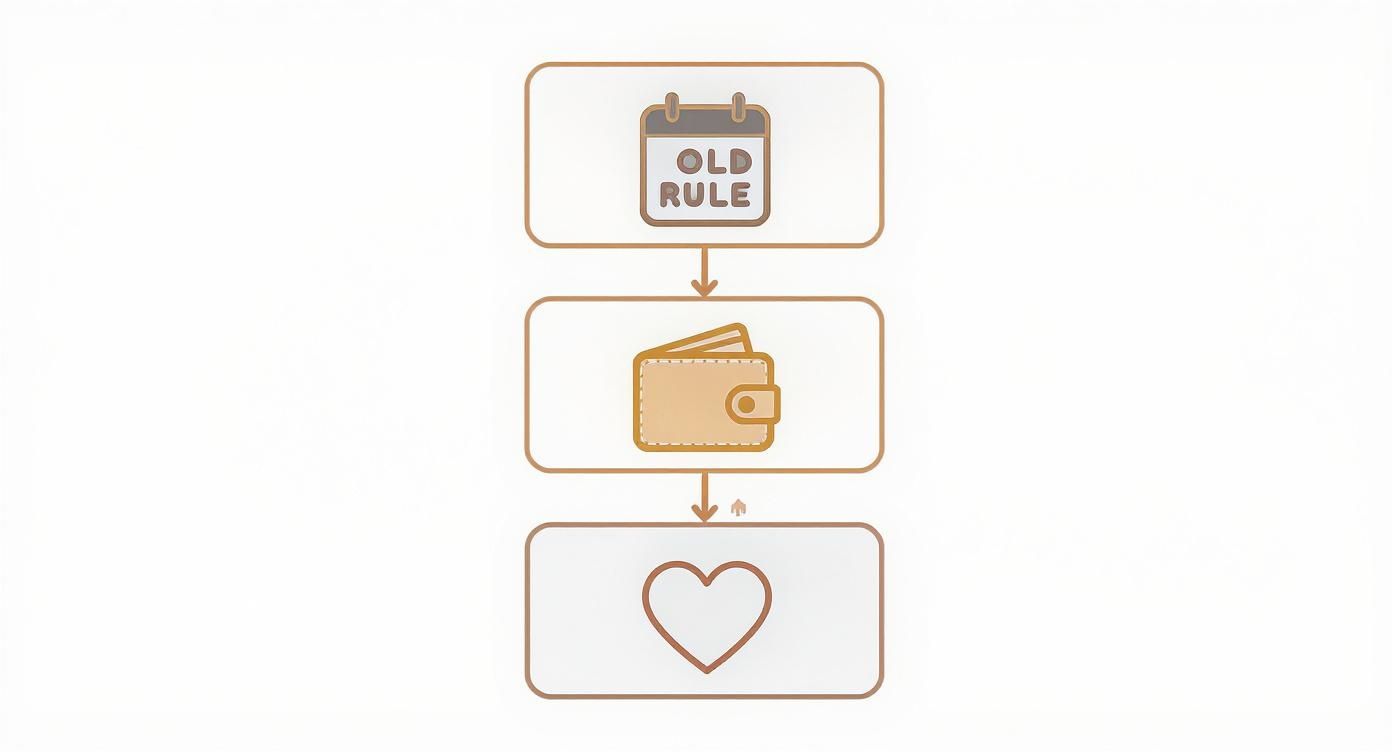
The takeaway here is simple: today's budgeting is about what feels right for your finances and your values, not what some outdated rule tells you.
Design Complexity and Craftsmanship
The style of the setting itself is a major factor in the final cost. A simple, elegant solitaire setting is a timeless classic and is often the most budget-friendly option because its beauty lies in its simplicity. As designs get more intricate, the price naturally rises to account for the extra materials and the skilled labour involved.
Here are a few popular styles and how they affect the price:
- Halo Settings: A circle of smaller diamonds around the centre stone. This is a brilliant trick for adding major sparkle and making the main diamond look bigger, but those extra stones and the detailed work come at a cost.
- Pavé Bands: Bands that are "paved" with tiny diamonds. Just like a halo, this adds a ton of fire and brilliance but requires more materials and meticulous setting work.
- Three-Stone Rings: A centre stone flanked by two smaller ones, representing the past, present, and future. The price reflects the total carat weight and quality of all three stones.
Finally, there’s the value of true craftsmanship. A bespoke ring from an artisan like Daniel Fine isn’t just an assembly of parts; it's a piece of art. You’re investing in a one-of-a-kind design, engineered with incredible attention to detail to last a lifetime. That dedication to quality and artistry is factored into the final cost, ensuring you get something truly special.
How to Maximise Your Engagement Ring Budget
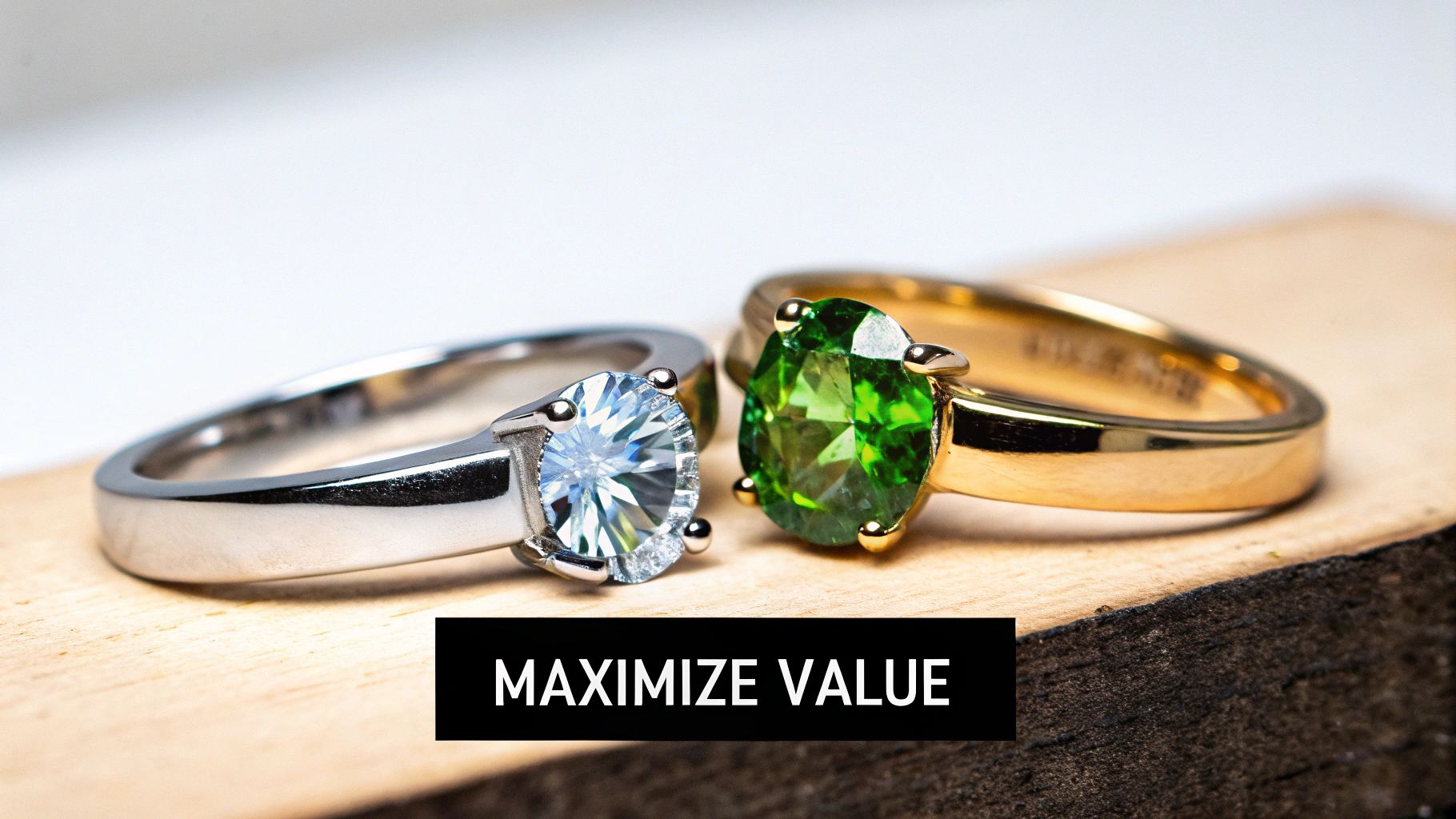
Knowing your budget is the first step, but making that budget work hard for you is where the magic really happens. With a few smart strategies, you can end up with a ring that looks far more impressive than its price tag might suggest. It’s all about making savvy trade-offs and knowing where to find real value.
This isn’t about cutting corners; it’s about being a strategic buyer. By focusing on what creates genuine visual impact and being open to modern alternatives, you can design a breathtaking ring that also aligns perfectly with your financial comfort zone.
Let's run through the playbook for getting the absolute most out of your investment.
Choose Your Centre Stone Wisely
The centre stone is the star of the show and, without a doubt, the biggest line item on your budget. But these days, you have more options than ever before, each offering a unique balance of beauty, value, and origin. An informed choice here is the single most effective way to manage your overall spend.
The Rise of Lab-Grown Diamonds
A lab-grown diamond is chemically, physically, and optically identical to a mined one. The only real difference is its origin story—one is grown in a highly controlled environment, while the other comes from the earth.
This modern marvel offers incredible value. For the same budget, you can typically get a lab-grown diamond that is 30-50% larger or boasts higher quality grades than its natural counterpart. It's a fantastic way to achieve a bold, brilliant look without stretching your finances.
Beautiful Diamond Alternatives
If having a diamond isn't a non-negotiable, a world of stunning alternatives opens up. These gemstones bring their own unique character to the table and can deliver exceptional value.
- Moissanite: Known for its fiery brilliance, Moissanite often throws more rainbow-like flashes of light than a diamond. It’s nearly as durable and comes at a fraction of the cost, making it a hugely popular choice for anyone wanting a large, dazzling stone.
- Sapphires and Other Gemstones: For a touch of personal colour, why not consider a sapphire, ruby, or emerald? These precious gems create a unique and timeless look—famously worn by royalty and celebrities alike—and often offer more size for your money compared to a diamond.
To help you see the differences at a glance, here’s a quick comparison of the most popular centre stone choices.
Comparing Centre Stone Options
| Feature | Natural Diamond | Lab-Grown Diamond | Moissanite |
|---|---|---|---|
| Price | Highest price point | 30-50% less than natural | Most affordable option |
| Durability | 10/10 on Mohs scale (hardest) | 10/10 on Mohs scale (identical) | 9.25/10 on Mohs scale (very durable) |
| Brilliance | Classic white sparkle | Classic white sparkle | Intense, fiery rainbow sparkle |
Ultimately, the right stone is a personal choice, but understanding these key differences in price and appearance is crucial for making your budget go further.
Master the Art of the Trade-Off
Even tiny adjustments to a diamond's specifications can lead to significant savings, often without any noticeable difference to the naked eye. This is where a little bit of knowledge goes a very long way.
Buy Shy of the 'Magic' Carat Weight
Diamond prices don't scale smoothly; they jump at key carat weights like 1.0 carat, 1.5 carats, and 2.0 carats. In the industry, we call these "magic numbers."
By choosing a diamond that weighs just below one of these marks—say, a 0.90-carat instead of a 1.0-carat—you can save a substantial amount of money. The visual difference in size is virtually impossible to spot once it's set, but the difference in price can be thousands.
This is one of the industry's best-kept secrets. A 0.95-carat diamond looks identical to a 1.0-carat diamond in a ring, but the savings can be put towards a more intricate setting or a higher-quality cut.
Prioritise Cut Over Other Cs
As we've mentioned, the Cut is the most important 'C' when it comes to a diamond's sparkle. A well-cut diamond will look brilliant and full of life, while a poorly cut stone will just seem dull, no matter its colour or clarity.
You can often find huge value by choosing a diamond with a slightly lower colour grade (like G or H) or a clarity grade with inclusions you can't see with the naked eye (like VS2 or SI1). These compromises are practically invisible but can free up a huge portion of your budget to invest in an "Excellent" cut grade, which is what guarantees that jaw-dropping sparkle.
Use the Setting to Your Advantage
The ring's setting isn't just there to hold the stone; it's a powerful tool for enhancing its appearance. A clever setting choice can make your centre stone appear larger and more brilliant, giving you a high-impact look for less.
One of the most effective styles for this is the halo setting. By surrounding the main stone with a circle of tiny pavé diamonds, a halo creates a seamless surface of sparkle that makes the centre diamond look significantly larger. It’s a brilliant illusion that adds instant glamour.
Similarly, choosing a band with a slim, delicate profile can make the centre stone look more prominent by comparison. The contrast in proportions draws the eye right to the main diamond, making it the undeniable hero of the piece.
Creating a Realistic Budget You Can Stick To
https://www.youtube.com/embed/XM5zA54NGMA
Alright, you now have a solid understanding of what drives a ring’s price and where to find real value. Now comes the most personal part of the journey: figuring out a budget that actually works for you.
This isn’t about plucking a number from thin air or clinging to some old, outdated “rule.” It’s about taking an honest look at your finances and landing on a figure that feels comfortable, responsible, and, most importantly, exciting. The whole point is to kick off this new chapter with a beautiful symbol of your love, not a source of financial stress. A well-planned budget makes sure the ring is a celebration, free from the shadow of buyer’s remorse.
A Practical Three-Step Budgeting Framework
Figuring out what to spend doesn't need to be complicated. Forget the dense spreadsheets and financial wizardry; it really just boils down to balancing what you have, what’s coming in, and what’s going out. A simple, honest check-in is all it takes.
Here’s a straightforward way to think about it:
- Assess Your Savings: First, what do you already have set aside? Do you have a savings account you’ve been building for this? Answering this gives you a firm, immediate starting point.
- Analyse Your Income and Expenses: Take a quick look at your monthly take-home pay versus your essential costs—rent, bills, groceries, you know the drill. How much is left over that you could comfortably put towards the ring each month without feeling the pinch or sidelining other goals?
- Consider Your Debts and Future Plans: Be real about what you already owe, like a car loan or student debt. And what about your shared future? Are you saving for a house deposit or planning a big wedding? The ring budget needs to slot neatly into this bigger picture.
Going through these three steps will help you land on a number that’s grounded in your reality, not someone else's expectations.
Sample Budgets: What You Can Actually Achieve
To give you a clearer idea of what’s possible, let’s walk through a few common budget scenarios. These examples really show how making smart choices can get you a stunning ring at any level, especially when you’re working with a bespoke jeweller like Daniel Fine, who is all about maximising value.
The $4,000 Budget: A Focus on Brilliance
You can create a genuinely beautiful and timeless ring at this price point.
- Stone: Think a brilliant lab-grown diamond around 0.70-0.90 carats with an excellent cut and clarity. Or, you could opt for a gorgeous moissanite that delivers incredible size and fire for the price.
- Setting: A classic solitaire setting in 14k or 18k gold (yellow, white, or rose) is perfect here. It’s elegant, timeless, and puts all the focus right where it belongs: on the centre stone.
The $7,000 Budget: The Popular Sweet Spot
This budget is right around the Australian average and opens up a lot more flexibility with size and detail.
- Stone: You’re looking at a high-quality lab-grown diamond that clears the 1.0-carat mark. Alternatively, you could get a stunning natural diamond just under a carat to get the most for your money.
- Setting: More intricate designs come into play. A delicate pavé band or a subtle hidden halo becomes easily achievable, set in your favourite gold or even the cool lustre of platinum.
The $12,000+ Budget: Premium and Bespoke
With a more generous budget, the world of premium features and full customisation is yours.
- Stone: This is where you can secure a larger, high-grade lab-grown diamond (1.5 carats or more) or a natural diamond over a carat with exceptional specs across all 4Cs.
- Setting: True bespoke design really comes to life here. You can craft a complex, one-of-a-kind piece, like an elaborate multi-stone halo or a striking three-stone design, all in premium platinum.
Remember This: Your budget doesn’t define how beautiful or meaningful the ring is. A thoughtfully designed ring, at any price, will always mean more than a generic, expensive one bought under pressure.
Don’t Forget the Hidden Costs
Finally, a truly smart budget accounts for more than just the sticker price. There are a couple of essential, and often overlooked, costs to factor in to protect your investment from day one.
The big one is ring insurance. Honestly, this is non-negotiable for something so valuable and sentimental. Insurance protects you from loss, theft, or damage, and the peace of mind it provides is priceless. You can usually add it to your home and contents policy or take out a specialised jewellery policy.
Another thing to keep in mind is potential resizing. While a good jeweller like Daniel Fine includes a complimentary first resize, it’s worth knowing that fingers can change over time and future adjustments might be needed. Thinking about these small but important details makes your budget truly bulletproof.
A Few Final Questions You Might Be Asking
Alright, we've covered the averages, busted the old-school salary myths, and unpacked what really goes into the price of a ring. But you might still have a few lingering questions. Let's tackle them head-on, so you can move forward with total confidence.
Is It Better to Buy a Ring Online or From a Jeweller?
This really boils down to what you value most. Online stores can throw a massive selection at you with some pretty sharp pricing, mainly because they don't have the overheads of a physical showroom. If you're a seasoned researcher and know exactly what you want, it can be a solid option.
But a bespoke jeweller offers something you just can't get through a screen. There's an undeniable magic in seeing diamonds sparkle under the light, feeling the weight of the ring in your hand, and getting real, one-on-one advice. For a purchase this meaningful, having an expert artisan you can trust—someone who’ll be there for cleanings, resizing, and future milestones—is invaluable.
For most people, the trust, personalised service, and guarantee of flawless craftsmanship are non-negotiable. It’s the difference between buying a product and commissioning a work of art.
How Can I Find My Partner's Ring Size Without Ruining the Surprise?
Ah, the classic mission! Don't worry, there are a few sneaky ways to get this right. The most foolproof method is to borrow a ring they already wear on their left ring finger. Take it to a jeweller, get it sized, and return it before they notice it's gone.
If that’s too risky, here are a few backup plans:
- Trace it: When they're not looking, place one of their rings on a piece of paper and carefully trace the inside circle with a fine-point pen. An experienced jeweller can get remarkably close with this.
- Phone a friend: Recruit one of their close friends or a family member. They could suggest a "just for fun" trip to a jewellery store or cleverly work the topic of ring sizes into a conversation.
- The educated guess: As a last resort, the average ring size in Australia is an L or M. You can make a guess based on their build.
Honestly, don't stress too much about getting it perfect. Any good bespoke jeweller, like us here at Daniel Fine, will include a complimentary resizing after the proposal to make sure the fit is absolutely spot-on.
Does a Jeweller's Brand Name Make a Ring More Expensive?
One hundred percent, yes. When you buy from one of those famous brands with the iconic little blue box, a huge chunk of what you're paying for is the name itself. That premium covers their multi-million dollar marketing campaigns, prime real estate, and brand prestige—not necessarily a better diamond or superior craftsmanship.
This is where working with an independent, bespoke jeweller gives you a massive advantage. Your budget is funnelled directly into what matters: the quality of the stone and the artistry of the ring. For the same price as a smaller, mass-produced ring from a big brand, you can often get a significantly larger, higher-quality diamond in a custom-made setting. It's about putting your money into the piece itself, not the logo.
Should I Get the Engagement Ring Insured?
Absolutely. Don't even think twice about it. An engagement ring is a major financial purchase, but more than that, it’s a symbol packed with sentimental value. Insuring it against loss, theft, or damage isn’t just a good idea—it’s essential for peace of mind.
You generally have two options:
- Add it to your home and contents insurance: You can usually list the ring as a specified, high-value item on your existing policy.
- Take out a specialised jewellery policy: These dedicated policies often provide more comprehensive coverage, like worldwide protection, which is perfect if you travel.
To get insured, you'll need a formal valuation from your jeweller. This document details the ring's specifications and replacement value, which your insurer needs to create the policy. Think of it as the final, crucial step in protecting your beautiful investment.
At Daniel Fine, we believe creating the perfect ring should be an exciting and transparent journey, not a stressful one. We specialise in crafting bespoke pieces that put every cent of your budget toward breathtaking quality and artistry. Explore our collection or start designing your one-of-a-kind ring with us today.