When you're weighing up lab-grown diamonds vs moissanite, the most important thing to know is this: one is a real diamond, and the other is not. It’s that simple. Lab-grown diamonds are pure carbon, identical to their mined counterparts in every way—chemically, physically, and optically. Moissanite, on the other hand, is made from silicon carbide, a completely different gemstone celebrated for its own unique, fiery sparkle.
Defining Lab-Grown Diamonds and Moissanite
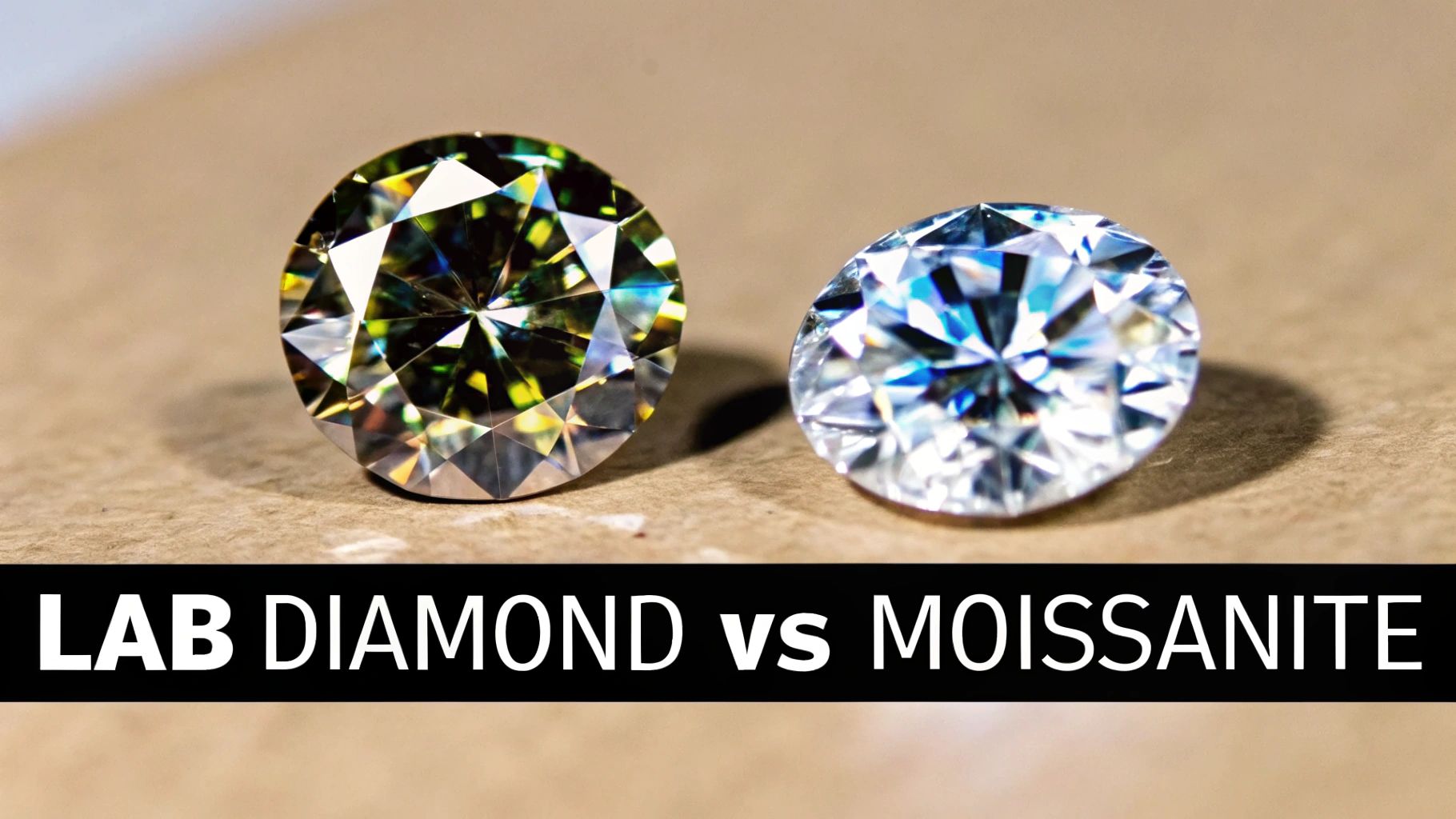
To make the right choice, you need to get past the idea that both are just 'fake diamonds'. They aren't. Understanding where each comes from and what they're made of is the first step to appreciating what makes them special.
A lab-grown diamond is precisely what it sounds like—a diamond grown inside a highly controlled laboratory. These facilities mimic the intense pressure and heat found deep within the Earth's crust, where natural diamonds are born. The finished product is a stone made of pure, crystallised carbon, making it physically and visually indistinguishable from a mined diamond.
Moissanite’s story, however, started in space. It was first identified in 1893 by Nobel Prize-winning chemist Dr. Henri Moissan, who discovered tiny crystals of it in a meteorite crater. These crystals were silicon carbide (SiC), a compound that's incredibly rare on Earth but known for its remarkable hardness and brilliance. Because natural moissanite is too scarce and small for jewellery, all the moissanite you see today is created in a lab.
Key Compositional Differences
The real distinction between these two stones is at the atomic level. This fundamental difference is what dictates everything from their sparkle to their durability.
- Lab-Grown Diamond: This is 100% pure carbon (C), just like a natural diamond. Its atomic structure creates that classic, balanced sparkle—a mix of white light (brilliance) and rainbow flashes (fire)—that diamonds are so famous for.
- Moissanite: This is made of silicon carbide (SiC), a completely different chemical compound. Its unique structure refracts light differently, producing a more intense, fiery, rainbow-like sparkle.
Here’s the most critical takeaway: a lab-grown diamond isn't a simulant of a diamond; it is a diamond. Moissanite is a diamond simulant—a beautiful alternative stone that looks similar but has its own distinct chemical identity.
With this foundation, we can now properly compare their appearance, durability, and value. While both are stunning and ethical alternatives to mined gemstones, they are fundamentally different materials. Knowing this is the key to choosing the stone that truly fits your style and what you value most.
| Feature | Lab-Grown Diamond | Moissanite |
|---|---|---|
| Chemical Makeup | Pure Carbon (C) | Silicon Carbide (SiC) |
| Origin | Lab-created, mimics nature | Lab-created, based on meteorite discovery |
| Identity | A real diamond | A diamond simulant |
| Primary Appeal | Authentic diamond properties | Exceptional sparkle and affordability |
Comparing Sparkle: Brilliance and Fire
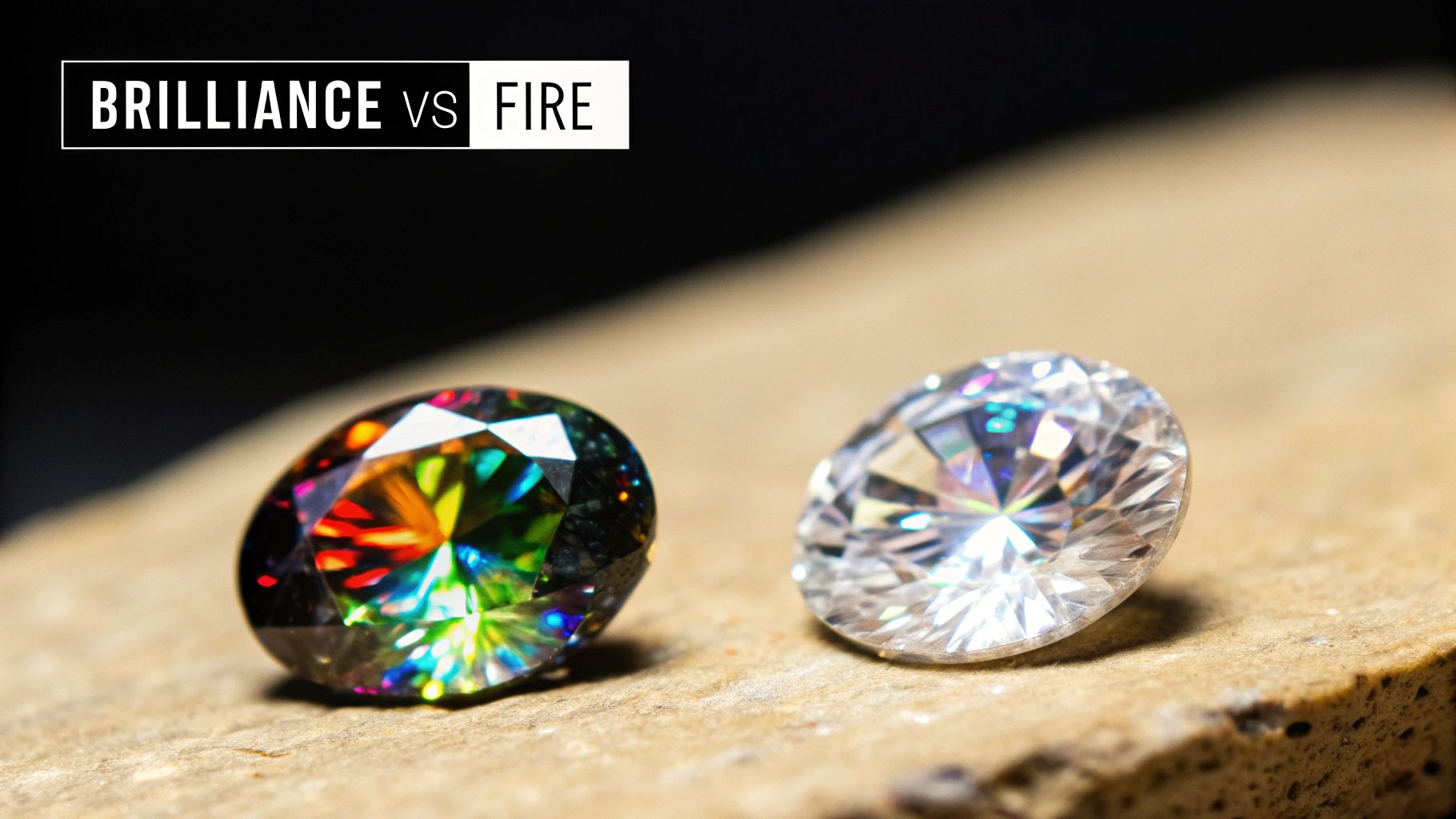
How a gemstone plays with light is what gives it its unique personality, and this is where lab-grown diamonds and moissanite really show their differences. They’re both incredibly beautiful, but they sparkle in completely distinct ways. To get to the heart of it, we need to look at brilliance, fire, and colour.
Brilliance is all about the white light that flashes back at you—it's the stone's essential sparkle. Fire, on the other hand, is the explosion of rainbow colours you see when the stone moves. A lab-grown diamond, made of pure carbon, offers that iconic, sophisticated balance of bright white light and colourful fire that has captivated people for centuries.
Moissanite, however, is famous for its almost over-the-top light performance. People often call it a "disco ball," and they're not wrong—it’s all down to its unique chemical structure.
Moissanite: The Fiery Spectacle
Moissanite is doubly refractive, which is a key point of difference. This means as light enters the stone, it splits into two, effectively doubling the sparkle and amplifying its effect. When you combine this with a very high refractive index (2.65 to 2.69), you get more fire than any other gemstone on the market—even more than a diamond. The result is a vibrant, intense shower of rainbow flashes that you can't miss.
If you’re someone who loves a bold, attention-grabbing look, the intense fire of moissanite is a huge drawcard. It creates a dazzling, lively sparkle that truly comes alive in direct sunlight or under spotlights.
The key takeaway is that moissanite doesn't just sparkle; it puts on a light show. Its high refractive index produces an abundance of fiery, rainbow-coloured flashes, making it a spectacular choice for those who want maximum sparkle.
Lab-Grown Diamonds: The Classic Brilliance
Because a lab-grown diamond is chemically identical to a mined diamond, it delivers a more balanced dance between brilliance (white light) and fire (coloured light). Diamonds are singly refractive and have a refractive index of 2.42. This structure returns light in a way that produces crisp, bright flashes of white, punctuated by more subtle, elegant pops of colour.
This is the classic sparkle that most people picture when they think of an engagement ring. It's a timeless look—radiant without being overwhelming. A well-cut lab-grown diamond shows a mesmerising pattern of light and shadow, giving it a depth and sophistication that sets it apart from moissanite’s fiery display.
Choosing a lab-grown diamond means you're getting the true diamond experience. Its sparkle isn't better or worse than moissanite's; it’s just different. It prioritises a balanced, crisp brilliance over an intense, fiery rainbow.
A Note on Colour Grades
The visual comparison also has to include the stone's body colour. Years ago, moissanite had a reputation for having slight yellow or green undertones, but modern production has almost completely solved this. Today's high-quality moissanite is genuinely colourless, easily comparing to the D-E-F range on the diamond colour scale.
Lab-grown diamonds are graded on the exact same GIA D-to-Z scale as natural diamonds. This gives you a massive range of options, from the iciest, perfectly colourless ‘D’ grade to stones with a noticeable warm tint. You can choose a stone that fits your exact preference and budget, whether that’s an icy-white look or something with a bit more warmth.
Ultimately, the choice comes down to your personal taste: the fiery, rainbow spectacle of moissanite or the classic, balanced brilliance of a lab-grown diamond.
Hardness, Durability, and the Realities of Daily Wear
An engagement ring isn't just a piece of jewellery; it’s a constant companion through all of life's adventures. That means it needs to be tough. When weighing up a lab-grown diamond against moissanite, understanding their durability is key to making a choice you'll be happy with for decades.
Both stones are incredibly resilient, but their differences are best understood by looking at the Mohs scale of hardness. This simple 1-to-10 scale tells us how resistant a mineral is to scratching.
A lab-grown diamond is, chemically and physically, a real diamond. It scores a perfect 10 out of 10 on the Mohs scale. This isn't just a high score—it's the top of the charts. As the hardest material used in jewellery, it’s exceptionally difficult to scratch.
Moissanite comes in at a very impressive 9.25 on the Mohs scale. Don't let that "point-seven-five" fool you; this makes it one of the hardest substances on earth, outranking even sapphire and ruby. For an engagement ring meant to be worn every day, this is more than enough muscle.
What This Means in the Real World
So, what does a 10 versus a 9.25 actually look like on your hand?
A diamond's 10 rating means that, practically speaking, only another diamond can scratch it. This gives you incredible peace of mind. Your ring will inevitably come into contact with keys, door frames, and kitchen benchtops, but the diamond will emerge unscathed, keeping its facets sharp and its surface flawless.
Moissanite, at 9.25, is also a champion of scratch resistance. It will confidently handle the knocks and scrapes of everyday life and continue looking brilliant. For most people, the practical difference between a 9.25 and a 10 is almost negligible. Both offer a level of durability that far surpasses what's needed for a lifetime of wear.
When it comes down to it, the lab-grown diamond's perfect 10 rating is the absolute gold standard for durability. It’s the ultimate assurance against scratches, but moissanite’s resilience is exceptional in its own right.
Beyond Scratches: Chipping and Breaking
Hardness is all about resisting surface scratches. Toughness, on the other hand, is about a stone's ability to resist chipping or breaking from impact. The good news is that both lab-grown diamonds and moissanite are incredibly tough. Neither is prone to chipping with normal wear, thanks to their solid crystal structures that can handle the occasional bump.
This focus on durable, ethical choices is something we're seeing more and more from savvy Australian buyers. The local market for all diamonds (both mined and lab-grown) is currently valued at around AUD 1.09 billion. Forecasts suggest it could grow to AUD 1.60 billion by 2034, largely driven by a growing appetite for sustainable and resilient materials like lab-grown diamonds. For those interested in the numbers, you can find more data on the Australian lab-grown diamond market.
Will It Go Cloudy?
A common worry is whether a stone will lose its sparkle and turn cloudy over time. Let's clear this up: neither a lab-grown diamond nor moissanite will ever go cloudy or lose its inherent optical properties.
If your ring starts to look a bit dull, the culprit is almost always a thin film of everyday grime—oils from your skin, lotions, and soap residue. A simple clean is all it takes to bring back that day-one sparkle.
Here’s the durability takeaway in a nutshell:
- Lab-Grown Diamond: With its Mohs score of 10, it offers unmatched scratch resistance. Its surface will remain pristine for a lifetime.
- Moissanite: Its score of 9.25 provides phenomenal durability, making it perfectly suited for an engagement ring you'll wear every single day.
Ultimately, both of these stones are built to last. Your decision rests on whether you want the absolute, undisputed champion of hardness in a diamond, or the outstanding and almost-as-tough resilience of a moissanite.
Breaking Down Price and Long-Term Value
Let's talk about the bottom line: price. For many people, the budget is a major, if not the most significant, factor when choosing between a lab grown diamond and moissanite. How each stone is priced not only affects what you'll spend but also defines what "value" really means for you.
Moissanite’s pricing is refreshingly simple. It’s based on size (in millimetres) and, to some extent, quality (like colourless vs. near-colourless). It completely bypasses the complex 4Cs system used for diamonds. What does this mean for you? You can get a seriously impressive, eye-catching stone for a fraction of the cost of a lab grown diamond of a similar size.
To put it in perspective, a 2-carat moissanite might cost thousands less than a 2-carat lab grown diamond. This makes moissanite an incredible option if your goal is to maximise size and sparkle without breaking the bank.
The Diamond Pricing Model
Lab grown diamonds, while much more accessible than their mined counterparts, are a bigger financial commitment than moissanite. Their price is dictated by the classic 4Cs: Cut, Colour, Clarity, and Carat weight. This meticulous grading system, certified by respected gemological labs like the IGI, means that two lab diamonds of the exact same carat weight can have wildly different price tags based on their overall quality.
This complexity actually works in your favour. It gives you more control to find a stone that hits your sweet spot, balancing the characteristics you care about most with your budget. You can decide whether to prioritise a flawless colour grade, an impeccable cut, or simply a larger carat size.
Before we dive deeper into financial value, it's worth remembering that durability plays a huge part in a stone's long-term worth.
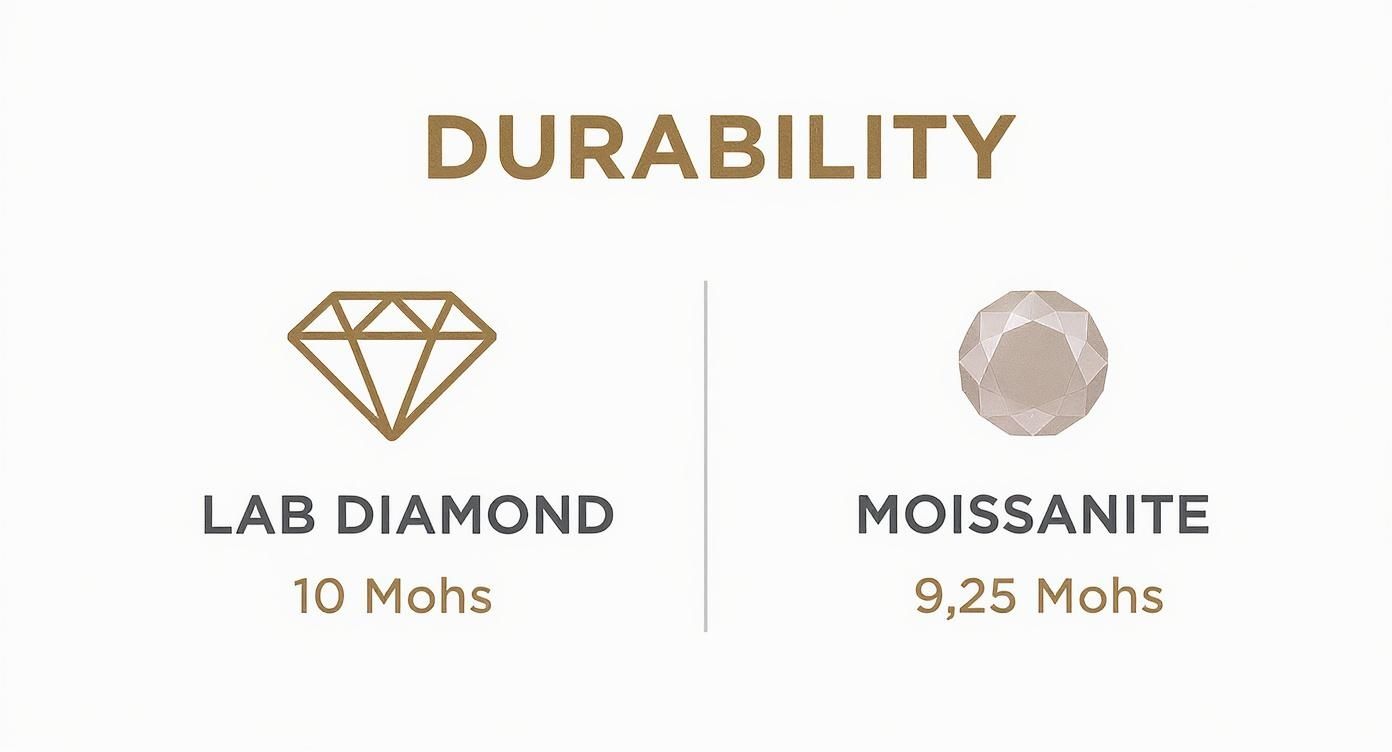
As you can see, both are incredibly tough and perfect for everyday wear, but a lab grown diamond clinches the top spot on the Mohs scale as the hardest material on earth.
For a quick reference, this table breaks down the key differences at a glance.
Lab Grown Diamond vs Moissanite At a Glance
| Characteristic | Lab Grown Diamond | Moissanite |
|---|---|---|
| Price | More expensive | Highly affordable |
| Value | Based on the 4Cs (Cut, Colour, Clarity, Carat) | Based on size and quality |
| Resale Value | Limited, market is still evolving | Very limited to none |
| Durability | 10 on Mohs scale (hardest material) | 9.25 on Mohs scale (very durable) |
| Long-Term Worth | Sentimental & aesthetic; prices are becoming more accessible | Sentimental & aesthetic; excellent budget choice |
This table helps frame the decision, but let’s talk more about what happens after you've made the purchase.
Considering Resale and Investment Value
It’s crucial to go into this purchase with the right mindset. Neither lab grown diamonds nor moissanite should be seen as a financial investment that will grow in value. A beautiful ring is an emotional purchase; its real worth is in the joy and personal meaning it holds for you.
Think of your ring as an emotional investment, not a financial one. Both stones are designed to offer a lifetime of enjoyment and memories, which is a value that can't be measured in dollars.
The market for lab grown diamonds is particularly dynamic right now. As technology gets better and production increases, prices have become more and more attractive. We've seen this trend firsthand in the Australian market, where lab-grown diamond prices have fallen significantly since 2020. This has supercharged their popularity among people who want both ethical sourcing and affordability.
The global market, valued at around USD 28.27 billion in 2025, is projected to keep growing, showing a massive worldwide shift in what customers want. You can learn more about these market dynamics in this full report on the lab-grown diamonds market.
Defining Your Personal Value
So, which stone is the "better value"? That’s entirely up to you and what you prioritise for this special piece of jewellery.
- Choose Moissanite if: Your top priority is getting the largest, most brilliant stone your budget can buy. You love a dazzling, fiery sparkle and aren't attached to the idea of owning a traditional diamond.
- Choose a Lab Grown Diamond if: You want a stone with the exact same chemical, physical, and optical properties as a diamond—because it is a diamond. You value the timeless prestige and classic brilliance that only a diamond can provide, but at a much more attainable price than a mined one.
By understanding these key differences, you can confidently choose the stone that perfectly aligns with your budget, your style, and what you'll cherish most for years to come.
How to Choose the Right Stone for You
Deciding between a lab-grown diamond and moissanite really comes down to one simple question: what do you value most in a gemstone? Forget about which stone is "better" in a technical sense. The real question is which one is better for you. Once you get clear on your priorities, personal style, and budget, the right choice often becomes surprisingly obvious.
This guide is designed to move past the technical jargon and give you real-world, practical advice. We'll connect your personal desires for your jewellery with what each of these incredible stones actually delivers, so you can feel completely confident in your final decision.
Scenarios to Guide Your Decision
Think for a moment about what’s truly driving this purchase. Is it the powerful symbolism of a diamond? The sheer visual impact of a large, dazzling stone? Or is it about finding that perfect balance between budget and beauty? Your answer is the key.
Let's walk through a few common scenarios we see every day:
-
"I want a true diamond—the history, the meaning—but I want it to be ethical and affordable."
If this sounds like you, then a lab-grown diamond is your clear winner. You value the heritage and timeless appeal that only a diamond offers. For you, the fact that it's physically and chemically identical to a mined diamond is non-negotiable. A lab-grown origin simply ticks all the right boxes, aligning perfectly with your ethics and your budget. -
"My top priority is getting the biggest, most brilliant stone my budget allows."
In this case, moissanite is almost certainly your perfect match. You're looking for serious visual impact—a big, bold stone that turns heads with its fiery sparkle. You love the idea of maximising your budget for a larger, more brilliant gemstone and are genuinely excited by its unique, rainbow-like light show. -
"I just want a beautiful, durable white stone for everyday wear and I’m open to options."
Here, both stones are fantastic contenders. Your decision will likely boil down to the subtle differences in their sparkle. If you prefer that classic, crisp white brilliance, a lab-grown diamond is probably the way to go. But if a more vibrant, colourful flash of fire sounds more like you, then moissanite is a wonderful choice.
A Quick Word on Certification and Authenticity
Feeling secure in your purchase often comes down to the paperwork, and this is another area where these two stones differ. It’s a key detail that speaks to their distinct places in the jewellery world.
Any reputable lab-grown diamond will come with a grading report from an independent gemological laboratory, like the International Gemological Institute (IGI). This certificate is vital. It officially documents the stone's 4Cs—Cut, Colour, Clarity, and Carat—giving you an objective, third-party assessment of its quality and confirming its identity as a true diamond. It’s the exact same type of certification you’d expect for a high-quality mined diamond.
Moissanite, being a different gemstone altogether, doesn't get a diamond grading report. Instead, a quality moissanite will be accompanied by a certificate of authenticity from its creator. This document guarantees the stone is a genuine, lab-created moissanite and often includes a limited lifetime warranty that covers its brilliance and fire, ensuring it won’t cloud or dull over time.
The paperwork tells the story: A lab-grown diamond is graded as a diamond because it is a diamond. A moissanite is certified as a moissanite because it’s a stunning gemstone in its own right.
Final Thoughts for Your Bespoke Piece
At the end of the day, this is a deeply personal and subjective choice. There is no right or wrong answer when comparing these two exceptional stones. The best advice I can give is to reflect on what will bring you the most joy every time you look down at your hand.
Here at Daniel Fine, we specialise in creating bespoke pieces that tell your story. Whether you’re drawn to the classic elegance of a lab-grown diamond or the show-stopping fire of a moissanite, our passion is helping you design a ring that perfectly captures your vision. Our entire process is built around you, ensuring the finished piece is a true reflection of your style and values.
Think about your long-term happiness. Will you feel a deeper sense of pride owning a true diamond, or will the impressive scale and sparkle of a moissanite make you smile more? Be honest with yourself about what truly matters, and you’ll make a choice you'll cherish for a lifetime.
Common Questions About Lab Diamonds and Moissanite
Even after weighing up the differences, you might still have a few practical questions. That’s completely normal. Here, we’ll tackle some of the most common queries we hear from our clients, helping you clear up any final doubts before making your choice.
Can a Jeweller Tell the Difference Between Moissanite and a Lab Diamond?
Yes, any trained jeweller or gemologist worth their salt can spot the difference, but it's not always obvious to the untrained eye. They aren't just looking; they're using specific tools and knowledge of a stone's optical properties.
The biggest giveaway is something called double refraction. Moissanite is doubly refractive, which means that if you look through the side facets, you can sometimes see the opposite facets appear doubled. A diamond, being singly refractive, won't do this. Professionals also use a diamond tester, which measures thermal conductivity. Since diamond and moissanite conduct heat at different rates, the tool gives an instant reading.
That said, if you put a high-quality moissanite and a well-cut lab diamond side-by-side, most people wouldn't be able to tell them apart at a glance.
Which Stone Is Better for an Engagement Ring?
This is the million-dollar question, and honestly, the answer is entirely personal. There isn't a single "better" stone—only the one that’s better for you.
Your decision really boils down to your priorities:
- For the Diamond Purist: If you love the tradition, prestige, and classic beauty of a diamond, then a lab-grown diamond is your clear winner. It's chemically, physically, and optically identical to a mined diamond, giving you that authentic experience with the bonus of a clearer conscience and a friendlier price tag.
- For the Sparkle Maximiser: If your main goal is to get the most fire and brilliance for your budget, moissanite is an incredible choice. You can opt for a much larger stone that throws off dazzling rainbow flashes, creating serious visual impact.
Both are exceptionally hard and more than durable enough for the daily wear of an engagement ring. The final choice just comes down to your personal taste and what you want your stone to represent.
Will Moissanite or Lab Diamonds Get Cloudy or Change Colour?
Absolutely not. Neither a lab-grown diamond nor a moissanite will ever go cloudy, lose its colour, or stop sparkling. Both are incredibly stable materials that will look just as beautiful in 50 years as they do today.
When a ring starts to look a bit dull, it's almost always just a buildup of daily life—lotions, natural skin oils, soap, and dust. This thin film coats the surface, stopping light from entering and reflecting, which temporarily dulls the sparkle.
The good news is that a simple clean is all it takes to restore your stone's original, fiery brilliance. The underlying optical properties of your gemstone will never fade.
How Should I Clean My Lab Diamond or Moissanite Ring?
Caring for both stones is identical and super easy. A little bit of regular maintenance will keep them looking brand new.
One of the best at-home methods is to use a soft toothbrush, warm water, and a drop of mild dish soap. Gently scrub the stone and setting, paying extra attention to the underside where grime loves to hide. Rinse it well and pat dry with a soft, lint-free cloth. For a deeper clean, ultrasonic cleaners are perfectly safe for both lab diamonds and moissanite set in platinum or gold.
Will Moissanite Pass a Diamond Tester?
This is a common point of confusion. A basic, handheld diamond tester that only measures thermal conductivity will not be fooled. Diamonds are fantastic thermal conductors, while moissanite is not, and this difference is how these simple testers tell them apart.
Where it gets tricky is that some newer, more advanced multi-testers also check for electrical conductivity. Moissanite is electrically conductive (while diamonds are not), so these professional devices can accurately identify it. So, while a basic tester won't get it wrong, a professional with the right equipment will always know the difference.
Choosing between a lab-grown diamond and moissanite is a big decision, but it doesn’t need to be a stressful one. By focusing on your style, your budget, and what truly matters to you in a gemstone, you’ll find the perfect centrepiece for a ring you’ll adore forever.
At Daniel Fine, our passion is crafting bespoke jewellery that tells your unique story. Whether you're captivated by the timeless elegance of a lab-grown diamond or the brilliant fire of a moissanite, we are here to guide you through every step of the design process. Explore our collection or begin your custom journey with us.
Article created using Outrank