If you're an October baby, you're in luck. Your birthstone is the opal, one of the most magical and mesmerising gems on the planet. What makes it so special is its signature “play-of-colour,” an incredible effect that sends a kaleidoscope of hues shimmering across its surface. No two opals are ever the same.
The Enchanting World of the Opal Birthstone
Welcome to the captivating universe of the opal. Unlike gems that stick to one solid colour, an opal holds a whole world within its depths. It’s a spectacular dance of fire and light, with flashes of electric blue, deep green, fiery red, and sunny yellow that seem to move and shift with every turn. It truly is like holding a piece of a rainbow in your hand.
For centuries, this shifting spectacle has inspired a sense of awe and wonder. Ancient cultures treasured opals, with some believing they were born from bolts of lightning and others seeing them as the tears of gods. This rich history has cemented the opal's status as a powerful symbol of hope, purity, and truth.
A Gemstone of Legend and Meaning
The symbolism attached to opal is as deep and varied as its colours. Throughout history, it has been seen as an incredibly lucky stone, thought to hold the virtues of every single gem whose colour appeared in its spectral fire. This made it a powerful talisman for everything from creativity and passion to emotional healing.
For those born in October, the opal’s symbolism runs deep:
- Hope and Purity: It’s often seen as a representation of innocence and a clear conscience.
- Creativity and Inspiration: The stone is believed to spark artistic expression and spontaneity.
- Fidelity and Loyalty: It also stands for faithfulness and loyalty in relationships.
The Australian Connection
While opals were once sourced from places like Hungary and South America, Australia’s arrival on the scene completely changed the game. The discovery of opal in Australia in the late 19th and early 20th centuries quickly established the country as the world's premier source. The first major deposits were unearthed in New South Wales in the late 1880s, which really set the stage for its global fame.
You can dive deeper into the history of the opal gemstone and its journey to stardom. Today, Australian opals are the gold standard, celebrated for their exceptional stability and absolutely breathtaking beauty.
Exploring the Different Types of Opals
When you hear the word ‘opal’, you probably picture a stone alive with shifting colours. But that single name covers a whole family of wonderfully diverse gemstones. Not all opals are the same; each type has its own distinct personality, shaped by how and where it was formed. Getting to know these differences is the first step in truly appreciating the incredible depth of October's birthstone.
Think of the opal family as a collection of artists, each with their own unique style. Some are bold and dramatic, while others are soft and ethereal. From the dark, cosmic depths of a Black Opal to the warm, glowing heart of a Fire Opal, every variety tells a different story.
This visual guide breaks down the opal stone's core attributes, from its symbolism to its rich history.
As you can see, an opal’s identity is a beautiful blend of its physical makeup and the deep meanings it has carried for centuries.
To help you get a clearer picture, let's take a closer look at the four main players in the opal world. Each one is a stunner in its own right.
A Comparison of Major Opal Types
| Opal Type | Body Colour | Primary Origin | Key Characteristics |
|---|---|---|---|
| Black Opal | Dark grey to jet black | Lightning Ridge, Australia | Dark body creates a dramatic contrast, making the play-of-colour appear exceptionally vibrant and electric. |
| White Opal | Translucent to opaque white | Coober Pedy, Australia | The most common type, offering a soft, dreamy, and classic look with a more subtle, pastel play-of-colour. |
| Boulder Opal | Ironstone (brown) | Queensland, Australia | Precious opal forms in veins within its host rock, resulting in a unique, earthy appearance. Very durable. |
| Fire Opal | Yellow, orange, red | Mexico | Valued for its fiery body colour rather than play-of-colour. Often faceted to enhance its glow. |
This table gives you a snapshot of what makes each opal special, but their individual beauty really comes alive when you get to know their stories.
Black Opals: The Cosmic Beauty
When you think of the most valuable and sought-after opal, you're almost certainly picturing a Black Opal. These incredible gems come almost exclusively from one small spot on the planet: Lightning Ridge in New South Wales, Australia.
What makes them the king of opals? It’s all about their dark body tone, which can range from a deep grey to a true jet black. This dark canvas provides the most stunning backdrop, making the play-of-colour pop with an electrifying intensity. Flashes of brilliant red, electric green, and deep blue seem to float against a velvety void, like a distant galaxy captured in stone. It's this rarity and dramatic beauty that puts high-quality Black Opals at the top of the price list.
White Opals: The Classic Dream
White Opals, sometimes called light or milky opals, offer a much softer, more classic kind of beauty. This is the most common type of opal, with huge deposits found in Coober Pedy, South Australia. Its body ranges from a dreamy translucent to a milky opaque white.
Here, the play-of-colour is more subdued than in a Black Opal, presenting as a gentle, pastel shimmer rather than a dramatic explosion of light. The effect is like sunlight dancing on water. This timeless elegance makes White Opals a perennial favourite for jewellery that calls for a touch of subtle charm.
Boulder Opals: The Earthy Masterpiece
Boulder Opals are truly nature’s one-of-a-kind artworks. Found mainly in Queensland, Australia, these unique gems form in the cracks and crevices of ironstone boulders. Instead of trying to separate the thin sliver of precious opal, miners cut the stone to include the host rock, giving it a natural backing.
The result is a wonderfully organic gemstone where vibrant veins of colour are woven through the rich, earthy brown of the ironstone. No two Boulder Opals are ever the same. Their freeform shapes and raw composition make them a go-to for designers creating artistic, statement pieces that really celebrate the rugged beauty of the earth.
Boulder opals are celebrated for their durability and natural composition. The ironstone backing not only provides stability but also enhances the vibrancy of the opal's colour, creating a striking and earthy aesthetic unique to this variety.
Fire Opals: The Fiery Heart
Now we head away from Australia to Mexico, home of the vibrant Fire Opal. Unlike its Aussie cousins, the Fire Opal’s fame comes from its intense background colour, not necessarily its play-of-colour. These gems absolutely glow with fiery shades of yellow, orange, and deep red, looking just like a captured sunset.
While some Fire Opals are a solid, glowing colour, the most prized specimens combine that fiery body with brilliant flashes of green and other hues. They’re often faceted just like a diamond or ruby—something rarely done with other opals—which allows them to sparkle with an intense, warm light.
It's impossible to talk about opals without circling back to Australia. The country is the undisputed giant in the opal world, producing somewhere between 90% to 97% of the global supply. This dominance led to the opal being officially named Australia's national gemstone and its significance in 1993. The gems from this region, especially the black opals from Lightning Ridge, are famous worldwide for their breathtaking quality.
How Gemologists Determine an Opal's Value
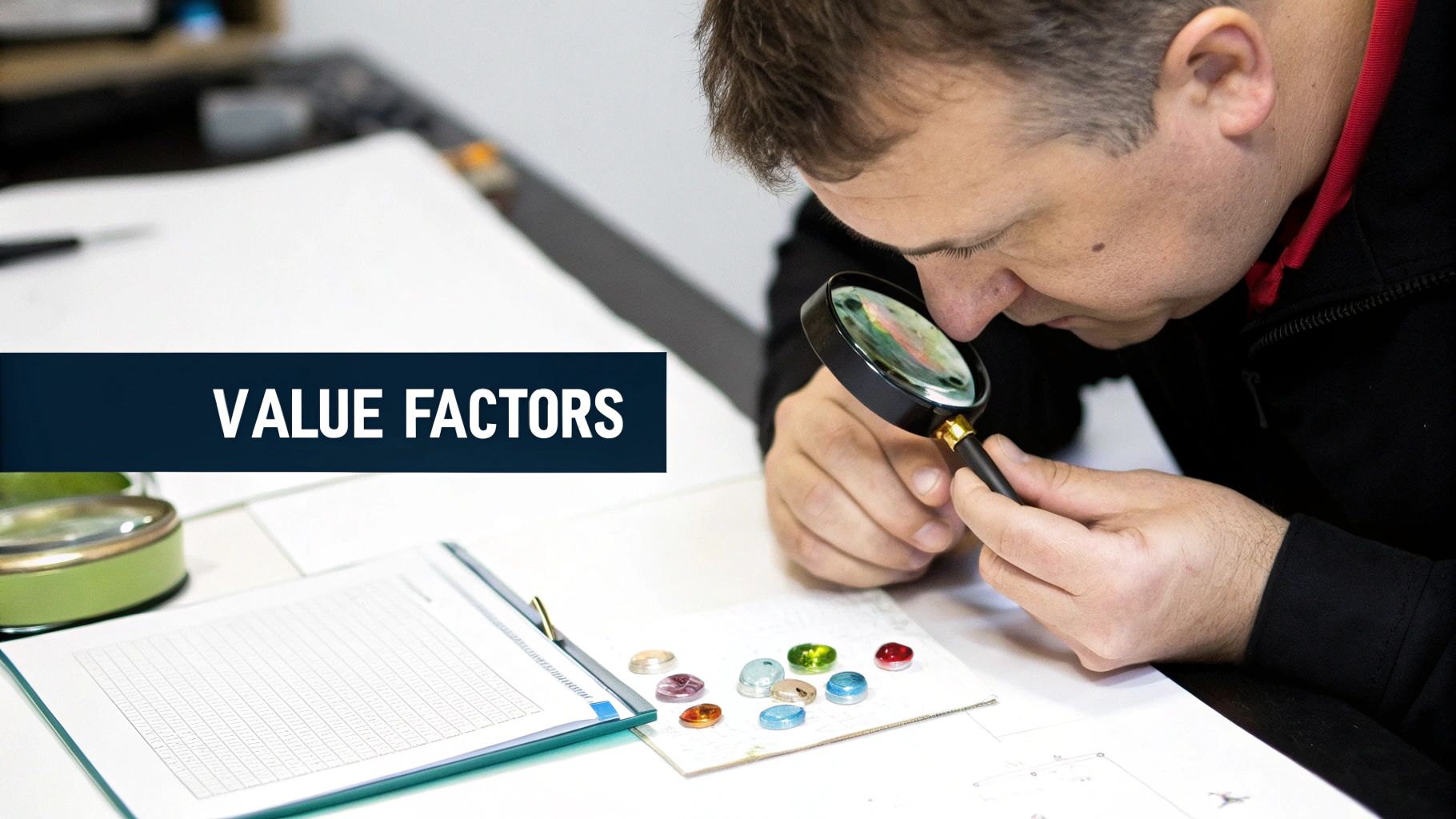
So, what makes one opal fetch a higher price than another? Figuring out an opal's value is a fascinating mix of science and art. Unlike diamonds with their strict 4Cs, opals are judged on a completely different set of criteria, and it all boils down to one thing: the quality and drama of their inner fire.
Learning about these factors is like learning the secret language of the gemstone itself. It helps you see the subtle differences that make one stone pretty, and another a truly breathtaking investment. Let's dive into what the experts look for when they size up this incredible gem.
Play-of-Colour: The Main Event
First and foremost, the most important factor in an opal’s value is its play-of-colour. This is that spectacular flash and dance of different hues you see when you turn the stone in the light. You can think of it as the opal’s personality—is it quiet and subtle, or is it putting on a dazzling light show?
This magical effect happens because light bends and splits as it passes through countless microscopic silica spheres, which settled into neat stacks as the opal formed millions of years ago. The more brilliant, intense, and varied those colours are, the more valuable the stone.
In the world of opals, not all colours are considered equal. The rarity of certain hues plays a huge part in the final valuation:
- Most Common: Blue and green flashes are what you'll see most often, and they are beautiful in their own right.
- Less Common: Oranges and yellows bring a wonderful warmth and start to push the stone's value up.
- Rarest and Most Prized: Red and violet flashes are the holy grail. An opal that shows off a strong, fiery red is exceptionally rare and commands a top price.
A truly top-tier opal will light up with a full spectrum of vibrant colours, visible from every angle, creating a mesmerising display that never gets old.
Body Tone: The Perfect Backdrop
Right after play-of-colour, the next thing to look at is the opal's body tone. This is simply the underlying base colour of the stone, which acts as the canvas for that colourful light show. Gemologists use a standard tone scale ranging from N1 (jet black) to N9 (light white).
The rule of thumb here is simple: contrast is king. A darker body tone, like you’d find in a black opal from Lightning Ridge, provides a dramatic, inky backdrop. This makes the play-of-colour pop with incredible intensity, which is why black opals (rated N1 to N4) are the most valuable.
On the other end of the spectrum, white opals (N7 to N9) have a light, milky background. While still lovely, this paler body tone can make the play-of-colour seem softer or more pastel, which generally means a lower price tag compared to their darker cousins.
The darker the body tone, the more the spectral colours pop. A true N1 black opal acts like a velvet night sky, allowing every flash of colour to shine with maximum brilliance and creating a perception of greater depth.
Clarity and Carat Weight
When it comes to clarity in an opal, we're not looking at it the same way as a diamond. Instead of searching for tiny internal marks, an expert checks for things like cracks, "crazing" (a fine network of hairline cracks), or any cloudy spots that might interrupt the beautiful play-of-colour. A clean, stable stone is always going to be more desirable.
Carat weight also plays a role, but it's not as straightforward as with other gems. A massive opal with dull, patchy colour will be worth far less than a smaller stone that's alive with exceptional, vibrant flashes. Of course, if all other quality factors are equal, a larger opal will naturally be worth more.
The Importance of Origin
Finally, where an opal comes from can have a huge impact on its value. Australia is the undisputed king of the opal world, supplying around 95% of all precious opal. Australian opals are famous for their stability and stunning play-of-colour.
The country's opal industry is a major force in the global market. Its production value hit about $41 million USD back in 2012, with the Coober Pedy region in South Australia alone contributing to roughly 80% of the world's precious opal supply. It's not uncommon for high-grade black opals from these legendary mines to sell for hundreds, or even thousands, of Australian dollars per carat. You can find more on the global opal trade on Wikipedia.
Opals from specific, famous mining locations like Lightning Ridge (for black opals) or Coober Pedy (for white opals) often carry a premium. This is because they have a historical reputation for producing world-class stones, adding a layer of prestige and quality assurance that collectors are more than happy to pay for.
How to Look After Your Opal Jewellery
An opal’s breathtaking beauty comes from its unique composition, which includes a surprising amount of water—anywhere from 3% to 21% of its weight. Think of your opal as a living gem. It just needs a little more mindfulness than a diamond or sapphire, but with the right care, its inner fire will burn bright for a lifetime.
Opals are also quite soft, ranking between 5.5 and 6.5 on the Mohs hardness scale. This means they can be scratched by harder gems, so a gentle touch is the golden rule for keeping your opal jewellery as flawless as the day you got it.
The Right Way to Clean Your Opal
Cleaning an opal is refreshingly simple and doesn't require any harsh chemicals or fancy gadgets. In fact, aggressive cleaning is the fastest way to cause damage. The best approach is always the gentlest one.
For solid opals, a straightforward routine is all it takes:
- Mix a gentle solution: A few drops of mild dish soap in a bowl of lukewarm water is perfect. Avoid hot or cold water, as sudden temperature shifts can cause a thermal shock, leading to cracks.
- Wipe with care: Dip a soft, clean cloth (microfibre is ideal) into the soapy water and gently wipe the opal's surface. Steer clear of any brushes, even soft ones, as the bristles can easily scratch the delicate gem.
- Rinse and dry immediately: Use a separate cloth dampened with plain water to wipe off any soap. Gently pat the piece dry with a soft, lint-free cloth right away.
That’s it! This simple process is all you need to lift away daily grime and bring back your opal’s brilliant lustre without putting it at risk.
A crucial word of warning: never, ever use ultrasonic cleaners, steamers, or harsh chemicals like bleach and ammonia on opals. These methods are far too aggressive and can strip the stone of its natural moisture, causing fine cracks (known as "crazing") or permanently ruining its colour.
Smart Storage for Lasting Beauty
How you store your opal is just as important as how you clean it. The goal is to shield it from two main threats: scratches from harder jewellery and dehydration from overly dry air.
Always give your opal its own space. A soft, padded jewellery box or an individual fabric pouch is the perfect solution. This simple step prevents harder stones like diamonds or sapphires—or even the metal from other jewellery—from scraping against its surface. Tossing everything into one box is one of the most common ways opals get damaged.
If you live in a particularly dry climate or are putting your opal away for a long time, here’s a great tip: place a small piece of damp cotton wool in the box with it. This creates a humid micro-environment that stops the stone from drying out and cracking.
Special Care for Doublets and Triplets
It’s absolutely vital to know whether your opal stone birthstone is a solid opal or a doublet or triplet, because their care needs are completely different. Doublets and triplets are composite stones, created by gluing a thin slice of precious opal onto a backing (doublet) and sometimes adding a clear cap on top (triplet).
Because these stones are held together with adhesive, water is their worst enemy. You must never submerge or soak an opal doublet or triplet. Water can work its way between the layers, dissolving the glue and causing the stone to separate or take on a foggy, lifeless appearance. For these types of opals, a quick wipe with a soft, damp cloth, followed by immediate drying, is the only cleaning method you should use.
How to Style and Gift Opal Jewellery
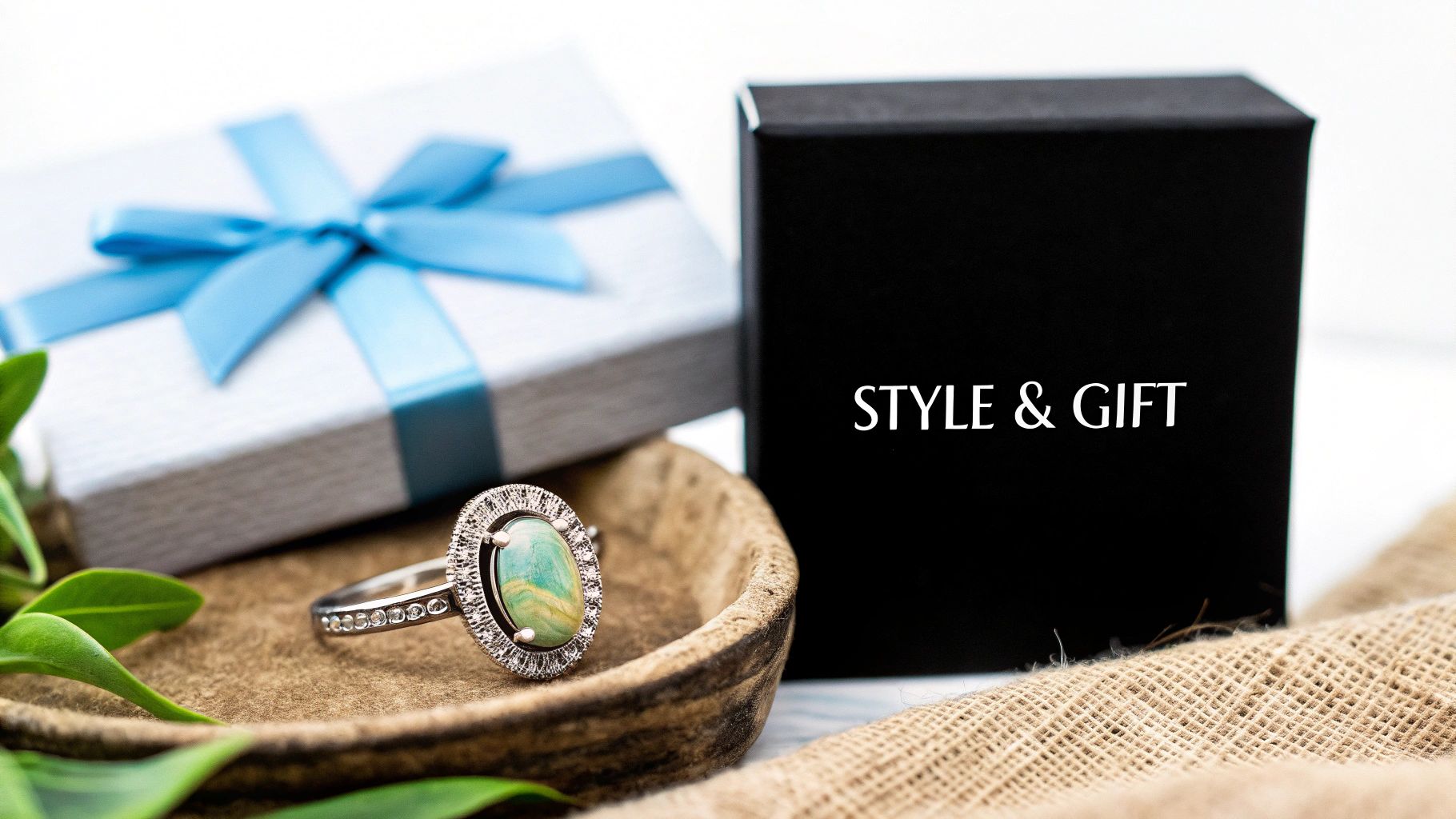
Opals are chameleons. Their unique personality makes them incredibly versatile, perfect for showcasing your personal style or giving a gift that’s packed with meaning. An opal can be subtle and classic one moment, then bold and dramatic the next—it all comes down to how it's presented.
This section is all about unlocking that potential. Whether you're hunting for a piece for yourself or for someone special, the real magic happens when you match the stone's unique character to the wearer's. The right metal and setting can completely transform its entire vibe.
Styling Your Opal Stone Birthstone
Pairing opals with different precious metals is the secret to creating a specific mood. Every combination tells a slightly different story, letting you tailor the piece to your personal taste or a specific occasion.
Here are a few classic pairings that really make an opal sing:
- Black Opals with Yellow Gold: Talk about a power couple. This high-contrast combination is pure luxury. The warmth of yellow gold makes the fiery reds and electric greens in a black opal practically jump off the stone. It’s a bold, statement look that’s perfect for a show-stopping cocktail ring or an unforgettable pendant.
- White Opals with Platinum or White Gold: For an aura of pure sophistication, you can’t go wrong with a soft white opal set in a cool, silvery metal. This pairing creates an ethereal, classic aesthetic that’s absolutely ideal for delicate earrings or a truly romantic engagement ring.
- Boulder Opals with Silver or Rose Gold: The earthy, artistic feel of a boulder opal works beautifully with the understated finish of sterling silver or the gentle warmth of rose gold. These metals complement the stone’s natural ironstone without overpowering it, making them perfect for organic, one-of-a-kind designs.
Beyond the metal, think about the moment. A simple opal pendant or a pair of small stud earrings can add just the right splash of colour to an everyday outfit. For those more formal events, a larger opal ring or a dazzling bracelet will make a memorable impact, drawing every eye with its mesmerising dance of colour.
The Art of Gifting Opal Jewellery
Giving an opal is about so much more than just gifting a beautiful gem—it's offering a piece steeped in symbolism and history. As the opal stone birthstone, it’s a natural choice for anyone born in October, but its meaning runs far deeper, making it a thoughtful gift for all kinds of milestones.
Traditionally, the opal is the gemstone for a 14th wedding anniversary, symbolising the passion and fire kept alive in a relationship. Its long-held association with love, hope, and good fortune also makes it a perfect gift for graduations, birthdays, or any moment that calls for celebrating a new beginning.
When you gift an opal, you're not just giving a piece of jewellery. You're giving a story—a symbol of creativity, loyalty, and the promise of a bright future, captured forever in a kaleidoscope of colour.
To make the gift truly personal, think about the recipient's personality. Do they have a favourite colour? You can find an opal with dominant flashes of blue, green, or red to match their taste. The sheer variety within the opal family means you can always find a piece that feels like it was made just for them.
From a delicate necklace for a daughter to a custom ring from Daniel Fine for a partner, the right opal tells a personal story, making it one of the most cherished gifts you can ever give.
Of course, here is the rewritten section with a more natural, human-written tone and flow.
Common Questions About Opals
Even after you get to know opals, a few common questions and myths tend to pop up. It’s no surprise, really—a gem this unique is bound to inspire a bit of curiosity. Let's tackle some of the most frequent queries to round out your understanding of October's incredible birthstone.
Getting these answers straight helps you appreciate not just the opal's physical beauty, but also its rich history and what it’s really like to own one.
Are Opals Unlucky If You Weren't Born in October?
This is a big one, a popular myth with surprisingly recent origins. For most of history, opals were seen as powerful symbols of good fortune, hope, and truth. People considered them incredibly lucky because their stunning play-of-colour was thought to hold the virtues of every other gemstone combined.
So where did the "unlucky opal" idea come from? You can trace it back to a novel from the 19th century, which did a lot of damage to the gem's reputation for a while. Thankfully, that superstition has largely faded. Today, anyone who loves gems appreciates the opal stone birthstone for its unique, breathtaking beauty, no matter when their birthday is.
What's the Difference Between a Solid Opal, a Doublet, and a Triplet?
Knowing what your opal is made of is absolutely crucial, especially when it comes to caring for it. The terms solid, doublet, and triplet describe how the stone is put together, which directly impacts its durability and, of course, its value.
- Solid Opal: This is the real deal—a single, natural piece of precious opal that's been cut and polished straight from the earth. It's the most valuable and durable form you can get.
- Doublet: A doublet is created by gluing a thin slice of precious opal to a dark backing, often ironstone or black potch. This little trick makes the colour pop and brings the price down, making beautiful opals more accessible.
- Triplet: A triplet takes things one step further. It's a doublet with a clear, protective dome of quartz or glass added on top. While this adds a layer of durability, it's also the least valuable of the three.
It's vital to know which type you have, because doublets and triplets must never be soaked in water. The moisture can get into the adhesive layers and cause the stone to cloud or fall apart.
"For most of history, opals were seen as incredibly lucky tokens, believed to bestow the gift of prophecy and protection upon their wearer. The modern myth of opals being unlucky is a misconception that overshadows their true historical significance as symbols of hope and purity."
Can I Wear My Opal Ring Every Day?
You certainly can, but you'll need to be mindful. Opals are a softer gemstone, ranking between 5.5 and 6.5 on the Mohs scale of hardness. To put that in perspective, a diamond is a 10. This means an opal can get scratched more easily from bumping against everyday surfaces.
If you're planning on daily wear, a protective setting is your best friend. A bezel setting, which wraps a metal rim around the gem’s edge, is a fantastic choice. It’s also just good practice to take your opal jewellery off before you do things like gardening, playing sports, or cleaning with harsh chemicals. A little care goes a long way.
Why Are Australian Opals Often More Valued?
There's a good reason Australian opals hold a premium spot in the market: stability. Opals from Down Under are famous for being non-porous, and their play-of-colour is both reliable and incredibly intense.
In contrast, some opals from other parts of the world, like Ethiopia, are "hydrophane," which means they can absorb water like a sponge. When they do, their colour can temporarily change or they can even become transparent. The real risk, though, is that they can become prone to cracking as they dry out. The rock-solid stability and legendary vibrancy of Australian opals, backed by the history of mining towns like Lightning Ridge, keep them at the top of the list for collectors and jewellers alike.
Ready to discover the perfect opal that tells your unique story? At Daniel Fine, we specialise in creating bespoke jewellery that captures life’s most precious moments. Explore our collection or commission a custom design to begin your journey.